Spring training opens in five weeks, and Kyle Tucker still doesn’t know where he’ll be playing in 2026. The four-time All-Star outfielder entered free agency as the consensus top position player available, valued by Spotrac’s market projections at a contract approaching $400 million. Instead, he joins Alex Bregman, Bo Bichette, and Cody Bellinger among the marquee names watching from the sidelines as the calendar turns and the market refuses to accelerate. Thirteen of the top 25 free agents remain unsigned, creating an unprecedented standoff between elite players and teams that supposedly need them.
The Tucker situation encapsulates everything strange about this offseason. Multiple teams have expressed serious interest. The Mets, Dodgers, and Blue Jays are described as the most aggressive suitors, with Toronto considered by The Athletic’s Ken Rosenthal as the favorite to ultimately land his services. Yet no deal has materialized despite weeks of reported conversations and mutual interest that should have produced an agreement by now. Something is preventing buyer and seller from finding common ground, and understanding what requires examining the competing priorities that define modern baseball negotiations.
Tucker’s representatives reportedly want a long-term deal that reflects his status as one of baseball’s best all-around players. He turned 29 in January, meaning a six or seven-year contract would carry him through his early-to-mid thirties when production typically declines. Tucker posted a .289/.369/.585 slash line in 2025, per Baseball Reference, with 34 home runs and a 155 wRC+ according to FanGraphs that ranked among the top ten position players in baseball. Teams willing to make that commitment would be betting that Tucker’s combination of hitting, power, and defense ages gracefully enough to justify the investment. It’s a reasonable bet given his track record, but it’s a bet nonetheless, and teams have grown increasingly cautious about taking those risks in recent years.
The alternative approach involves shorter-term contracts with higher annual values, allowing Tucker to return to free agency after two or three seasons and potentially secure additional long-term money if his performance holds. The Dodgers and Mets prefer this structure, offering premium annual salaries without the decade-long commitment that Tucker might prefer. This creates a fundamental disconnect: Tucker wants security, teams want flexibility, and neither side has moved enough to bridge the gap.
The Blue Jays Factor: Toronto’s Aggressive Pursuit
ESPN’s Jeff Passan has identified the Toronto Blue Jays as Tucker’s most likely destination, citing the team’s increasingly aggressive posture and willingness to offer the long-term contract that other suitors have avoided. The Jays have failed to build a consistent contender around Vladimir Guerrero Jr. and Bo Bichette (the latter now also a free agent after Toronto’s inability to extend him), and adding Tucker would represent the most significant free agent signing in franchise history.
Toronto’s pitch centers on playing alongside Guerrero in the middle of an order that would immediately become one of baseball’s most dangerous. The Blue Jays have money to spend after consecutive disappointing seasons reduced payroll expectations, and ownership has signaled willingness to invest in proven talent rather than continuing to wait for homegrown players to develop into championship-caliber contributors. Tucker would accelerate the timeline significantly if he chose the Blue Jays over American League and National League alternatives.

The Canadian market presents considerations beyond pure baseball analysis. Playing in Toronto involves different tax implications, media scrutiny patterns, and lifestyle adjustments that some players find appealing and others prefer to avoid. Tucker spent his entire professional career with the Houston Astros in the American League West, meaning Toronto would represent a significant geographic and cultural shift regardless of the financial terms involved.
The Blue Jays’ recent signing of Kazuma Okamoto at third base effectively removed them from the Alex Bregman sweepstakes, concentrating their resources on landing Tucker. If Toronto is willing to offer both the contract length Tucker desires and a competitive annual salary, they have positioned themselves as the only suitor capable of meeting all his requirements. Whether Tucker is willing to embrace that opportunity remains the central question of this prolonged negotiation.
The New York Factor: Mets and Dodgers Circle
The Mets’ interest in Tucker intensified after losing Pete Alonso to the Orioles in a signing that removed their primary offensive target from consideration. New York now faces the reality that their lineup needs significant addition to compete with the Braves, Phillies, and Dodgers for National League supremacy. Tucker alongside Juan Soto would create one of baseball’s most intimidating corner outfield combinations, providing the kind of star power that the Mets’ ownership has consistently sought since purchasing the team.
The Mets’ preference for shorter contract terms creates friction with Tucker’s camp, however. According to ESPN’s Kiley McDaniel, New York wants to offer fewer than four years with a premium annual value, allowing them to reassess after a defined period rather than committing through Tucker’s decline phase. This structure worked for the team in previous negotiations, but Tucker may not need to accept it given other options on the table. The Mets’ financial firepower is legendary, but that firepower is only useful if they’re willing to deploy it in ways that players find acceptable.
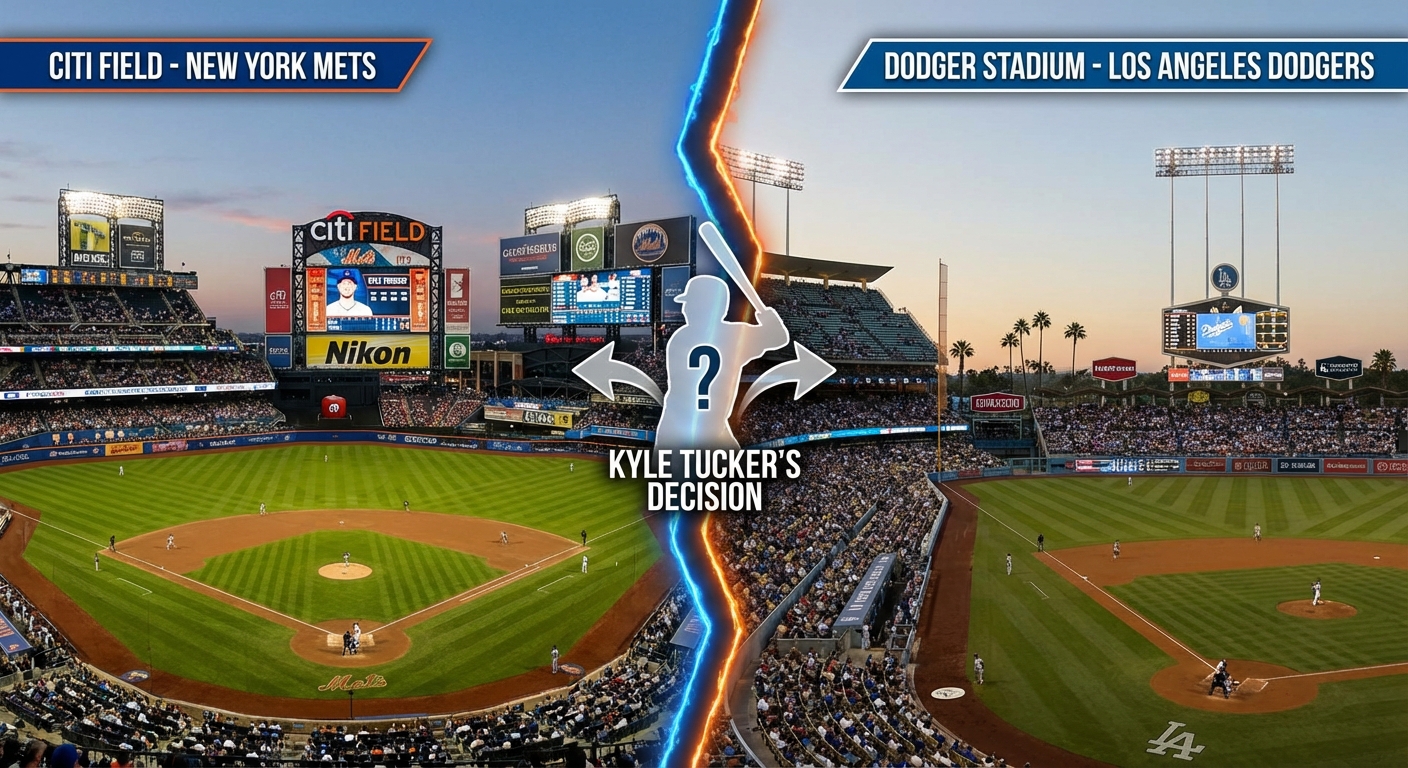
The Dodgers represent the most intriguing fit despite their preference for shorter deals, as MLB Network’s Jon Morosi has reported. Los Angeles has mastered the art of constructing championship rosters through a combination of homegrown talent, shrewd trades, and strategic free agent additions. Tucker would slot into an outfield that has produced consistently elite production. His 90th-percentile barrel rate and exit velocity per Statcast data would provide another All-Star-caliber bat in a lineup that already features legitimate MVP candidates. The Dodgers’ organizational infrastructure and championship pedigree might appeal to Tucker even if their contract offer doesn’t match Toronto’s term length.
The Yankees have been mentioned as interested parties but seem more focused on Cody Bellinger, whose left-handed bat would better complement their existing roster construction. New York’s payroll constraints and luxury tax considerations limit their flexibility compared to rivals willing to spend without similar restrictions. Unless Tucker’s market collapses entirely, the Yankees appear unlikely to emerge as a serious finalist for his services.
The Broader Market Dynamics: Why Everyone Is Waiting
Tucker’s prolonged free agency reflects systemic patterns that have characterized baseball’s offseason for several years. Teams have become increasingly analytical about contract valuation, applying rigorous models to determine how much production they can expect per dollar spent. Those models typically punish long-term deals for players approaching 30, projecting decline curves that make six-year contracts look expensive compared to alternatives.
Players and agents, understandably, resist this framework. Elite performers like Tucker generate value that exceeds what WAR-based calculations capture, including postseason experience, clubhouse leadership, and marketing appeal that analytical models struggle to quantify. The tension between how players value themselves and how teams value them creates standoffs that persist until one side capitulates or both find creative compromise.
The market interconnection further complicates matters. Teams waiting on Tucker are also monitoring Bregman, Bichette, and Bellinger, understanding that one signing could trigger a cascade of activity that reshapes the remaining landscape. Nobody wants to overpay by committing early, so everyone waits for someone else to establish market rates. This collective hesitation extends timelines and frustrates players who expected their free agency to resolve more quickly.

The existing coverage of the MLB market standoff has documented the frustration players feel about this annual pattern. Tucker and his peers have limited leverage once spring training begins and teams finalize their roster construction. The pressure to sign increases weekly as the calendar advances, potentially forcing players to accept terms they would have rejected in December. Whether that dynamic ultimately benefits Tucker or the teams pursuing him depends entirely on who blinks first.
How the Tucker Sweepstakes Resolves
The likeliest scenario involves Tucker signing with the Blue Jays on a deal in the six-year, $200 million range, splitting the difference between the long-term security he wants and the per-year value that reflects his elite production. Toronto has the most aggressive posture, the clearest need, and the willingness to make the kind of commitment that other suitors have avoided. Unless another team dramatically increases their offer, the Blue Jays have positioned themselves as the presumptive winner of this extended competition.
A Mets signing remains possible if Steve Cohen authorizes a contract that exceeds what the team’s baseball operations department initially proposed. Cohen has demonstrated willingness to override financial considerations when targeting players he wants, and Tucker alongside Soto would create the kind of star-studded roster that generates excitement regardless of immediate championship implications. The Mets’ path to Tucker runs through ownership decisions rather than front office strategy.
The Dodgers could emerge as Tucker’s destination if he prioritizes championship probability over contract terms. Los Angeles offers the best organizational infrastructure, the most proven championship culture, and the deepest roster of any suitor. What they may not offer is the financial commitment that Tucker could secure elsewhere. That tradeoff defines his decision: maximize earnings or maximize winning? Different players answer that question differently, and Tucker’s choice will reveal his priorities.
The dark horse outcome involves Tucker accepting a shorter-term deal with opt-outs, betting on himself to return to free agency after demonstrating continued elite performance. This approach worked for players like Trea Turner and Manny Machado, who secured massive second contracts after proving their value remained exceptional. Tucker’s age makes this riskier than it would have been three years ago, but the strategy has historical precedent for maximizing career earnings.
The Verdict
Tucker is worth a six-year commitment in the $200-220 million range, and the Blue Jays are the most likely team to make it. Toronto is the only suitor simultaneously willing to offer the contract length Tucker demands, the annual value his production justifies, and a lineup context where he becomes the franchise-altering addition rather than a luxury upgrade. That combination of organizational desperation and financial flexibility is what closes deals in January, not December.
The deeper insight the market is missing: Tucker’s value is actually higher than the stalled negotiations suggest. His defensive versatility across all three outfield positions, per FanGraphs, combined with his switch-hitting ability makes him a rarer commodity than the typical 29-year-old free agent. Teams fixated on age-based decline models are underweighting the fact that Tucker’s skill set — contact quality, plate discipline, and positional flexibility — historically ages better than raw power or speed. The team that signs him is not just buying six years of production. They are buying a player whose floor is substantially higher than what the analytical models project, because the models were built on players with different skill profiles.
Toronto should finalize a deal before pitchers and catchers report in mid-February, likely in the six-year, $210 million range. Once Tucker signs, the logjam breaks and the remaining top-tier free agents find homes within days.
Sources
- Passan’s MLB free agency, trade intel on Tucker, Bregman, more - ESPN
- Kyle Tucker rumors and free agency news - MLB.com
- Kyle Tucker 2025 season stats - Baseball Reference
- Kyle Tucker Statcast batting profile - Baseball Savant
- 2026 MLB free agents - Spotrac