Picture the scenario. Bases loaded, two outs, bottom of the ninth, a one-run game. The pitch crosses the inside corner. The umpire calls it ball four, and the tying run trots home. The pitcher steps off the rubber, looks toward the plate, and taps his cap. Fourteen seconds later, the videoboard confirms what the Hawk-Eye cameras saw: strike three, the pitch caught the zone by half an inch, inning over, game over. This is not a hypothetical anymore. Starting March 25, when the Giants host the Yankees on Opening Night at Oracle Park in what will be the first regular-season game broadcast on Netflix, every pitch in every Major League Baseball game will be subject to technological review through the Automated Ball/Strike Challenge System. The first spring training games using the system begin in two days. After seven years of development, three years of minor league testing, and decades of arguments about whether human eyes can reliably judge a ball traveling 95 miles per hour across a 17-inch plate, baseball’s most significant rule change since the pitch clock is here. And it is going to change everything.
Twelve Cameras and a Tap of the Helmet
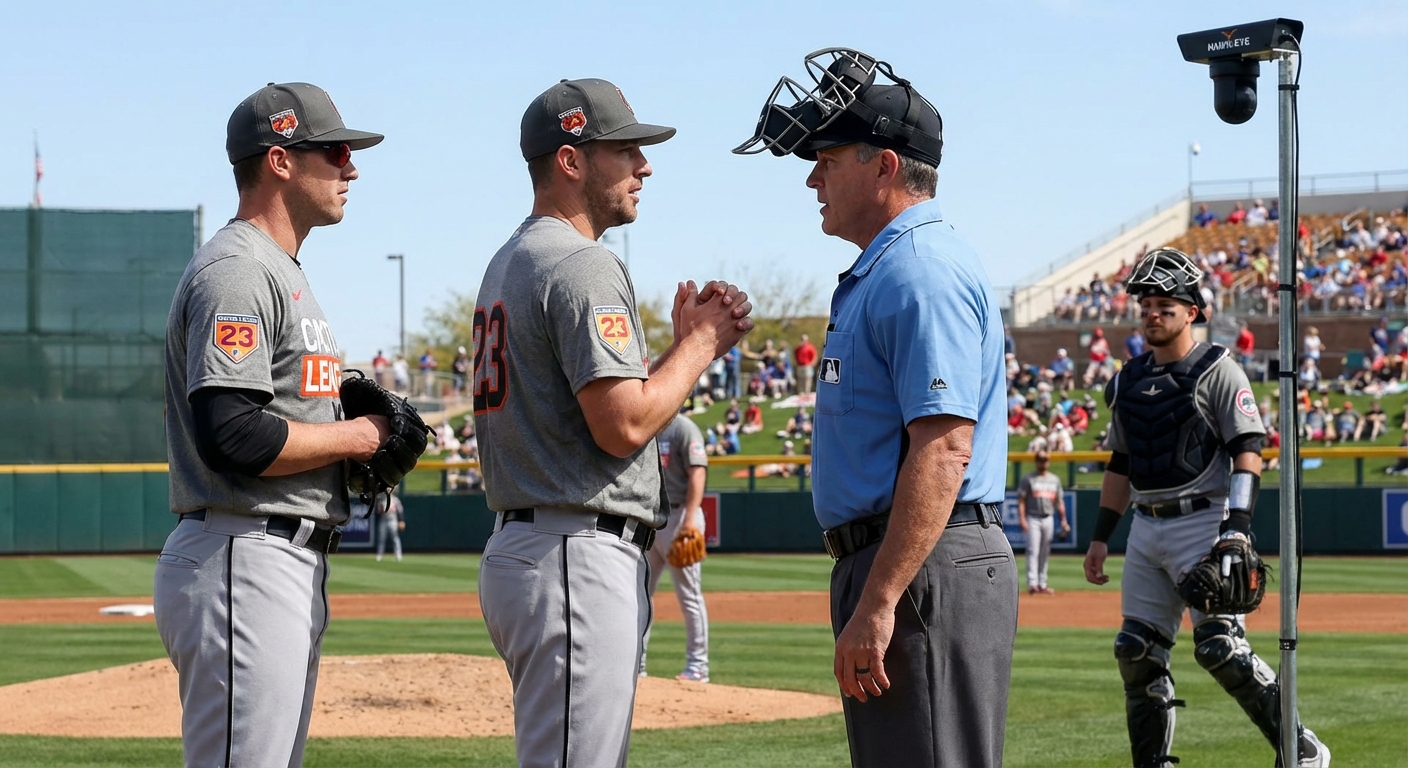
The mechanics of the ABS Challenge System are deliberately simple. Human umpires still call every pitch. The man behind the plate still crouches, still tracks the ball, still punches his fist for strike three. Nothing about the rhythm of a plate appearance changes until a player disagrees. At that point, the batter, pitcher, or catcher can challenge the call by tapping their helmet or cap within approximately two seconds. Managers cannot initiate challenges. Dugout coaching is prohibited. The decision belongs to the player who saw the pitch up close, and the clock starts the moment the call is made.
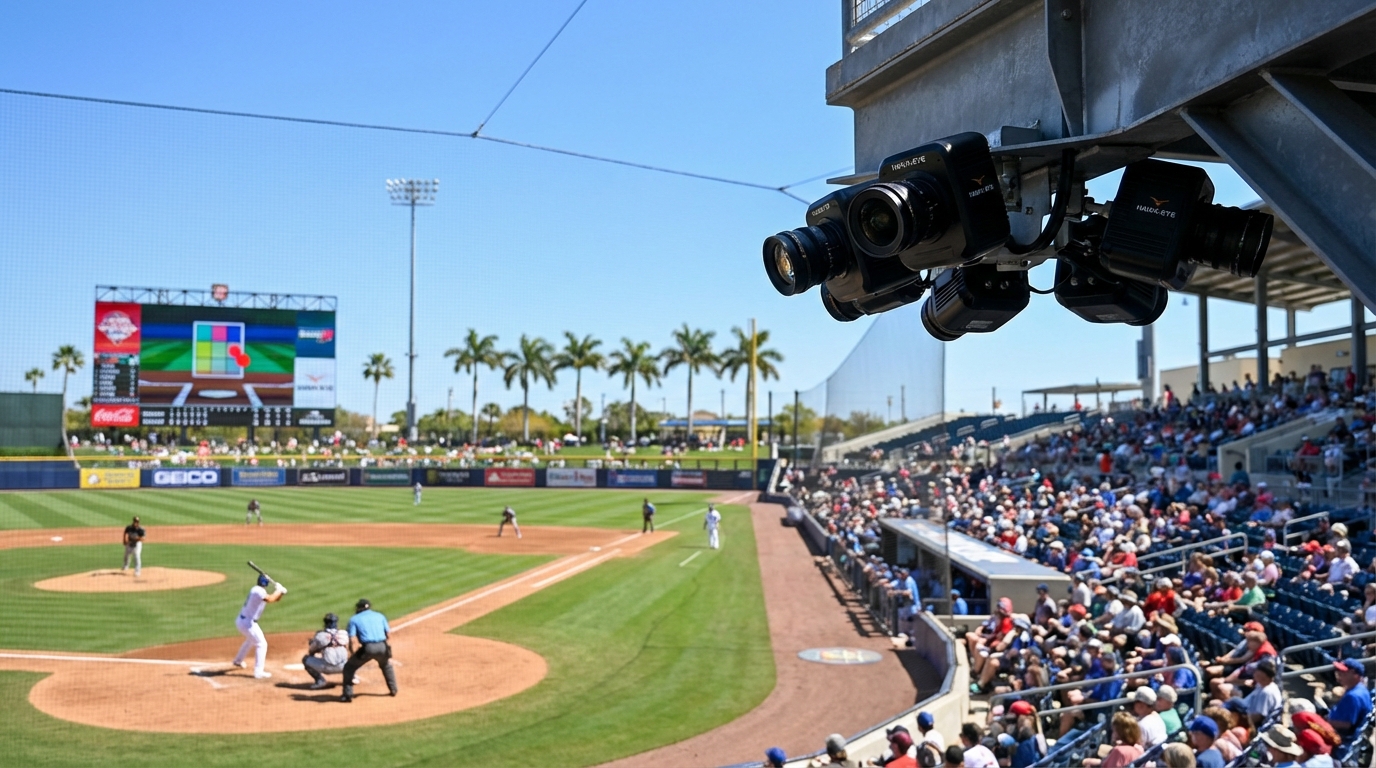
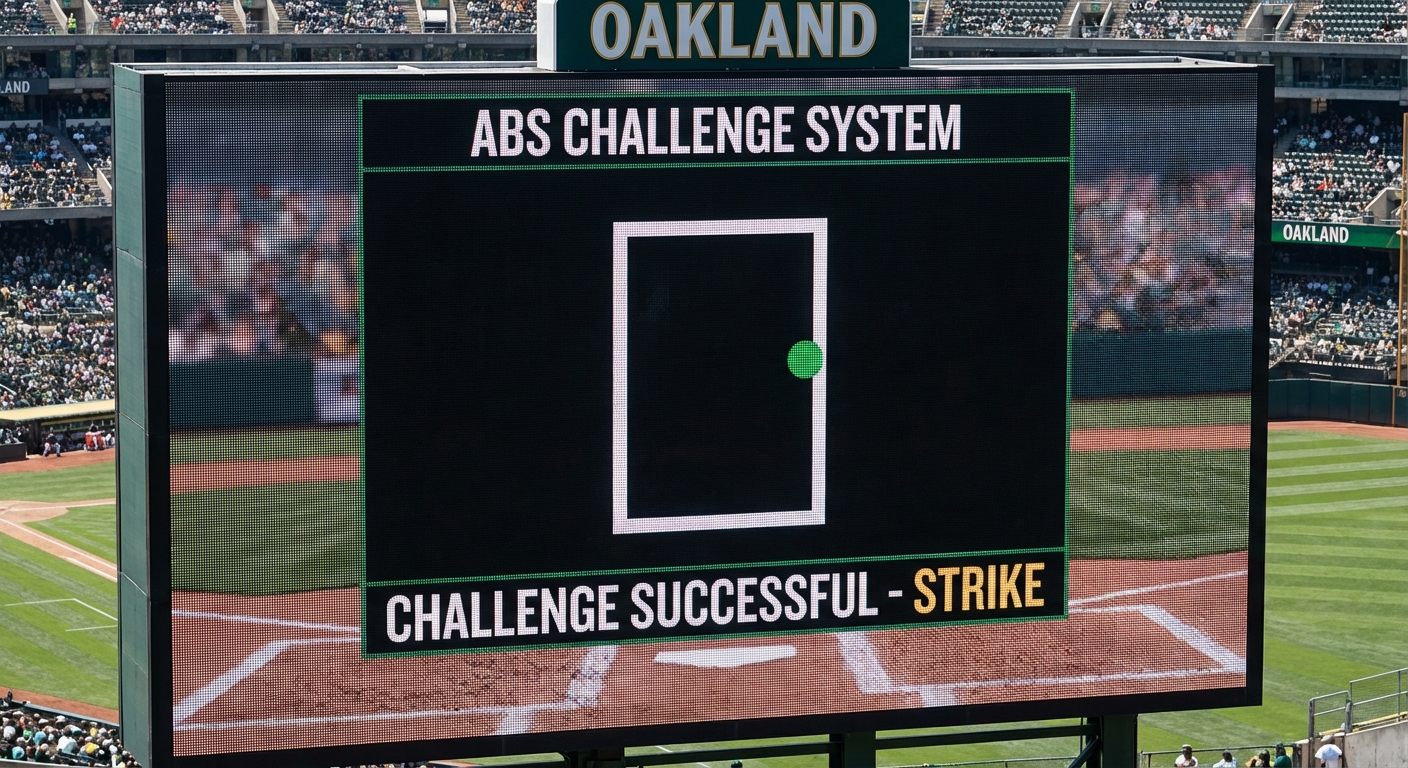
When a challenge is initiated, 12 Hawk-Eye cameras positioned around the stadium perimeter feed tracking data through a T-Mobile 5G private network to produce a visualization of the pitch’s path through the strike zone. That visualization appears on the videoboard for everyone in the stadium and watching at home to see. The entire process, from helmet tap to resolution, takes an average of 13.8 seconds, per MLB.com. Each team receives two challenges per game. Successful challenges are retained, meaning a team could theoretically challenge every missed call without running out, provided they keep getting them right. If both challenges are lost in regulation, a new challenge is automatically granted at the start of each extra inning.
The strike zone itself is a two-dimensional rectangle: 17 inches wide (the full width of home plate), with the top set at 53.5% of the batter’s standing height and the bottom at 27%. Individual zones are calibrated by measuring each player’s height during spring training. A pitch is a strike if any part of the ball touches the zone at the decision point, which is set at the center of the plate, 8.5 inches from both the front and back edges. The technology’s margin of error, per MLB’s testing data, is approximately one-sixth of an inch. During Spring Training 2025 testing across 288 games, the Hawk-Eye system recorded just four tracking glitches out of 88,534 pitches, an error rate of 0.005%.
288 Games of Evidence
MLB did not arrive at this moment impulsively. The ABS system has been tested in the minor leagues since 2023, with the challenge format specifically piloted across 288 Spring Training games in 2025 and running concurrently in Triple-A throughout the season. The data from that testing is what convinced the Joint Competition Committee to approve the system in a 9-2 vote last September, per ESPN.
The numbers paint a clear picture. Teams averaged 4.1 challenges per game during Spring Training 2025, with an overall overturn rate of 52.2%, meaning players were right about the missed call more often than not. Only 2.6% of all pitches were challenged, and the average game length increased by just 57 seconds, a negligible addition to a sport that already implemented a pitch clock specifically to accelerate pace of play. Catchers proved the most effective challengers at a 56% success rate, followed by hitters at 50% and pitchers at a more modest 41%, per MLB.com. The pattern makes intuitive sense: catchers see every pitch from directly behind the plate and develop an instinct for the zone that surpasses the batter’s split-second read. Pitchers, who are 60 feet away and watching from a dramatically different angle, are the least reliable judges of their own work.
Perhaps the most telling statistic is what the system revealed about the baseline it is designed to correct. Big league umpires call approximately 94% of pitches correctly, per UmpScorecards tracking data. That sounds impressive until you apply it to scale. In a game with 290 pitches, a 6% miss rate means roughly 17 incorrect calls per game. Across a 162-game season, that compounds into thousands of wrong calls per team, some of them in moments that decide playoff races. The 2025 All-Star Game offered a preview of what the challenge system could accomplish at the highest level: four of five challenges against plate umpire Dan Iassogna were overturned, suggesting even elite umpires miss calls that technology catches.
Chris Sale Won’t Touch It
Not everyone in baseball is enthusiastic about the new reality. Chris Sale, the Atlanta Braves’ left-hander and one of the game’s most vocal competitors, has made his position unambiguous. “I will never challenge a pitch,” Sale told Fox Sports. “I’m not an umpire; that’s their job. I’m a starting pitcher.” Sale’s objection is rooted in a traditionalist view of the game that sees the umpire’s authority, including his mistakes, as part of baseball’s fabric. “Across all games in my entire career, there have been balls called strikes and strikes called balls, and you just kind of deal with it,” he said. “I’ve dealt with both sides, and I’m fine to kind of keep dealing with it.”
Sale is the most public dissenter, but he is not alone. Zac Gallen, the Arizona Diamondbacks starter who served on the Competition Committee that approved the system, admitted to Cronkite News that he leaned against implementation. “Honestly, I was pretty indifferent,” Gallen said. “I think if you were to ask me, I would probably lean more so against it, not necessarily in favor of it.” He revealed that seven teams opposed the new system, though the committee’s structure (six owners, four players, one umpire) meant the vote was always likely to pass. “Whether you were in favor of it or opposed, it was coming anyway,” Gallen acknowledged. The frankness is telling. The challenge system arrived not because every player demanded it, but because the broader consensus among ownership, fans, and the league office was that getting calls right matters more than preserving the human element that gets them wrong.
The Umpire Paradox
The most surprising wrinkle in the ABS story is the umpires’ own preference. Commissioner Rob Manfred revealed in December that umpires actually favored full automation over the challenge format. “I think that they were more receptive to using it on every pitch, because nobody knows what he would have called,” Manfred told Dodger Blue. “The problem with the challenge system is it points out when you’re wrong. And I think nobody likes to be shown, in front of 48,000 people, they just missed the pitch.” The irony is rich. The people most commonly assumed to oppose technological oversight would actually prefer more of it, specifically because the halfway measure of challenges publicly exposes their errors in a way that full automation would not.
The challenge system also threatens to eliminate one of baseball’s most theatrical traditions: the manager-umpire argument. In the 2025 season, 61.5% of ejections involving players, managers, and coaches were related to ball-and-strike disputes, per ESPN. With a mechanism to correct those calls now built into the game, the motivation to charge out of the dugout and kick dirt on home plate largely disappears. Some traditionalists view this as a loss. Baseball’s arguments have produced legendary confrontations and memes in roughly equal measure. But the trade-off is straightforward: fewer ejections, fewer incorrect calls deciding games, and a system that prioritizes accuracy over theater.
The system will also fundamentally devalue pitch framing, a skill catchers have spent years perfecting. The art of receiving a pitch just outside the zone and presenting it as a strike becomes worthless when a challenged call goes to cameras that care only about the ball’s actual location. Sale acknowledged this shift directly: “The catchers nowadays, the way they catch the ball, the way they receive it, they make them all look like strikes,” he said. “I think they’re all strikes.” The ABS zone disagrees. It is slightly smaller than the traditional umpire-called zone, meaning pitches that have historically been called strikes on the corners will now be correctly identified as balls when challenged.
The Strategy Nobody’s Figured Out Yet
The tactical implications of the challenge system are vast and, as of mid-February, largely theoretical. Trea Turner, the Philadelphia Phillies shortstop, has been thinking about the strategic layer. “Now, that human element is back on the players,” Turner told Phillies Nation. “If I do challenge, which I don’t plan on challenging too much, it would probably be on the corners, more so than up and down.” His reasoning reflects the instinct most hitters will follow: corner pitches are harder for umpires to judge and more likely to be overturned, while high and low calls are generally more obvious.
Turner also highlighted the late-game implications. “I think it will change the game a lot late,” he said. “Just making sure those calls are right in the biggest moments.” Phillies manager Rob Thomson is already pushing his players to use their challenges aggressively in spring training, even in low-stakes situations, to build familiarity before the games start counting. “These guys play five innings to start spring training,” Thomson said. “So we need to push them to use it so that they can learn.” The learning curve will be steep. Triple-A data showed that challenge frequency increased as games progressed, with only 1.6% of first pitches challenged compared to 8.2% of full-count pitches. The pressure moments, the at-bats where one pitch decides an outcome, are where the system will matter most.
Craig Counsell, the Chicago Cubs manager, offered a different perspective. “I hope the umpires get them all right,” Counsell said, pushing back on the notion of challenges as a strategic advantage. “That’s what you hope every game.” It was a characteristically dry response, but it contained a truth that the league’s data supports: the best outcome is not clever challenge management but umpires who are accurate enough to make the system irrelevant. Whether that optimism survives contact with a full season of borderline pitches remains the open question.
What Changes on March 25
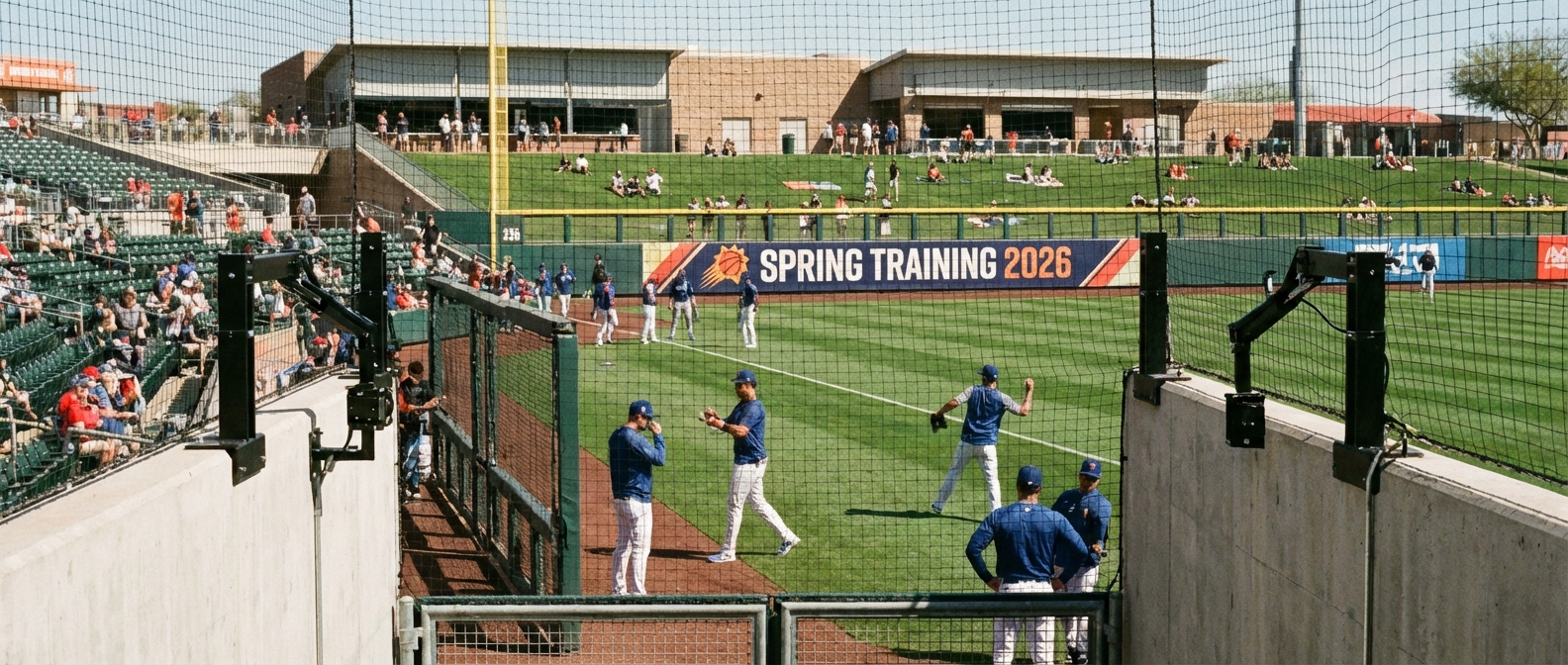
When the first pitch of the 2026 regular season crosses the plate at Oracle Park on March 25, baseball will enter uncharted territory. The ABS Challenge System will be active in every game, at every ballpark, through the entire postseason. The only exceptions are the Mexico City Series, the Field of Dreams game, and the Little League Classic, where the technology will not be deployed. Every other pitch, from the first spring training exhibition on February 20 to the final out of the World Series, will be tracked, measured, and available for review. Fans surveyed during the 2025 testing period responded favorably: 72% said the Challenge System had a positive impact on their experience, while only 10% had a negative perception, per MLB.com.
The NFL Combine begins this week, and the NBA is returning from its All-Star break, but baseball’s technological revolution is arguably the most consequential story in American sports this February. The ABS system will not eliminate umpires. It will not remove the human element from the game. What it will do is give players the power to correct the calls that have decided games, series, and seasons since the sport’s inception. Rob Manfred framed the committee’s work in measured terms. “I commend the Joint Competition Committee for striking the right balance of preserving the integral role of the umpire in the game with the ability to correct a missed call in a high-leverage situation,” the commissioner said, “all while preserving the pace and rhythm of the game.” The pace will barely change. The rhythm will adjust. But the calls, for the first time in 150 years of professional baseball, will be right when it matters most. That alone makes March 25 the most important Opening Night the sport has had in a generation.
Sources
- ABS Challenge System coming to MLB full time in ‘26 - MLB.com
- MLB approves robot umpires for 2026 as part of challenge system - ESPN
- Braves LHP Chris Sale on ABS Challenge System: ‘I Will Never Challenge a Pitch’ - Fox Sports
- Diamondbacks react to MLB’s ABS challenge system - Cronkite News
- Rob Manfred: MLB Umpires Prefer Full Automated Strike Zone Over Challenge System - Dodger Blue