Nathan MacKinnon has 74 points. Connor McDavid has 72. Two points separate two of the most electrifying players in NHL history, and we’re not even at the halfway mark of the season. This isn’t just a scoring race. This is the defining rivalry of modern hockey, playing out in real time, and whoever wins the Hart Trophy this spring will have earned it against an opponent operating at a level we rarely see.
The hockey world has grown accustomed to McDavid’s dominance. He’s won the Hart Trophy three times, the Art Ross five times, and the Conn Smythe once despite being on the losing side of a Stanley Cup Final. For years, the question wasn’t whether McDavid was the best player in the world but rather how wide the gap was between him and everyone else. That gap has closed. MacKinnon, the reigning Hart winner, isn’t just keeping pace with McDavid this season. He’s pushing him, challenging him, and at times outplaying him. The result is must-watch hockey every night either man takes the ice.
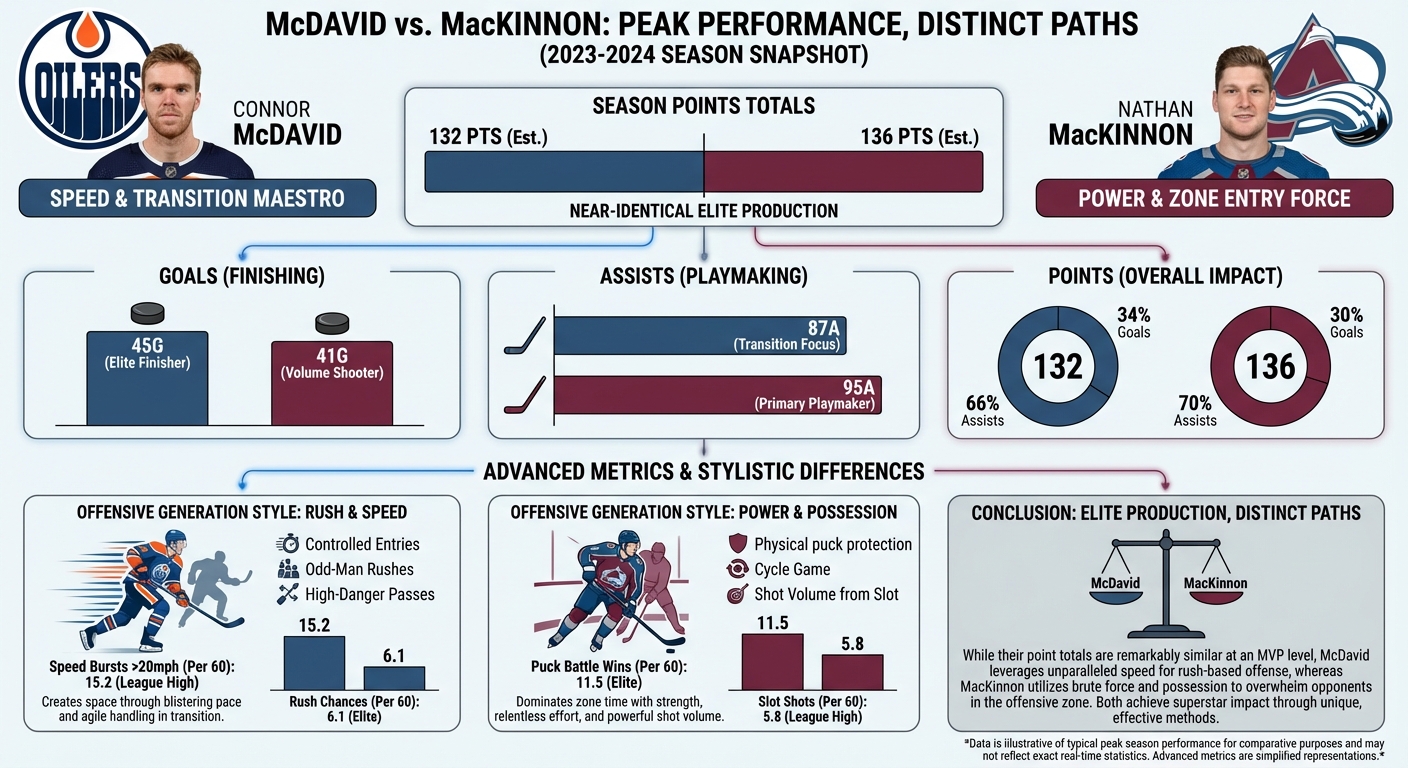
What makes this race fascinating isn’t just the point totals. It’s how differently these two superstars generate offense. McDavid remains the league’s premier individual talent, a player capable of taking over games through sheer skating ability and vision. MacKinnon has evolved into something equally dangerous but fundamentally different, a player who elevates everyone around him while still producing at historic rates. Understanding the contrast between their approaches reveals why this Hart race matters beyond the hardware.
The Speed Demon’s Evolution
Connor McDavid leads the NHL in 22-plus mph speed bursts with 80 this season, per NHL EDGE tracking data. He also leads in 20-plus mph bursts with 351, according to NHL.com stats. These aren’t just numbers on a tracking sheet. They represent the core of McDavid’s game, the ability to create time and space through pure velocity that no defender in the league can match. When McDavid decides to accelerate through the neutral zone, defensemen are left with impossible choices. Step up and risk getting burned on the outside. Stay back and give him time to survey the ice. Either way, he usually wins.
The 28-year-old is currently riding a 15-game point streak, per Hockey Reference, his second-longest of his career. During this stretch, he’s recorded three four-point games and one five-point performance. Even with Leon Draisaitl on his team producing at elite levels, McDavid leads Edmonton in scoring by 15 points. He remains, in the most fundamental sense, the engine that drives everything positive for the Oilers.

But McDavid has also evolved this season. Earlier in his career, critics occasionally noted that his game could become one-dimensional when teams successfully took away his speed. He’d force plays, try to beat defenders one-on-one when patience might have been the better choice. That player is gone. McDavid at 28 reads the ice better than McDavid at 24. He’s learned when to push the pace and when to slow the game down. His 47 assists, best in the league, reflect a player who understands that making the right pass often beats making the highlight-reel play.
His top skating speed this season, recorded against Calgary back in October, represented the fastest mark of the NHL EDGE tracking era for any Oilers player. The tools remain elite. What’s changed is the wisdom with which he deploys them. McDavid has stopped trying to beat the game through athleticism alone. He’s figured out how to beat it through intelligence while using his athleticism as the trump card it was always meant to be.
MacKinnon’s Complete Transformation
Nathan MacKinnon leads the NHL with 35 goals this season, according to ESPN Stats & Info, complemented by 39 assists. Those numbers tell one story. The eye test tells another. MacKinnon isn’t just scoring more than ever before. He’s playing a more complete brand of hockey than at any point in his career, and that completeness is what separates him from the pack of elite players chasing McDavid.
Watch MacKinnon on a shift where he doesn’t register a point. You’ll see a player who backchecks with purpose, who positions himself correctly in the defensive zone, who wins battles along the boards that don’t show up in any box score. The Avalanche trust MacKinnon in all situations now, something that wasn’t always true earlier in his career. He kills penalties. He takes defensive zone faceoffs. He plays against opponents’ best lines without Colorado needing to shelter him.

This transformation didn’t happen overnight. MacKinnon has spoken publicly about working with sports psychologists to manage his emotions on the ice. The player who once took bad penalties when frustrated or chased the game when things went wrong has developed the mental discipline to stay within himself. He’s learned that the best revenge for a bad shift is a good one, not a retaliatory slash. The maturity shows in his penalty minutes, down significantly from his early career averages, and in his overall effectiveness in close games.
The Avalanche roster around MacKinnon helps explain his evolution as well. Playing alongside Mikko Rantanen and Cale Makar means MacKinnon never needs to do everything himself. He can trust his linemates to finish plays he creates. He can trust his defenseman to join the rush at the right moments. This support structure has freed MacKinnon to focus on being the best version of himself rather than trying to be everything for a team that needed a superhero every night.
What the Numbers Actually Tell Us
Advanced analytics paint a picture of two players operating at historically elite levels through completely different means. McDavid’s expected goals percentage when on the ice remains among the league’s best, per Natural Stat Trick, driven primarily by his ability to generate high-danger scoring chances through individual effort. When McDavid carries the puck into the offensive zone, good things happen for Edmonton at rates that defy normal hockey logic.
MacKinnon’s numbers tell a team-oriented story. Colorado’s shot share metrics improve dramatically when he’s on the ice, but the improvement is distributed across multiple categories. The Avalanche generate more shots, allow fewer shots, create more high-danger chances, and surrender fewer high-danger chances when MacKinnon plays. The rising-tide effect is measurable across every teammate who shares his shifts, and the numbers back up what the eye test suggests.
Both players sit comfortably in the top five of points per game among skaters with at least 30 games played, per Hockey Reference. Both are on pace for 140-plus point seasons if they maintain their current production. Both have dragged their teams through stretches where supporting casts underperformed or injuries depleted depth. The separation between them isn’t performance but style, and style often comes down to personal preference rather than objective quality.
The Hart Trophy Criteria Question
The Hart Trophy goes to the player “judged most valuable to his team” as voted by the Professional Hockey Writers’ Association. That language has always created debate about what “most valuable” actually means. Is it the best player in the league? The player whose team would suffer most without him? Some combination of both? Different voters interpret the criteria differently, which is why the Hart Trophy winner isn’t always the league’s leading scorer.
McDavid’s case rests on his individual brilliance and his importance to Edmonton’s playoff hopes. Without McDavid, the Oilers are a borderline playoff team at best. He elevates a roster with significant flaws into contention through sheer force of will. Every game McDavid plays, Edmonton has a chance to win. Every game he misses, that chance diminishes dramatically. If value means “difference between having this player and not having him,” McDavid’s case is strong.
MacKinnon’s case rests on Colorado’s standing as one of the league’s best teams and his role as the primary driver of that success. He contributes at an elite level in every zone, not just the offensive end, and he does it consistently against the toughest competition. If value means “total positive contribution to team success,” his argument is equally compelling. He won the Hart last year on similar grounds, and nothing about his 2025-26 season suggests he’s regressed.
Why This Race Matters Beyond Hardware
Individual awards in team sports always carry an asterisk. Hockey is too fluid, too dependent on linemates and systems and goaltending, for any single player to truly control his fate. McDavid and MacKinnon both understand this reality. They’ve both spoken about caring more about team success than personal hardware. But the Hart Trophy race still matters because it forces us to articulate what we value in hockey players.
Do we want our superstars to be entertainers who dazzle with individual brilliance? McDavid offers that in abundance. His highlight-reel goals, his impossible passes through traffic, his ability to make defenders look foolish with pure speed all make hockey more exciting. Watching McDavid play is watching someone do things that shouldn’t be possible, and that entertainment value has real worth in growing the sport.
Or do we want our superstars to be models of versatility, players whose impact spans every phase of the game? MacKinnon offers that. His defensive commitment, his leadership, his capacity to lift linemates while still filling the stat sheet all represent what a franchise player should be. Watching MacKinnon play is watching someone who has mastered hockey as a whole, and that mastery has real worth in defining what elite performance looks like.
The answer, of course, is that we want both. We’re lucky enough to have both playing at peak levels simultaneously. The Hart Trophy race between McDavid and MacKinnon isn’t about determining which player is better. It’s about appreciating that hockey has two generational talents taking different paths to the same destination, and either one winning the award would be justified.
The Legacy Question
What makes this Hart Trophy race historically significant isn’t the two-point margin or the contrasting styles. It’s the fact that McDavid and MacKinnon are redefining what voters expect from a Hart candidate permanently. Before this era, the award largely went to the player with the most points on a playoff team. McDavid broke that mold by winning it on underperforming rosters through sheer individual dominance. MacKinnon broke it again by winning last year with an argument rooted in all-zone impact and team elevation rather than raw point totals.
Together, they have split the Hart Trophy electorate into two philosophical camps that may never reunite. Future candidates will be measured against one of these two archetypes: the transcendent individual force or the complete franchise cornerstone. That duality didn’t exist before McDavid and MacKinnon forced it into the conversation. Players like Auston Matthews, Kirill Kaprizov, and Nikita Kucherov will all be evaluated through this new lens for the rest of their careers.
The deeper legacy question is whether the NHL’s highest individual honor can survive having two equally valid but fundamentally incompatible definitions of value competing against each other every season. If MacKinnon wins again, it signals a permanent shift in how the hockey establishment defines superstardom. If McDavid reclaims the award, it reaffirms that singular brilliance still carries the most weight. Either outcome reshapes the Hart Trophy’s meaning for a generation.
Sources
- NHL Player Tracking Data - Connor McDavid - NHL.com, EDGE skating and speed burst statistics
- 2025-26 NHL Scoring Leaders - Hockey Reference, season statistics and point streaks
- NHL Awards Watch: Who’s Leading for Hart, Norris, Calder? - ESPN, Hart Trophy analysis and advanced metrics
- Colorado Avalanche Player Stats - Natural Stat Trick, on-ice shot share and expected goals data
- Top 10 Hart Trophy NHL MVP Candidates 2025-26 - Daily Faceoff, Hart Trophy voter perspectives and candidate breakdowns