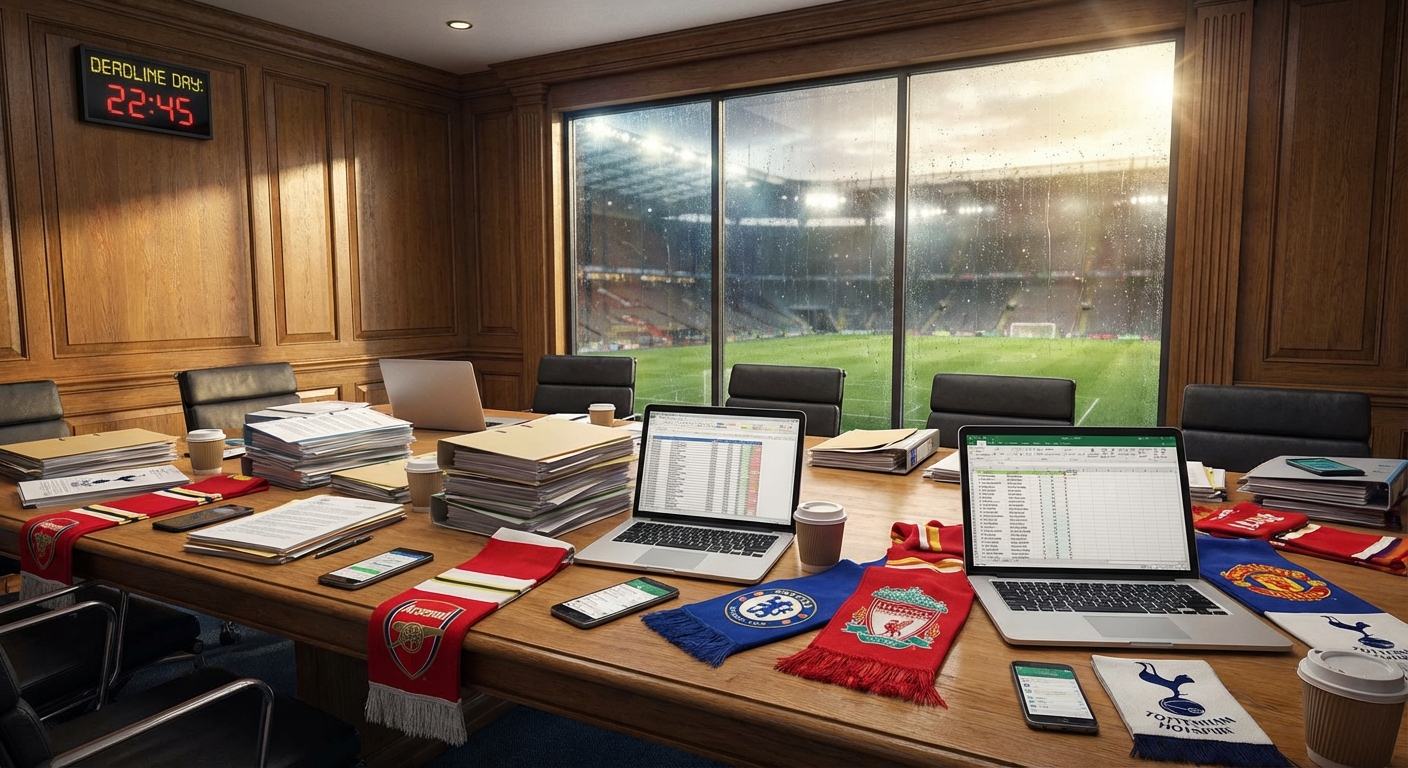
The January transfer window opened on New Year’s Day, and Premier League clubs wasted no time reminding everyone why this month drives football fans slightly insane. The winter window operates under different rules than its summer counterpart. Desperation factors in. Injuries change calculations overnight. And clubs holding onto players until deadline day discover just how much leverage evaporates when the clock starts ticking toward 7 PM on February 2.
This year’s window arrives after a summer that saw Premier League clubs collectively spend over £3 billion, per Transfermarkt, a record that seemed unsustainable even as the checks cleared. The Financial Fair Play implications of that spending spree have made January more interesting than usual. Some clubs need to sell before they can buy. Others are sitting on squad imbalances that summer optimism couldn’t hide. And a few are simply trying to survive until May, hoping that a single signing might be the difference between Premier League survival and Championship reality.
The early action suggests this window will follow the familiar January pattern: big clubs mostly standing pat, mid-table teams taking calculated gambles, and relegation-threatened sides making the kind of panic signings that look brilliant or catastrophic by April. But there are exceptions worth watching, moves that could reshape title races and European battles alike.
Real Madrid Sends Endrick to Lyon
The biggest name to move so far isn’t technically a Premier League story, but its implications ripple across European football. Endrick, the Brazilian wonderkid who arrived at Real Madrid with expectations usually reserved for generational talents, has joined Lyon on loan until the end of the season. The numbers tell a damning story: 99 minutes across all competitions in the first half of the campaign according to FBref, a paltry total for a player Madrid paid nearly €60 million to acquire per Transfermarkt.
The loan makes sense for everyone involved. Endrick is 19 years old and needs consistent minutes to develop the decision-making and tactical awareness that separate prodigies from professionals. Real Madrid’s attacking depth, with Vinícius Jr., Rodrygo, and Mbappé competing for starting spots, left no realistic path to regular playing time. And with Brazil’s World Cup squad taking shape for the summer tournament, Endrick desperately needed a stage to prove he belongs among the 23 players Dorival Júnior selects.

Lyon’s Ligue 1 struggles make them an unconventional destination for a player of Endrick’s profile, but the club has historically developed attacking talent at an elite level. The playing time will come. Endrick’s ability to convert opportunity into the kind of performances that justify Madrid’s investment will define the next six months of his career, and Lyon’s need for goals gives him the platform to do it.
Chelsea’s Clearance Sale Continues
Stamford Bridge has become football’s most expensive waiting room, and January represents another opportunity to thin the squad that Todd Boehly’s spending spree assembled. The names potentially available read like a cautionary tale about transfer strategy: Raheem Sterling, Axel Disasi, and Tyrique George have all been linked with exits, and the club’s willingness to absorb losses on players acquired so recently speaks to the chaos of the past two years.
Sterling’s situation is particularly striking. A £50 million signing from Manchester City per Transfermarkt who was supposed to provide Premier League-winning experience, he’s become a symbol of Chelsea’s dysfunction. Loan moves fell through. New managers came and went. And Sterling, still an England international with genuine quality, finds himself training with the reserves while his agent fields inquiries from clubs who can’t quite believe he’s actually available.
The Disasi situation is more straightforward. Chelsea have too many center-backs, and Disasi, despite showing flashes of the quality that made Monaco reluctant to sell, hasn’t established himself as first choice. A permanent sale seems more likely than a loan, with clubs in Italy and Germany expressing interest. The fee Chelsea accepts will indicate how desperate they are to clear wages and squad spaces before the window closes.
For Chelsea fans watching this unfold, the January window represents another test of the club’s new direction under Enzo Maresca. The manager has been clear about his preferences and his willingness to exclude players who don’t fit his system. But every sale requires a buyer, and Chelsea’s reputation for overpaying has paradoxically made it harder to move players on. Other clubs know Chelsea need to sell and have adjusted their offers accordingly.
Arsenal’s Quiet Confidence
Mikel Arteta’s comments about being “actively looking” at the market came with the caveat that Arsenal’s busy summer means January activity will be limited. The Gunners brought in significant talent during the primary window, and the system Arteta has built rewards familiarity over January reinforcements. But injuries have forced a recalculation. More players than anticipated have spent time in the treatment room, and the depth that looked sufficient in August has been tested repeatedly.

The midfield remains the most obvious area of concern. Thomas Partey’s fitness has been a constant question mark, and while Declan Rice has been everything Arsenal hoped when they paid Brighton’s asking price, ranking among the Premier League’s top midfielders in progressive carries per Opta, the supporting cast behind him lacks the reliability a title challenge demands. Arteta has made do with what he has, adjusting formations and asking players to fill unfamiliar roles. But a single signing, the right midfielder with the physicality to complement Rice and the technical quality to fit Arsenal’s possession game, could be the difference in a title race that promises to go the distance.
Whether Arsenal can find that player in January, when selling clubs demand premium prices and target players are reluctant to leave mid-season, remains uncertain. The smart money says Arteta sticks with his current squad and trusts the process that has taken Arsenal from mid-table mediocrity to genuine championship contenders. But smart money doesn’t win trophies, and the margin between first and second in the Premier League is measured in moments that squad depth can determine.
Liverpool’s Striker Situation
Alexander Isak’s injury against Tottenham sent ripples through multiple transfer plans. For Newcastle, it meant reassessing whether their squad could survive without their primary goal threat. For Liverpool, it raised questions about whether the Reds might need to act in a market they had planned to observe from the sidelines.
Liverpool’s attacking options have been sufficient, but the Isak situation highlighted a vulnerability that hasn’t been properly addressed. Darwin Nunez remains an enigma, brilliant one match and invisible the next, with an expected goals overperformance that fluctuates wildly match to match according to FBref. Diogo Jota’s injury history suggests planning around his availability is optimistic at best. And while Luis Diaz and Cody Gakpo can play through the middle, neither is a natural center-forward in the way Isak would have been.
The irony isn’t lost on Liverpool supporters. Isak was their priority target before Newcastle’s investment transformed him from a promising striker into an untouchable franchise player. The injury isn’t serious enough to prompt an emergency sale, but it does remind everyone what Liverpool lacks and what they would need to compete for the striker who would genuinely solve their problems.

Brentford’s Smart Scouting and Spurs’ Quick Strike
The most interesting January business often happens outside the spotlight. Brentford’s pursuit of a defensive midfielder has led them to Feyenoord’s Quinten Timber and PSV’s Joey Veerman, both players who would improve their midfield without breaking the bank. Thomas Frank’s ability to identify undervalued talent and integrate it into Brentford’s system has been one of the Premier League’s underrated success stories, and another shrewd January addition would continue that trend.
Tottenham earned plaudits for their Johnson deal from Crystal Palace, the kind of quick, decisive business that characterized their best transfer windows under Daniel Levy. Johnson provides defensive cover and attacking flexibility, two attributes Ange Postecoglou’s system demands. Whether Spurs make additional moves depends largely on outgoings, but the early indication suggests they’re positioned to strengthen without the frantic deadline day scrambling that has defined some recent windows.
The relegation battle will produce the most dramatic moves, as it always does. Clubs fighting for survival operate under different constraints than those competing for European places. A single signing can transform confidence and provide the quality that makes the difference between 17th and 18th. We’ve seen it before: a January arrival who scores the goals or provides the stability that keeps a club in the Premier League. The desperation produces mistakes, yes, but it also produces the kind of all-in gambles that occasionally pay off spectacularly.
What to Watch Through February 2
The window’s narrative is just beginning. Expect movement to accelerate as the February 2 deadline approaches, with clubs that have been patient suddenly discovering urgency as their preferred targets receive competing offers. The selling dynamic shifts dramatically in the final week, when buying clubs gain leverage and sellers must choose between accepting reduced fees or holding onto players who may have mentally checked out.
Real Madrid’s pursuit of Adam Wharton bears watching. The Crystal Palace midfielder has emerged as one of England’s most promising young talents, and Real’s interest suggests they see him as a long-term project worth investing in. Whether Palace sell mid-season, with their own ambitions still alive, or hold out for a summer bidding war will tell us something about how English clubs view their leverage against European giants.
The Premier League’s Financial Fair Play constraints will shape everything. Clubs that overspent in summer must balance their books, and that means January sales that might not have happened under different circumstances. Smart buying clubs are already identifying which players are available not because their clubs want to sell, but because their clubs have to sell.
Winners and Losers
The deeper story of this January window is a structural shift in how Premier League clubs approach winter business. The era of panic buying may be ending, replaced by something more calculated and, for fans, more frustrating. Clubs that spent aggressively last summer are now constrained by Financial Fair Play accounting periods that treat January and summer spending as part of the same ledger. That means the traditional January dynamic, where money solves problems, has been replaced by a more complex equation where wage bill management matters as much as transfer fees.
This creates a two-tier January market. Clubs with clean balance sheets, like Brentford and Tottenham, can move decisively on targets they identified months ago. Clubs carrying summer debt, like Chelsea and several relegation candidates, must sell before they buy, turning what should be a straightforward reinforcement window into a complex financial puzzle. The result is a window where the savviest operators are not those with the deepest pockets but those with the most flexible squad structures and the discipline to plan exits and arrivals as a single coordinated operation.
By February 2, the clubs that navigated this new reality most effectively will have gained advantages that compound across the second half of the season. A well-timed January signing does not just add quality; it shifts the psychological balance within a squad, signaling ambition to players who might otherwise begin questioning whether their club can match their aspirations.
Sources
- Premier League January Transfers - ESPN, Comprehensive tracker of all confirmed January 2026 deals
- Transfer News: January Window 2026 - Sky Sports, Rolling coverage of Premier League ins and outs
- January Transfer Window Grades - ESPN, Analysis and grading of major January signings
- Premier League Transfer Spending Data - Transfermarkt, Transfer fee records and spending breakdowns
- Premier League Player Statistics 2025-26 - FBref, Detailed player and team performance data