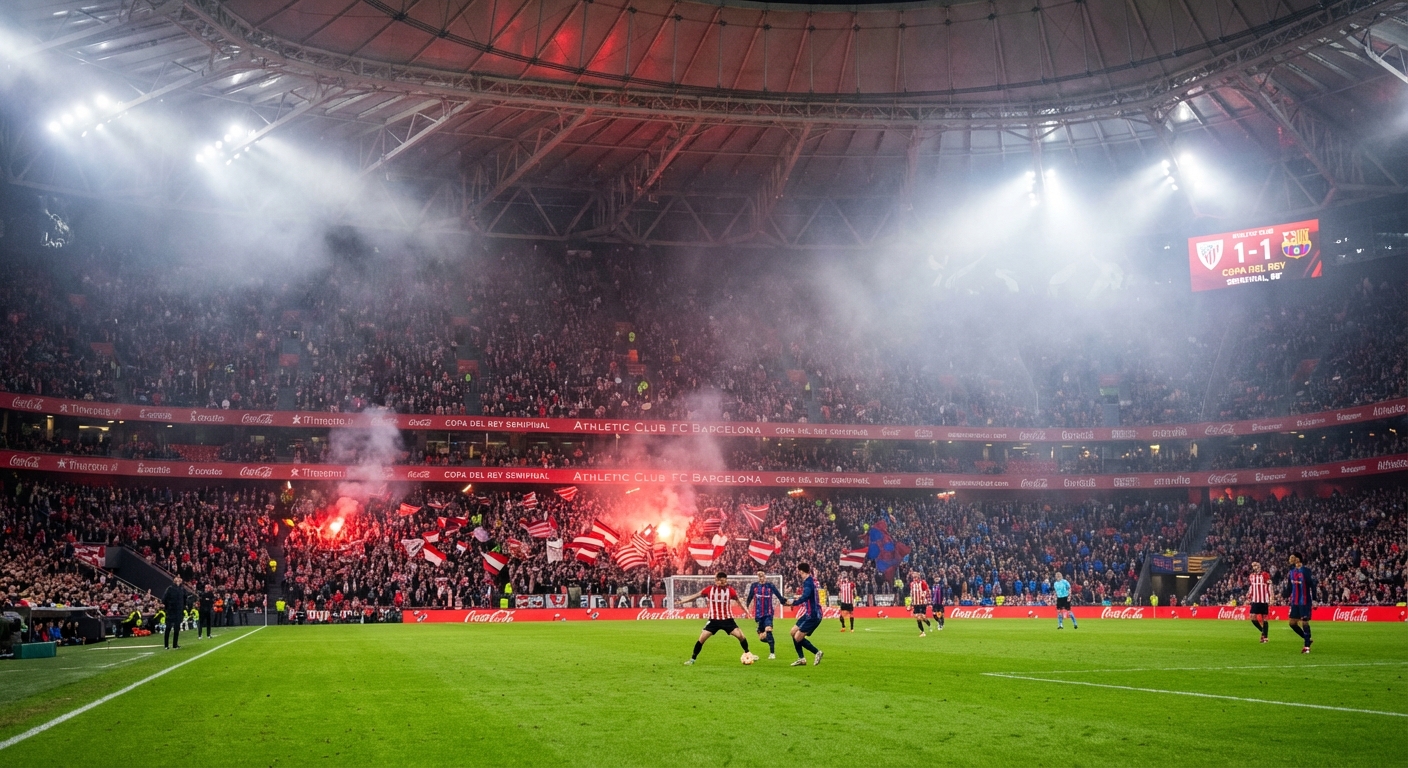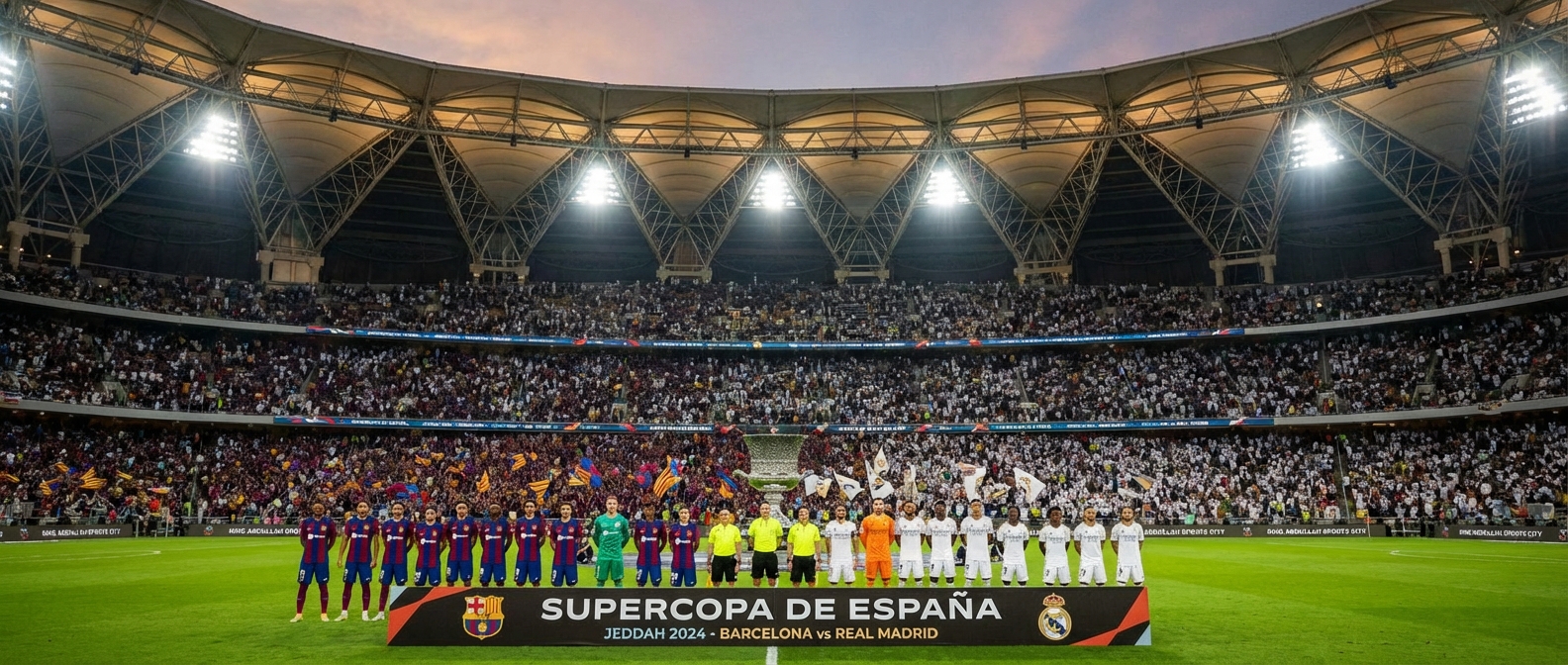
Barcelona demolished Athletic Bilbao 5-0 in Thursday’s semifinal, scoring four goals before halftime in a performance that served as both a statement and a warning. The Catalans have now won nine consecutive matches across all competitions according to Opta, their most dominant stretch of the season arriving at precisely the moment when it matters most. They travel to Jeddah for Sunday’s Super Cup final against Real Madrid as heavy favorites, their confidence bolstered by last year’s 5-2 demolition of these same opponents in the same competition. Yet the beauty of El Clasico lies in its unpredictability, and Real Madrid’s troubled season has somehow delivered them to another final against their eternal rivals.
Real Madrid advanced past Atletico Madrid with a 2-1 victory that required every ounce of their championship pedigree. The scoreline flattered a performance that exposed concerning vulnerabilities, particularly in defense where Xabi Alonso’s side continues to look uncertain without consistent personnel. Rodrygo, Antonio Rudiger, and Raul Asencio all left that match with injuries that put their availability for Sunday in question. Kylian Mbappe initially didn’t travel with the squad due to a knee issue, though a positive recovery allowed him to join teammates on Friday. The French superstar’s presence changes the calculus entirely, but his fitness remains a significant concern.
The stakes extend beyond a single trophy. Barcelona arrives seeking a record-extending 16th Super Cup title, further cementing their dominance in a competition they have owned historically. Real Madrid enters desperate for silverware to salvage a season that has fallen dramatically short of expectations. Alonso’s tenure has not produced the immediate transformation many anticipated when he left Bayer Leverkusen. As Sid Lowe of The Guardian has noted, questions about Alonso’s tactical fit at the Bernabeu have intensified with each disappointing result. A victory against Barcelona in the final would silence critics temporarily. A loss, especially a lopsided one like last year’s humiliation, could accelerate the pressure into crisis territory.
Barcelona’s Dominant Form
Hansi Flick has orchestrated a season of remarkable consistency since taking over from Xavi Hernandez. The German manager’s tactical approach has maximized Barcelona’s young talent, creating a high-pressing system that suffocates opponents before they can establish any rhythm. The 5-0 destruction of Athletic Bilbao demonstrated just how overwhelming Barcelona can be when everything clicks. They pressed relentlessly, transitioned instantly, and finished ruthlessly. Athletic, a quality side that had defeated Barcelona earlier this season, looked helpless against the wave after wave of Blaugrana attacks.

That run of form includes victories that demonstrated different aspects of Barcelona’s capabilities. They have won matches through patient possession, quick counterattacks, and sheer individual brilliance. Lamine Yamal, the teenage phenomenon who has already established himself as one of football’s most exciting talents, missed the Athletic match through injury but returned from the bench and appears set to start the final. His availability provides Barcelona with the creative spark that terrorizes defenders and creates space for teammates throughout the attacking third.
Robert Lewandowski continues to score with the efficiency that has defined his entire career. Pedri orchestrates play from midfield with a maturity that belies his age. Raphinha has emerged as a genuine star after seasons of inconsistency, his confidence at a level that makes him dangerous every time he receives the ball in attacking positions. Barcelona’s depth allows Flick to rotate without sacrificing quality, ensuring fresh legs and hungry players throughout his squad. They enter the final having had two extra days of recovery compared to Real Madrid, a tangible edge in a match expected to be played at relentless intensity.
Real Madrid’s Mounting Problems
The contrast between Barcelona’s serene confidence and Real Madrid’s mounting anxiety could not be more stark. Alonso took over a squad that had just won La Liga and the Champions League, inheriting perhaps the most talented roster in world football. The expectations were for immediate domination, a seamless transition from Carlo Ancelotti’s steady hand to the innovative tactical mind that had transformed Leverkusen into Bundesliga champions. Instead, Real Madrid have stumbled through a season marked by inconsistency, injuries, and performances that have raised fundamental questions about Alonso’s approach.
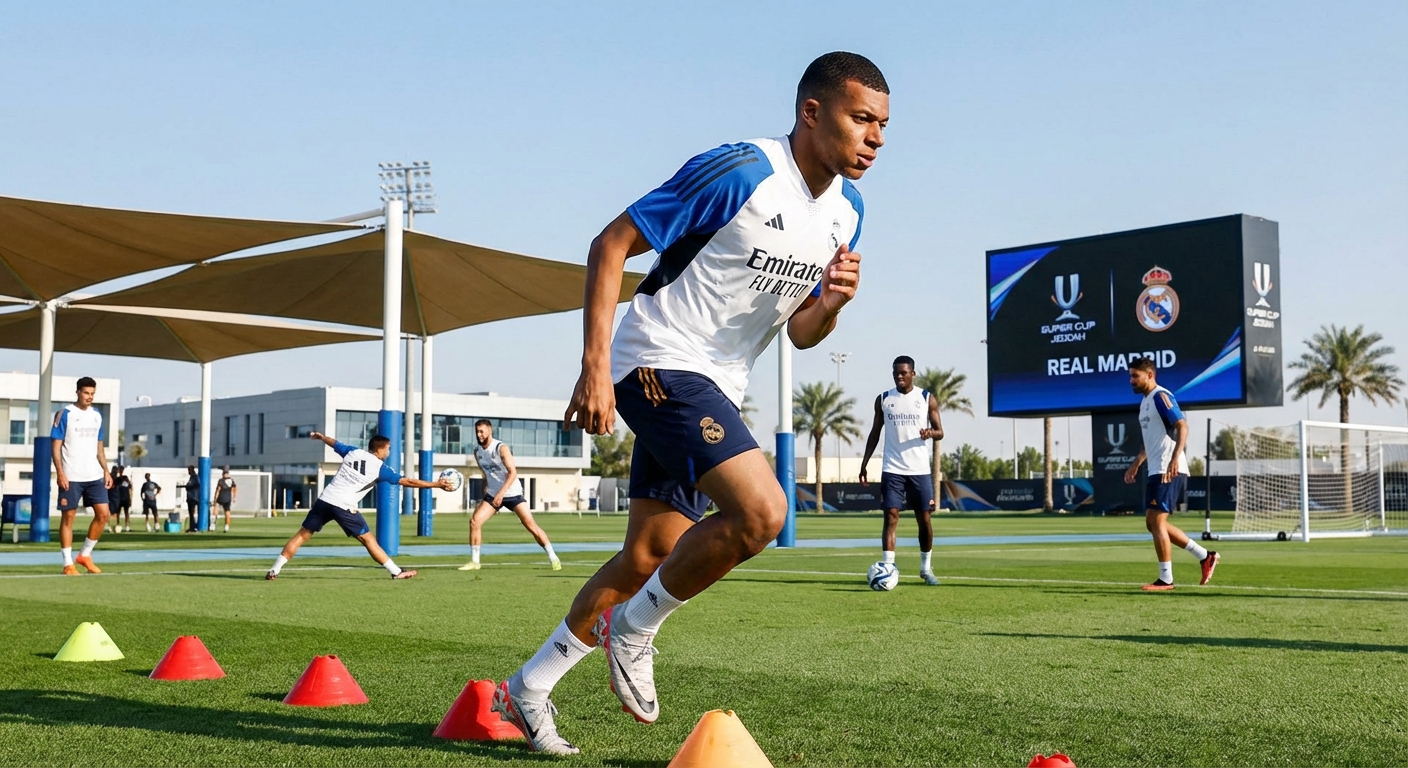
The injury situation threatens to derail whatever tactical plans Alonso has prepared. Rudiger’s availability remains uncertain after he departed the Atletico match with a knock. Asencio, who has emerged as a reliable defender during a season that desperately needed one, also faces a fitness test. The defense that was supposed to be anchored by World Cup winner Rudiger has instead been characterized by uncertainty and mistakes. Real Madrid have conceded goals in bunches per WhoScored, their high defensive line leaving them exposed to the kinds of quick counterattacks that Barcelona execute better than anyone in the world.
Mbappe’s situation encapsulates Real Madrid’s strange season. The French superstar arrived as perhaps the most anticipated transfer in football history, the culmination of years of pursuit finally delivering the game’s most dynamic attacker to the Santiago Bernabeu. He has delivered statistically, scoring 29 goals in 24 appearances across all competitions to lead the team, per FBref. Yet as ESPN’s Gab Marcotti has observed, the integration has been awkward at times, his preferred positions conflicting with Vinicius Junior’s role on the left wing. Vinicius has gone 16 matches without scoring according to Opta, a drought that would be concerning for any player but feels catastrophic for someone of his ability and reputation.
Flick’s Press vs. Alonso’s Positional Play
El Clasico typically produces open, attacking football regardless of what managers intend. The rivalry’s intensity creates situations where caution feels like surrender, pushing both sides toward aggressive approaches that prioritize offense over defensive stability. That dynamic plays directly into Barcelona’s hands, as their pressing and transition game thrive in chaotic environments. Real Madrid’s defensive vulnerabilities become more pronounced when the game opens up, exposing the spaces that Barcelona’s forwards exploit so effectively.
Flick has shown no inclination to deviate from his standard high press, trusting his players to win the ball back quickly and create chances before Real Madrid can organize. The Catalans have been particularly effective at recovering possession in dangerous areas per FBref, turning defensive actions into immediate attacking opportunities. Barcelona’s pressing triggers are designed to force mistakes from opponents attempting to build from the back, exactly the approach that Real Madrid’s shaky defense has struggled against throughout the season.
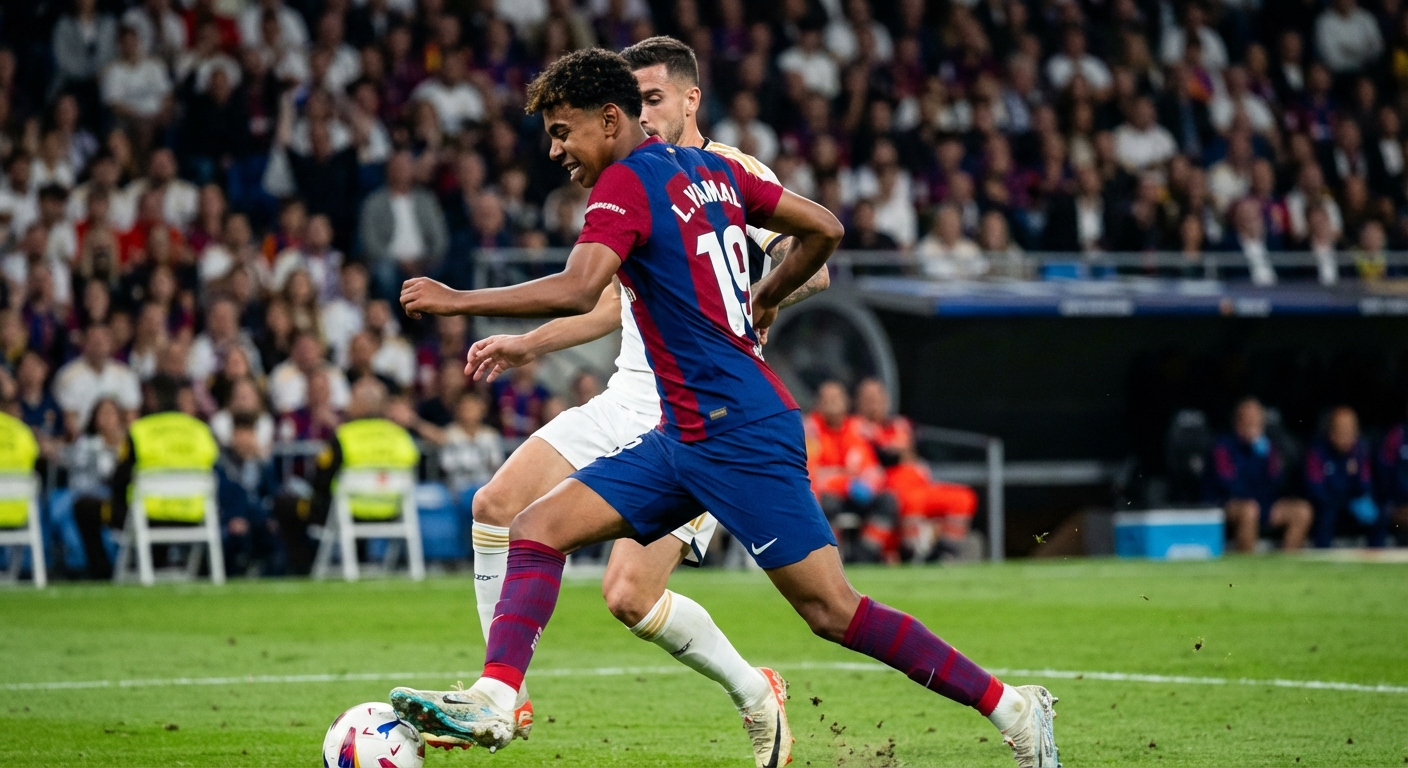
Alonso’s challenge lies in finding defensive organization without sacrificing the attacking firepower that represents Real Madrid’s primary advantage. Mbappe, Vinicius, and Rodrygo possess the individual quality to win matches regardless of tactical setups, but only if they receive service from a midfield that has been inconsistent in possession. The loss of key personnel forces Alonso to improvise, potentially deploying players in unfamiliar roles or trusting youngsters in moments that demand experience. Barcelona’s aggressive press has created problems for every opponent during this dominant stretch, and there is little reason to expect a depleted Real Madrid to fare differently.
The historical record offers Real Madrid some hope. El Clasico has produced stunning upsets throughout its history, matches where form meant nothing and individual brilliance carried unfancied sides to victory. Mbappe’s ability to score goals from seemingly impossible situations makes him a constant threat regardless of the game’s flow. One moment of magic could swing the match in Real Madrid’s favor, erasing the concerns about defensive structure and midfield control that have plagued them all season.
After the Buzzer
This Super Cup final carries consequences that extend well beyond the trophy itself. For Barcelona, a victory would mark their second consecutive Supercopa rout of Real Madrid and confirm that Flick’s rebuild has produced a squad capable of sustained dominance rather than isolated bursts of form. The four most recent El Clasicos have produced at least four goals per Transfermarkt, and Barcelona have been on the right side of that scoreline in three of those matches. Winning a 16th Super Cup title would also establish a psychological hold over Real Madrid entering the second half of the La Liga season, where Barcelona’s consistency has already opened a significant gap at the top of the table.
For Alonso, the calculus is starker. Dermot Corrigan of The Athletic has pointed out that Real Madrid’s board expected a trophy challenge on multiple fronts this season, not a firefighting exercise defined by injury crises and tactical uncertainty. A second straight Super Cup humiliation against Barcelona would raise pointed questions about whether Alonso’s positional play philosophy, so effective at Leverkusen with a squad built around it, can translate to a Real Madrid dressing room accustomed to a different approach. Alonso has yet to find a formation that maximizes both Mbappe and Vinicius simultaneously, and this match will test whether his recent experiments with a 4-4-2 diamond offer even a temporary solution. The broader question facing Real Madrid is whether their current problems are cyclical growing pains under a new manager or structural issues that demand deeper intervention before the Champions League knockout rounds arrive in February.
Sources
- Supercopa de Espana: Can Real Madrid, Atletico or Athletic Stop Barca? - ESPN
- Inside Real Madrid: Differences in the Dressing Room and Difficulties Facing Xabi Alonso - Sky Sports
- Barcelona Stats, 2025-2026 All Competitions - FBref
- Real Madrid Match Log 2025-26 - WhoScored
- As Clasico Nears, Real Madrid Are Still Taking Time to Adapt to Mbappe - ESPN