Artemi Panarin was scratched from the New York Rangers lineup on January 28 for what the team called “roster management purposes.” He sat. Then he played three games, all losses. Then he was gone, shipped to the Los Angeles Kings for prospect Liam Greentree and two conditional draft picks in a trade that confirmed what everyone in the hockey world already suspected: the Rangers are not just retooling. They are tearing the whole thing down.
New York’s record of 22-28-6 is the worst in the Eastern Conference, a staggering collapse for a franchise that entered the season expecting to compete. Their home record of 6-14-4 at Madison Square Garden, arguably the most famous arena in hockey, tells an even uglier story. The Garden has not been a home-ice advantage this year. It has been a mausoleum. And now, with the March 6 trade deadline just eight days away, the Rangers have positioned themselves as the league’s most aggressive seller, a team willing to move anyone and everyone to accelerate the next chapter.
The Panarin trade was the opening act. Vincent Trocheck, the 32-year-old center with a $5.625 million cap hit and three years remaining on his deal, is expected to follow. Carson Soucy has already been traded to the New York Islanders. The Rangers’ front office, led by GM Chris Drury, is not just selling off expiring contracts. They are moving core, term-controlled assets for prospects and picks. That distinction matters, because it tells the rest of the NHL exactly what kind of rebuild this is: a full reset, centered around goaltender Igor Shesterkin and whatever young talent they can stockpile between now and 2028.
The Panarin Deal: What the Rangers Got and What It Tells Us
The trade itself was straightforward in its structure but complicated in its context. Panarin, 34, went to Los Angeles along with 50% salary retention for the remainder of this season. In return, the Rangers received Liam Greentree, the Kings’ first-round pick (26th overall) from the 2024 draft, along with a conditional third-round pick in 2026 and a conditional fourth-round pick in 2028. If the Kings win a playoff round, the third-rounder becomes a second-rounder. If they win two rounds, the Rangers receive the additional fourth-round selection.
Panarin then signed a two-year, $22 million extension with Los Angeles, locking in an $11 million average annual value through the 2027-28 season. The extension explains why the return feels light. Panarin held a full no-movement clause and, per ESPN’s reporting, chose Los Angeles as his preferred destination despite interest from Carolina, Tampa Bay, and Washington. When a player dictates his destination, the selling team loses all leverage.
“Players of Panarin’s skill, hockey sense, resume… hard to find those players,” Kings GM Ken Holland told reporters after the deal. “He’s an elite offensive producing machine. You’re getting a player motivated, that wants to come out here.”
Holland’s comments reveal the Kings’ calculus. They are not rebuilding. They are pushing all their chips in. “You either compete, or you enter this long-term rebuild,” Holland said. “I’m not interested in a long-term rebuild.” That urgency allowed the Rangers to extract Greentree, who is widely considered the best prospect in the Kings’ organization, but it did not give them the haul that a player of Panarin’s caliber would normally command.

Greentree, the Prospect: Power Forward With a Ceiling and a Floor
Liam Greentree is 19 years old and currently captaining the Windsor Spitfires in the OHL. He is 6-foot-3, plays a power forward style, and his hockey sense is considered elite among prospects his age. Per his OHL stats this season, he has 23 goals and 45 points in 34 games, a strong line by any measure. But context matters. Last season, Greentree was third in the OHL in total points with 119 in 64 regular-season games. His pace this year projects to roughly 80 points over a full season, a significant drop that scouts are watching carefully.
The optimistic projection, according to Bleacher Report’s scouting analysis, is a creative top-six winger who produces 50 to 55 points annually at the NHL level. The pessimistic scenario is a physical third-liner who provides some insurance but never becomes a core piece. His skating was a concern during his draft year, and while he has made strides in that area, it is not yet at the level that projects automatic NHL success.
For the Rangers, Greentree is a bet on upside. He is the kind of prospect you acquire when you are building for 2028, not 2026. That timeline aligns with New York’s new reality: Shesterkin is the franchise, and everything else is being rebuilt around his prime years. Whether Greentree becomes a meaningful part of that future or simply a footnote in the Panarin trade depends on the next two years of his development.
Trocheck and the Next Domino
If the Panarin trade was the earthquake, the Trocheck situation is the aftershock that could reshape the entire deadline market. Trocheck, who recently won gold with Team USA at the Olympics and posted perfect penalty-kill statistics going 17-for-17, has seen his trade value spike at exactly the moment the Rangers need to maximize returns.
The 32-year-old center carries a $5.625 million cap hit through 2029, and he holds a 12-team no-trade clause that gives him significant control over his destination. According to NY Hockey Insider’s reporting, the Minnesota Wild have emerged as a “serious frontrunner” for Trocheck, with GM Bill Guerin developing a strong relationship with the center during the Olympic tournament. The Detroit Red Wings are also “actively gaining traction,” with GM Steve Yzerman reportedly willing to deploy elite prospects like Sebastian Cossa and Trey Augustine in a potential package.
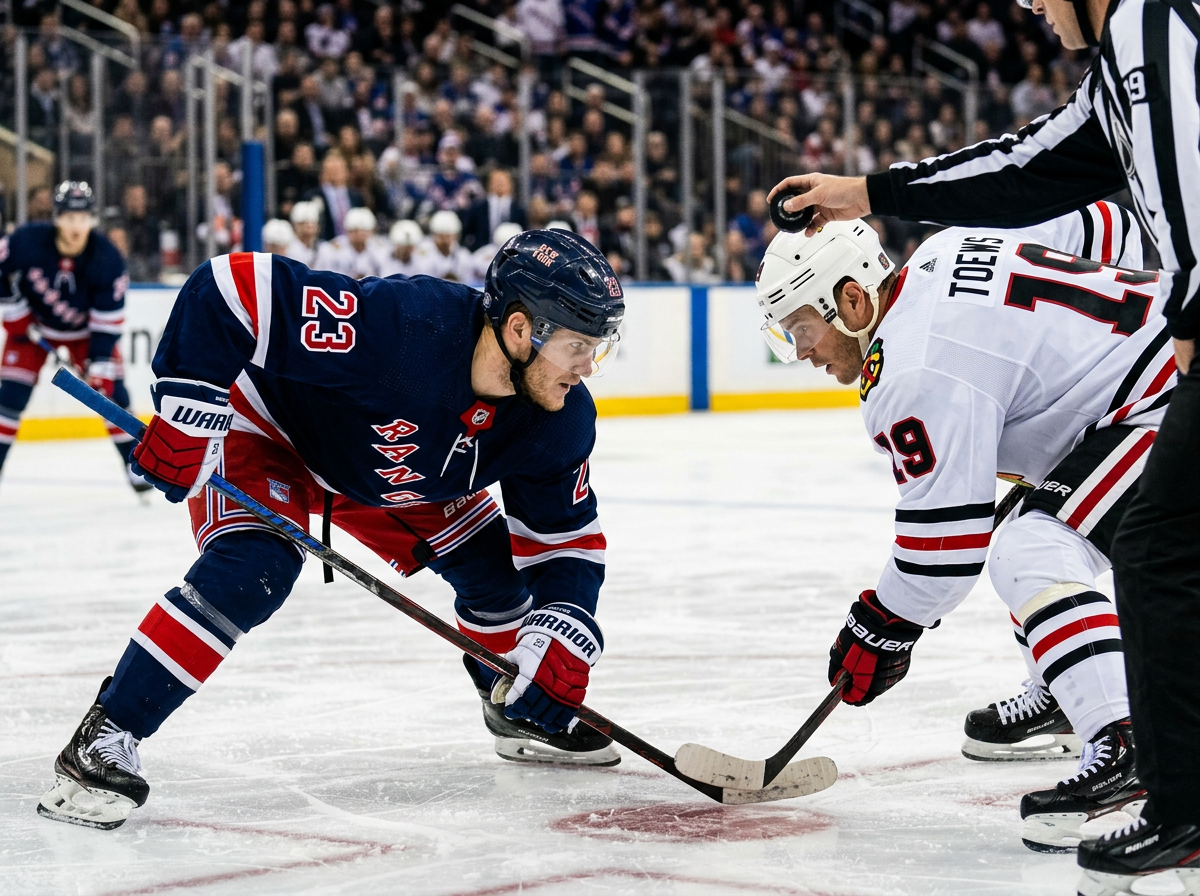
Trocheck’s preference complicates things. Reports indicate he wants to stay in the Eastern Conference, which narrows the field. The Carolina Hurricanes, a team Trocheck played for before signing with the Rangers, have also been linked to discussions. For the Rangers, the goal is clear: they want a blue-chip prospect and additional draft capital. Anything less than that, and they are better off keeping Trocheck and using his production to help Shesterkin’s workload during a long rebuild.
The financial math is significant for any acquiring team. Trocheck’s $5.625 million hit running through 2029 means this is not a rental acquisition. The buying team is committing to three full seasons of Trocheck’s contract, which means the deal has to make sense not just for March and April but for October and beyond. That term is a double-edged sword: it limits the field of suitors to teams with long-term cap flexibility, but it also means the Rangers can demand a higher return than they would for an expiring asset.
The Rangers’ Cap Strategy: Building Around Shesterkin
The deeper story behind these trades is not about the players leaving. It is about the player staying. Igor Shesterkin signed a massive extension earlier this season, and the Rangers have made it clear that their goaltender is the one untouchable piece in this rebuild. Every other move flows from that decision.
By trading Panarin (with 50% salary retention) and potentially moving Trocheck, the Rangers would clear more than $11 million in annual cap space. That is not just housekeeping. It is the foundation of a roster reconstruction strategy that prioritizes acquiring young, cost-controlled talent while maintaining enough cap room to add a marquee free agent or two when the team is ready to compete again. The approach mirrors what the Carolina Hurricanes did between 2017 and 2019, when they systematically shed veteran contracts, stockpiled picks and prospects, and then emerged as a perennial contender seemingly overnight.
The difference is that the Rangers are trying to do it with an elite, expensive goaltender in his prime. That compression creates urgency. Shesterkin is 30, and while goaltenders can play at a high level well into their mid-thirties, the Rangers cannot afford a five-year rebuild. They need the prospects they are acquiring now to develop faster than the typical NHL timeline suggests. It is a gamble, but it is a more calculated one than simply running back the same underperforming roster and hoping for different results.
Coach Mike Sullivan acknowledged the emotional toll of the transition. “Sometimes just the anxiety or uncertainty is more difficult to deal with than the finality of it,” Sullivan told reporters after the Panarin trade. “Everybody can move on.” When asked whether he anticipated the Rangers being in this position, Sullivan was blunt: “Did I anticipate us being here this year? No.”
Deadline Sellers Everywhere: The Rangers Are Not Alone
New York’s fire sale has dominated the headlines, but the Rangers are hardly the only team in sell mode as the March 6 deadline approaches. The seller’s market is deeper than it has been in years, and that reality will affect the prices that buyers pay for rentals and term players alike.
The Vancouver Canucks, who already traded captain Quinn Hughes to the Minnesota Wild earlier this month, are 18-31-6 and sit 32nd in the overall NHL standings. Their rebuild is in full swing, and forward Evander Kane is the next major piece expected to move. GM Patrik Allvin has signaled willingness to retain up to 50% of Kane’s salary, per multiple reports, to maximize the prospect and pick return.
The Calgary Flames are also selling. Blake Coleman, recently activated from injured reserve, addressed his uncertain future directly. “I’m a Flame until I’m told I’m not,” Coleman told reporters, per NHL.com’s trade buzz column. Coleman has 13 goals and eight assists in 44 games, and his playoff pedigree (two Stanley Cup rings with Tampa Bay) makes him an attractive add for contenders looking for depth scoring and penalty-kill presence. The Flames sit 11 points behind a wild-card spot, and veterans Justin Faulk, Jordan Binnington, and Brayden Schenn from the St. Louis Blues are also expected to be available as the Blues commit to their own version of a retool.
Then there is Steven Stamkos in Nashville. The 35-year-old has 28 goals and 39 points in his last 24 games after a miserable start to the season that saw him produce just five points in his first 22 contests. The Predators are four points behind a wild-card spot, and Stamkos holds a full no-move clause and an $8 million AAV through 2028, making any trade extraordinarily complicated. “I’m not too worried about it,” Stamkos said when asked about trade rumors. “I haven’t had any conversations about that.” His no-move clause means he controls his destiny, and moving that contract would require significant salary retention from Nashville.

The Buyer’s Dilemma: A Flooded Market Lowers Prices
The volume of sellers this year creates an unusual dynamic for contenders. When the Canucks, Rangers, Flames, Blues, and possibly Predators are all selling simultaneously, the supply of available talent far outstrips what buyers can absorb. That market imbalance should, in theory, push prices down. A contending team that might have paid a first-round pick and a prospect for a top-six forward two years ago could potentially get similar value for a second-rounder and a B-level prospect in this environment.
The Panarin trade already set a concerning benchmark for sellers. If a player who scored 57 points in 52 games, the ninth-best scorer in Rangers franchise history with 607 career points, returns only one prospect and two conditional mid-round picks, what does that signal about the market for lesser talents? The answer is that Panarin’s no-movement clause depressed his value, and not every situation will mirror that dynamic. Trocheck’s 12-team no-trade list, while restrictive, still gives the Rangers significantly more flexibility than Panarin’s full no-move clause did.
For buyers like the Edmonton Oilers, Colorado Avalanche, and Dallas Stars in the West, this is an opportunity to add at a discount. The risk is overpaying when patience could yield a better deal in the final 48 hours before the deadline. History shows that the best deadline deals often happen in the last 24 hours, when sellers panic and buyers pounce. With eight days remaining, the posturing has begun in earnest. The real action starts when the clock forces everyone’s hand.
What This Rebuild Needs to Work
The Rangers’ retool will be judged not by what they traded away but by what they build with the assets they receive. The Greentree acquisition is a start, but one prospect and conditional mid-round picks is not a foundation. The Trocheck trade, whenever it materializes, needs to bring the kind of return that moves the needle: a top prospect, a first-round pick, or both. If the Rangers can extract a package from Detroit or Minnesota that includes a genuine blue-chip talent, the combined haul from the Panarin and Trocheck trades could give them the makings of a competitive roster within three seasons.
The comparison that best fits this situation is the 2019-20 Ottawa Senators, who traded Erik Karlsson, Matt Duchene, and Mark Stone in a span of months and collected the draft picks that eventually became Tim Stutzle, Jake Sanderson, and Brady Tkachuk (via their earlier teardown). Ottawa’s rebuild took longer than anyone wanted, but the talent pipeline they created through aggressive selling eventually produced a competitive team. The Rangers are attempting something similar, but with the added pressure of a franchise goaltender whose contract demands they compete again before 2030.
The biggest risk is misidentifying the rebuild timeline. If Greentree does not develop as hoped, or if the Trocheck return underwhelms, the Rangers could find themselves in the same position as the Buffalo Sabres, who spent over a decade accumulating assets without ever translating them into playoff success. Chris Drury’s legacy as GM will be defined by whether he can turn this fire sale into the foundation of the Rangers’ next great team, or whether it becomes another cautionary tale about selling without a plan to buy.
Winners and Losers
Winner: The Los Angeles Kings. Holland got his franchise-caliber winger for a price that did not gut the organization’s future. Yes, they lost their top prospect and committed $22 million over two years to a 34-year-old, but Panarin is an elite playmaker who immediately makes their top six one of the best in the Western Conference. If the Kings make a deep playoff run, this trade looks like a masterstroke.
Winner: Buyers with patience. The flooded seller’s market means contenders who wait will find bargains. Teams like Edmonton, Carolina, and Dallas can afford to be strategic rather than desperate, picking off value plays in the final days before the deadline.
Loser: The Rangers, right now. The return for Panarin was underwhelming, and there is no guarantee that Greentree becomes a top-six NHL player. The Rangers had their hand forced by the no-movement clause, and the result is a trade that addresses the future without providing enough certainty to feel good about the present. The women’s hockey team showed what winning looks like in this Olympic cycle. The Rangers are a long way from that.
Loser: Sellers with complicated contracts. The Panarin precedent, where a no-move clause compressed the return to a fraction of fair value, should terrify every GM holding a star player with trade protection. Nashville, sitting on Stamkos’s full no-move and $8 million AAV, faces an almost impossible task if they decide to sell.
The next eight days will reshape the NHL for the next five years. The Rangers fired the starting gun. Now everyone else has to decide whether to run.
Sources
- Rangers Ready to Move On Following Panarin Deal to Los Angeles - NHL.com
- Sources: Rangers Send Artemi Panarin to Kings - ESPN
- NHL Trade Buzz: News and Notes, February 23 - NHL.com
- Massive Vincent Trocheck Trade Looming for Rangers - NY Hockey Insider
- Breaking Down the Rangers’ Panarin Trade Return, Featuring Liam Greentree Scouting Report - Bleacher Report