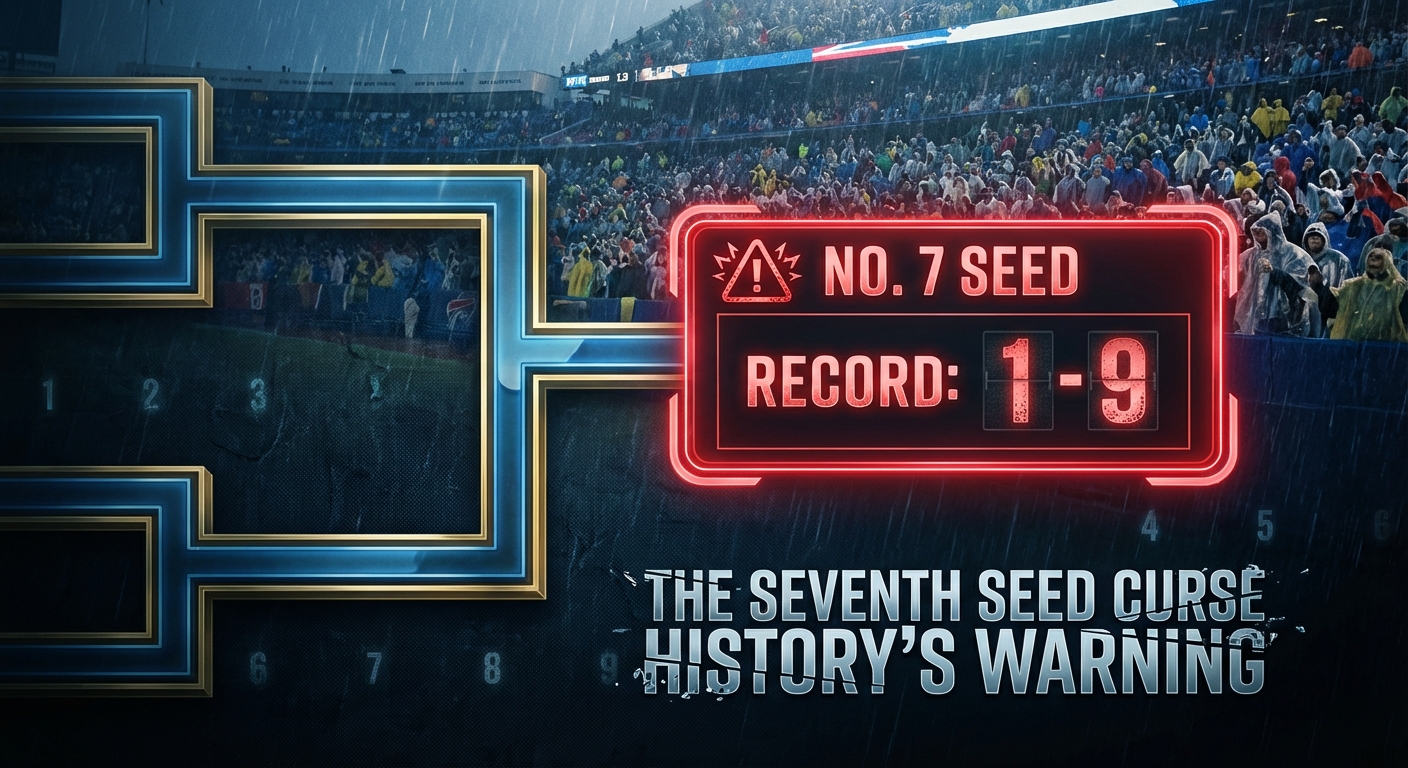
The San Diego Chargers’ wild card loss to the Buffalo Bills in January 2021 set a precedent that’s haunted every seventh seed since. That team, led by Justin Herbert in his rookie season, lost 27-17 in a game that was never particularly close despite the final score suggesting competitiveness. Since then, nine more seventh seeds have taken the field in Wild Card Weekend, and only one has emerged with a victory. The Green Bay Packers and Los Angeles Chargers carry that history into this weekend’s games, facing a statistical reality that suggests their seasons are about to end.
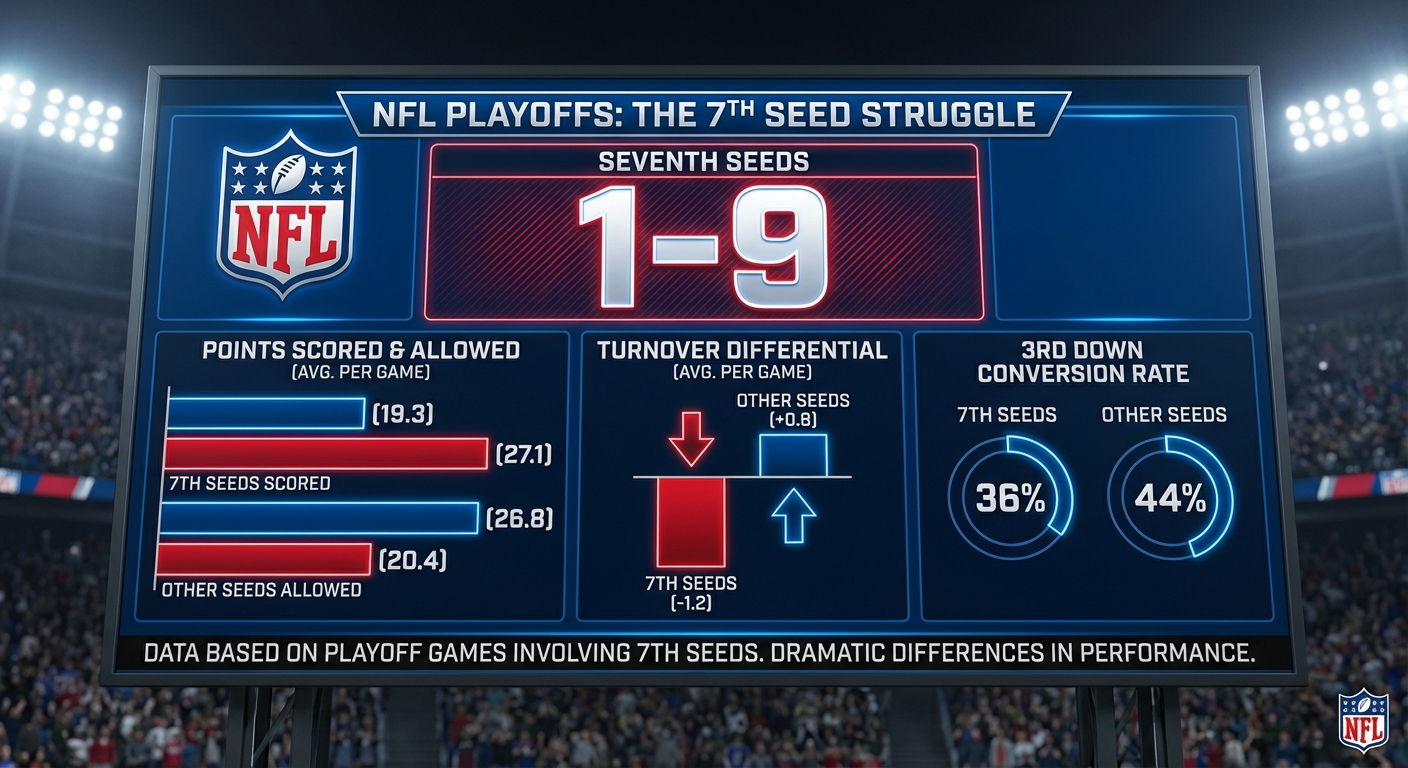
The numbers are stark and unforgiving. Seventh seeds in the expanded playoff format have gone 1-9, with an average loss margin of 13.7 points, per Pro Football Reference. That single victory belongs to the 2021 Pittsburgh Steelers, who defeated the Kansas City Chiefs 45-28 in a game that feels more like an outlier than a template for success. Every other seventh seed has lost, often badly, exposing the gap between teams that barely qualified for the postseason and opponents who earned home-field advantage through superior regular-season performance.
This isn’t random variance or small sample size noise. The pattern reflects fundamental disadvantages that seventh seeds face: playing on the road against opponents with superior records, traveling during a short week, and facing defenses that have had extra time to prepare for their tendencies. The regular season determines seeding for a reason, and teams that finish seventh in their conference typically got there through inconsistency that proves fatal when the margin for error disappears in January.
Yet both the Packers and Chargers enter Wild Card Weekend with legitimate reasons to believe they can defy history. Understanding why the curse exists, and what it would take to break it, provides essential context for evaluating their chances this weekend.
The Anatomy of Seven Seed Failures
The reasons seventh seeds struggle go beyond simple talent disparities. Travel logistics create immediate disadvantages that compound over the course of a game. Seventh seeds in the AFC often face cross-country trips, arriving in hostile environments with less recovery time than their opponents. The Chargers’ trip to New England this weekend follows that pattern exactly, with Justin Herbert facing a Patriots defense that hasn’t left home in three weeks and spent that time specifically preparing for Los Angeles’s offensive tendencies.
The quality of opponent matters significantly as well. Seventh seeds play second seeds, who earned that position by winning their division while accumulating one of the best records in the conference. These aren’t fluky home-field advantages against mediocre teams. Second seeds have typically proven themselves against quality competition throughout the regular season, building the kind of consistent excellence that translates to playoff success.
The timing of when seventh seeds clinch their playoff spots creates another subtle disadvantage. Most seventh seeds secure their berths in Week 17 or 18, meaning they’ve spent the final weeks of the season fighting for playoff positioning rather than building momentum with their best players healthy. Second seeds, by contrast, often clinch home-field advantage earlier and can manage workloads, rest injured starters, and enter the playoffs physically fresher than opponents who scraped their way into the bracket.
Statistical analysis of the ten seventh-seed performances reveals troubling patterns. According to NFL Research, those teams averaged 17.3 points scored in Wild Card Weekend, compared to 28.6 for their opponents. They committed an average of 2.1 turnovers per game while forcing just 0.9, per ESPN Stats & Info. Third-down conversion rates dropped from regular-season averages of 38% to playoff performances averaging 31%. Every metric suggests that seventh seeds play below their own baseline when facing the pressure and quality of playoff competition.
The 2021 Steelers: Why the Exception Proves the Rule
Pittsburgh’s victory over Kansas City in the 2020 season playoffs (played January 2021) remains the only seventh-seed triumph in the expanded format. Examining that game reveals circumstances so unusual that they actually reinforce why the curse typically holds rather than suggesting a path others can follow.
The Chiefs were demonstrably not themselves that day. Patrick Mahomes had suffered a concussion two weeks earlier and played through lingering effects that may have compromised his decision-making. Kansas City’s offensive line had been decimated by injuries throughout the season, leaving Mahomes running for his life on every dropback. The Chiefs committed four turnovers, including two Mahomes interceptions that led directly to Pittsburgh touchdowns.
The Steelers, meanwhile, played their best game of the season at the perfect moment. Their defense, which had been one of the league’s best early in the year before declining, recaptured its dominant form against a compromised opponent. T.J. Watt recorded 2.5 sacks and constant pressure, while the secondary capitalized on Mahomes’s uncharacteristic mistakes. Pittsburgh gained 340 yards on the ground, exploiting a Kansas City run defense that had been gashed repeatedly in December.
Nothing about that game suggested seventh seeds generally possess winning formulas. Instead, it showed that extraordinary circumstances, specifically facing a weakened opponent playing far below their capabilities, can overcome structural disadvantages. The 2025-26 Patriots and Bears don’t appear to be similarly compromised, meaning the Chargers and Packers can’t count on their opponents cooperating with upset bids.
The Chargers’ Path: Herbert vs. History
Justin Herbert returns to the playoffs for the third time in his career, seeking his first postseason victory. The Chargers’ franchise quarterback has compiled impressive regular-season statistics but hasn’t translated that production to January, going 0-2 with a passer rating of 78.3 in playoff appearances, according to Pro Football Reference. Those struggles came in his first two seasons when Los Angeles’s supporting cast was demonstrably lacking. This year feels different because the team around Herbert has improved substantially.
The Chargers finished 10-7 despite significant injuries to their offensive line and secondary. Herbert threw 32 touchdowns against just 9 interceptions, and the running game averaged 4.5 yards per carry behind a rebuilt ground attack. Los Angeles can win games multiple ways now, a flexibility that was missing in Herbert’s previous playoff experiences. That versatility will be tested against a Patriots defense that, per PFF, has allowed the second-fewest explosive passing plays since Week 10.
New England’s defensive transformation under new leadership has been the story of their season. Per ESPN Stats & Info, the Patriots allow just 18.2 points per game, ranking fourth in the league, and their 31 takeaways lead the conference. Drake Maye’s development at quarterback has exceeded expectations, giving New England an offense capable of keeping pace if games become shootouts. But the Patriots win by not allowing shootouts, by grinding opponents into submission through defensive excellence and clock management.
Herbert’s arm talent gives Los Angeles a chance in any game, but he’ll need to produce against a defense specifically designed to limit explosive plays. The Chargers’ deep passing game has been inconsistent this season, and the Patriots’ coverage schemes could force Herbert into the kind of check-down heavy approach that keeps games close but rarely produces road upset victories. As ESPN’s Bill Barnwell has noted, seventh-seed quarterbacks have posted a collective 72.1 passer rating in the expanded-playoff era, well below their regular-season marks.
The Packers’ Dilemma: Lambeau in Reverse
Green Bay’s situation carries irony that veteran Packers fans will appreciate uncomfortably. For decades, visiting teams dreaded January trips to Lambeau Field, where the cold and the crowd conspired to end seasons. Now the Packers travel to Soldier Field as the seventh seed, facing a Bears team that has discovered the magic of home playoff football. The franchise that once defined home-field advantage must overcome it.
The Bears’ emergence this season has been built on defensive excellence and efficient quarterback play. Chicago’s defense ranks fourth in total defense and second in takeaways, creating the kind of environment where small mistakes snowball into insurmountable deficits. The Packers’ inconsistent protection of their quarterback could prove fatal against a pass rush that recorded 48 sacks during the regular season.

Green Bay’s road record this season provides little comfort for Packers supporters. They finished 4-5 away from Lambeau, with losses to every playoff team they faced on the road. The formula that works at home, where the Packers can rely on crowd noise and familiar conditions, hasn’t translated to hostile environments. Soldier Field in January will be as hostile as any environment they’ve faced, with a Bears fanbase desperate to end a playoff drought that stretches back to 2010.
The Packers’ best path to victory runs through ball control and field position. If they can sustain drives, limit Chicago’s offensive possessions, and avoid the turnovers that have plagued seventh seeds historically, Green Bay has the talent to compete. Their offensive line has been their strength all season, and protecting their quarterback while opening running lanes could neutralize Chicago’s defensive advantage. PFF’s Sam Monson has highlighted that Green Bay’s offensive line ranks sixth in pass-blocking efficiency this season, one of the few metrics where the Packers grade out above their opponent.
The Turnover and Third-Down Benchmarks for a Seven-Seed Upset
For either the Chargers or Packers to defy history this weekend, specific circumstances would need to align favorably. Turnover differential must flip from the typical pattern that sees seventh seeds losing the turnover battle. Both teams would need to win the turnover margin or at least break even, something seventh seeds have accomplished in only two of ten games under the expanded format.
Third-down conversions provide another clear indicator of upset potential. Seventh seeds that convert above 40% of their third downs would break the pattern of declining efficiency that’s characterized previous failures. Both the Chargers and Packers possess the offensive capabilities to sustain drives, but doing so against defenses that have spent two weeks preparing specifically for their tendencies requires execution that previous seventh seeds haven’t demonstrated.
The quarterback play must exceed regular-season baselines rather than declining under playoff pressure. Herbert and Green Bay’s quarterback are both capable of special performances, but the seventh-seed history suggests that even talented quarterbacks struggle to produce their best in these circumstances. Whoever emerges with a victory will almost certainly have their quarterback perform at or above their season average, something that hasn’t happened often in this sample.
What History Tells Us
The seventh-seed curse exists for reasons rooted in competitive reality, not superstition or random variance. Teams that finish seventh in their conference typically have flaws that prevented them from earning better positioning, and those flaws get exposed against superior opponents in hostile environments. The pattern reflects structural disadvantages that are difficult to overcome regardless of talent or preparation.
What makes the seven-seed data particularly striking is how it mirrors a longer NFL trend. Before the expansion to 14 teams, the lowest-seeded wild card entrants in both conferences had a combined .320 winning percentage in Wild Card Weekend dating back to 2002, according to NFL Research. The league added a seventh playoff team to increase access, but it also widened the talent gap in the opening round. In every other major North American sport, the lowest playoff seeds win at least 25% of their first-round matchups over comparable periods. The NFL’s figure sits near 10%, a disparity that reflects football’s single-elimination format and the outsized impact of home-field advantage in a sport where one bad turnover can decide a game.
Both the Packers and Chargers possess the capability to challenge that pattern. Herbert’s 32-touchdown season and Green Bay’s top-tier offensive line give each team at least one area where they match or exceed their opponent. But the wide-open nature of this playoff field has historically not extended to the bottom of the bracket. The evidence, five consecutive seasons of seven-seed elimination, suggests that the expanded playoff format has created a round-one tier that rewards qualifying but rarely rewards winning.