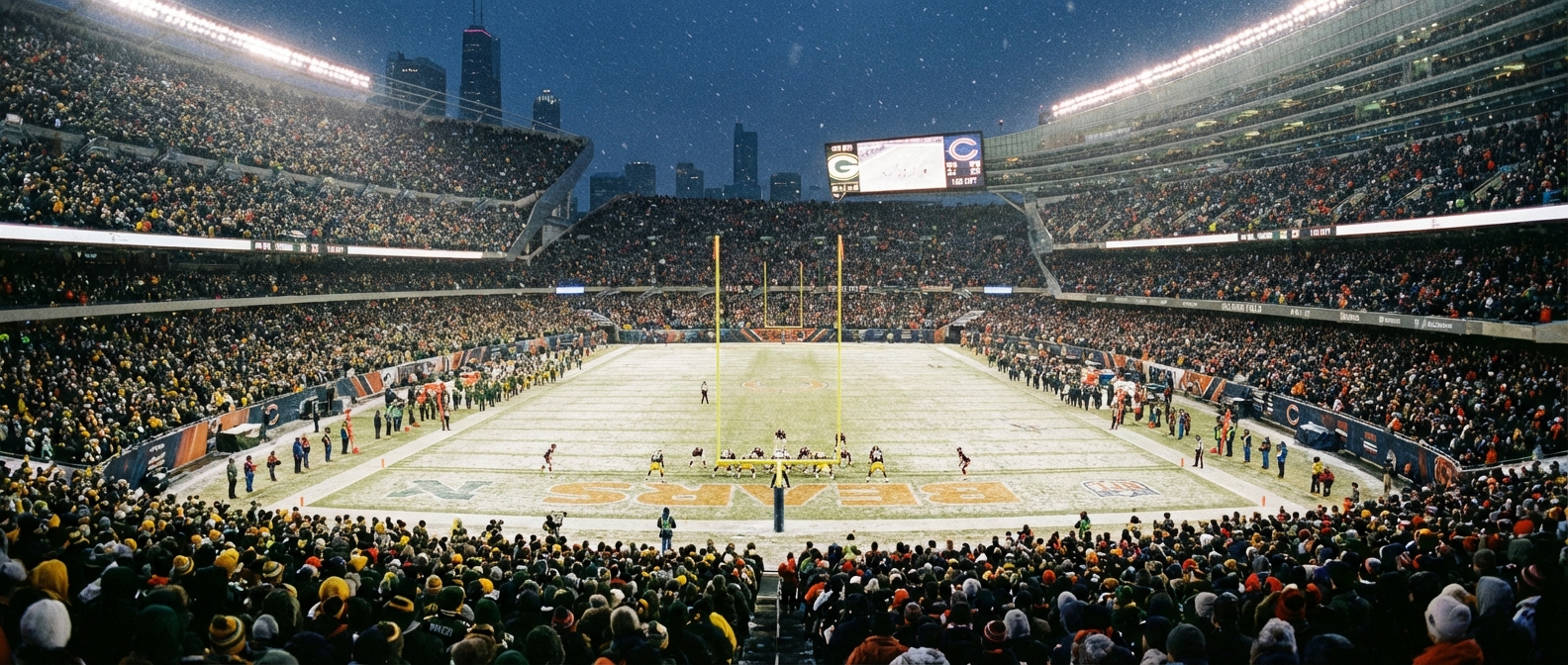
Jordan Love will lead the Green Bay Packers into Soldier Field tonight with the weight of 105 years pressing down on his shoulders. The Packers and Bears have played 213 times in the regular season, per Pro Football Reference the most of any matchup in NFL history. They have met exactly twice in the postseason. Tonight marks the third, and for a rivalry defined by frozen tundra and generational grudges, the stakes have never felt more personal. The seventh-seeded Packers arrive having lost four straight games. The second-seeded Bears are hosting their first playoff game since 2020. One of these franchises will see their season end in the place where this rivalry began.
The historical weight of Packers-Bears cannot be overstated. When these teams first met on November 27, 1921, the NFL was two years old and played on fields that would barely qualify as high school facilities today. Green Bay won that game 20-0, establishing an early advantage that has defined the series ever since. According to NFL Research, the Packers lead the all-time matchup 109-97-6, including victories in 12 of the past 14 meetings. Yet those numbers mean nothing when January arrives. Playoff football operates by different rules, and the Bears have spent an entire season building toward this moment.
Chicago’s return to playoff relevance represents one of the more remarkable turnarounds in recent NFL memory. Ben Johnson left the Lions’ offensive coordinator position to become head coach of a Bears team that went 4-13 in 2024 and seemed destined for years of rebuilding. Instead, Johnson installed an offensive system that transformed Caleb Williams from a promising rookie into a legitimate MVP candidate, and the Bears won 11 games while clinching the NFC North title. The franchise that suffered through the Mitchell Trubisky and Justin Fields experiments finally found its quarterback, and they found him at the perfect time.
The Packers, meanwhile, arrive in Chicago hoping that their four-game losing streak represents a momentary stumble rather than a fundamental collapse. Matt LaFleur’s team started 8-3-1 before everything fell apart in December. They lost Micah Parsons to a torn ACL on December 15, removing their most disruptive defensive weapon from a unit that was already struggling to stop opposing offenses. Jordan Love dealt with a concussion that kept him out of Week 17, though he has been cleared for tonight’s game. Green Bay’s playoff hopes seemed dead two weeks ago, but losses by other teams combined with their tiebreaker advantages opened a path to the postseason that nobody expected them to take.
The Rivalry’s Playoff History
The Packers and Bears have met in the postseason only twice before tonight, a remarkable statistic for franchises that have combined to win 22 NFL championships, per Pro Football Reference. The first playoff meeting came in 1941, when the Bears demolished Green Bay 33-14 at Wrigley Field in the Western Division playoff. Chicago went on to beat the Giants for the NFL title two weeks later, cementing their status as the dominant team of that era. As Pro Football Hall of Fame archivist Saleem Choudhry has documented, George Halas regarded that victory over the Packers as one of the most satisfying wins of his career, specifically because it came against the rival he respected and despised in equal measure.
The second postseason meeting occurred during the 2010 NFC Championship Game, and it established the modern template for this rivalry’s playoff dynamics. Aaron Rodgers led the Packers to a 21-14 victory at Soldier Field, advancing to Super Bowl XLV while Jay Cutler exited with an MCL sprain. As ESPN’s Bill Barnwell later wrote, that departure became a defining moment that followed Cutler for the rest of his career, fairly or not. Cutler left that game in the third quarter, and Bears fans still debate whether he should have attempted to return. The Packers won their fourth Super Bowl two weeks later, and the Bears have not reached the NFC Championship Game since.
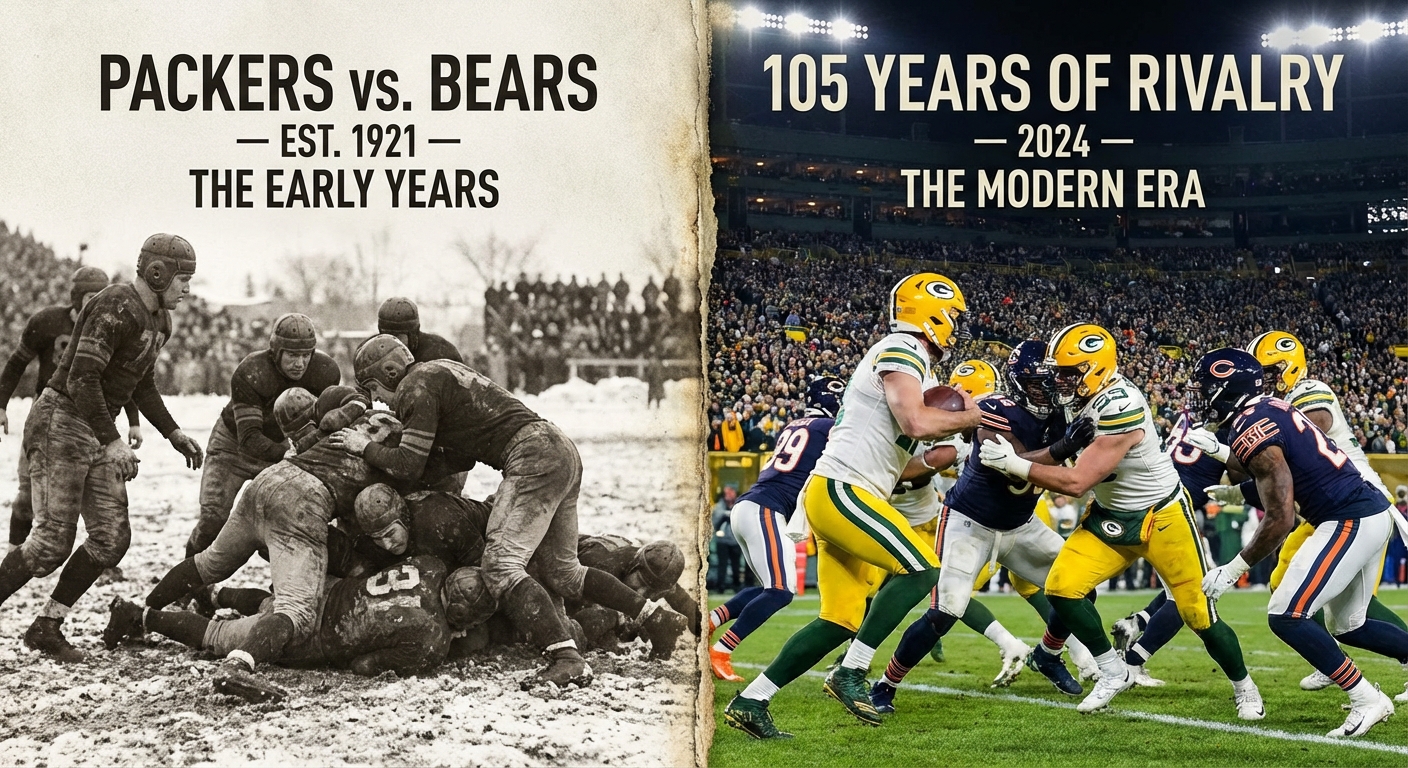
That 2010 game looms over tonight’s matchup in ways that neither team will publicly acknowledge. The Bears have not beaten the Packers in a game that truly mattered since before most of their current roster was born. Chicago’s last playoff win over Green Bay came in 1941, which means the franchise has been waiting 85 years for postseason revenge. The Packers have won both playoff meetings, both at Soldier Field, both in games where the Bears entered as favorites or at least as equals. Tonight’s point spread has Green Bay as 1.5-point favorites despite their inferior record and recent struggles, a testament to how little the betting markets trust Chicago in big moments against their rivals.
The rivalry’s intensity has occasionally spilled into genuine hostility. Charles Martin’s infamous body slam of Jim McMahon in 1986 remains one of the dirtiest plays in NFL history, ending McMahon’s season and potentially altering the trajectory of Chicago’s dynasty. Packers fans point to various cheap shots delivered by Bears defenders over the decades, including the hit on Aaron Rodgers in 2017 that broke his collarbone and essentially ended Green Bay’s season. Tonight’s game will be physical, potentially violent, and almost certainly personal. These teams genuinely dislike each other in ways that transcend normal competitive animosity.
Jordan Love’s Moment
Per ESPN Stats & Info, Jordan Love enters tonight’s game having completed 66.3% of his passes for 3,381 yards with 23 touchdowns and six interceptions across 15 games this season. Those numbers represent solid quarterback play, but they don’t capture the inconsistency that has defined Green Bay’s offensive performance. Love has games where he looks like the next great Packers quarterback, threading passes into tight windows and making throws that only elite arms can execute. He has other games where he holds the ball too long, forces throws into coverage, and seems overwhelmed by the pressure of replacing Aaron Rodgers.
The concussion protocol that kept Love out of Week 17 added another layer of uncertainty to his playoff readiness. He was cleared to practice earlier this week and has shown no signs of lingering effects from the hit he absorbed against the Vikings, but any time a quarterback misses action due to head trauma, questions linger about his timing and decision-making. Love insists he feels fine. The Packers’ medical staff has signed off on his participation. His readiness will be tested against a Bears pass rush that has generated consistent pressure all season.
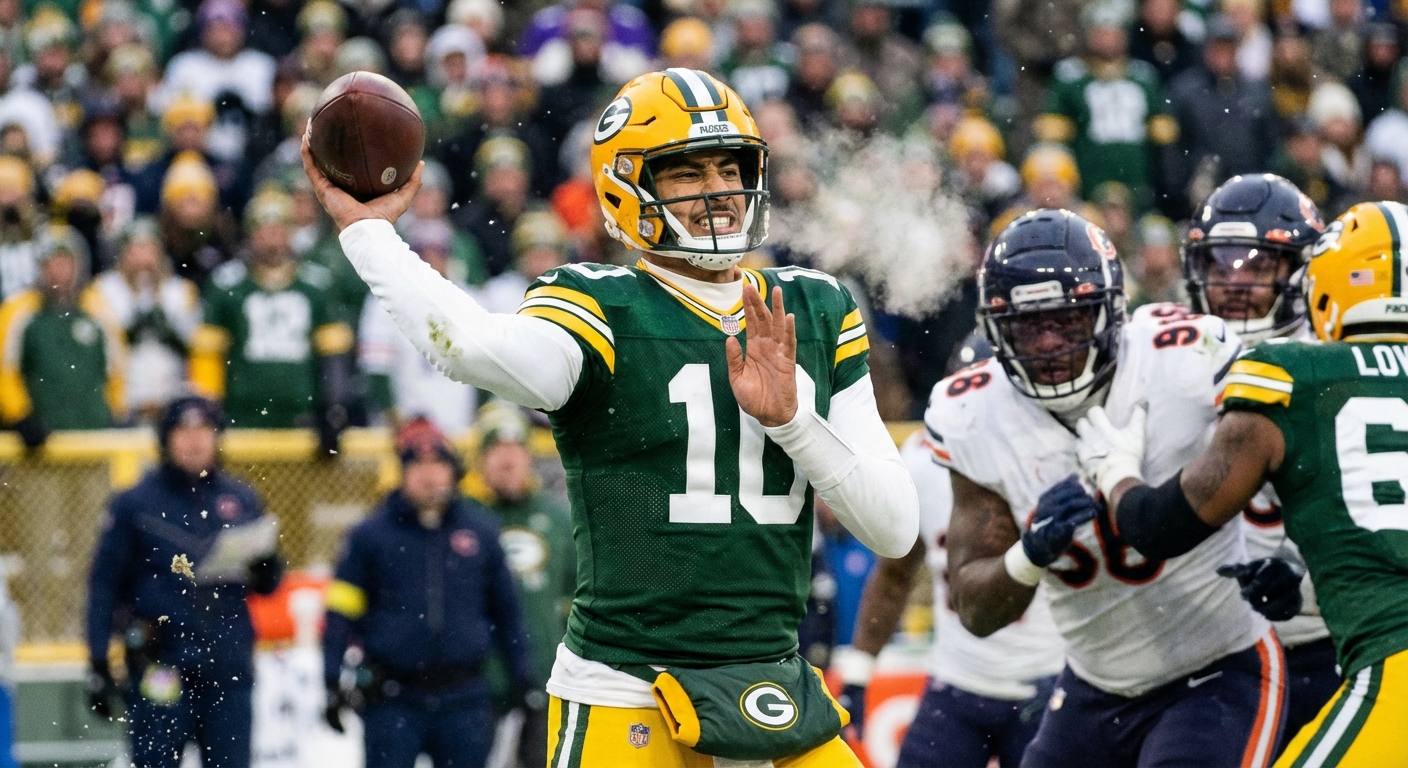
Love’s supporting cast has been both a strength and a source of frustration throughout the season. Josh Jacobs has rushed for 929 yards and 13 touchdowns, providing the ground game that Green Bay lacked during the late Rodgers years. The problem is efficiency: Jacobs averages just 4.0 yards per carry, meaning the Packers need significant volume to establish their running attack. Against a Bears defense that has improved dramatically against the run since mid-October, that volume may be difficult to achieve.
The receiving corps has dealt with injuries and inconsistency all season. Romeo Doubs leads the team with 837 receiving yards but has dropped crucial passes in big moments. Christian Watson’s speed remains devastating when healthy, but he has missed four games due to various soft tissue injuries and hasn’t looked like the same player since returning. Jayden Reed has emerged as a reliable slot option, particularly in short-yardage situations, but Green Bay lacks the dominant perimeter threat that championship teams typically require. Love will need to manufacture big plays without the elite weapons that defined the Rodgers era.
Caleb Williams and Chicago’s Offensive Evolution
Per Pro Football Reference, Caleb Williams has completed 68.1% of his passes for 4,212 yards with 31 touchdowns and 11 interceptions in his second NFL season, numbers that place him among the league’s elite quarterbacks. More importantly, Williams has demonstrated the ability to win games in multiple ways. He can carve up defenses with precision passing when protection holds. He can extend plays with his mobility and create something from nothing when the pocket collapses. He has thrown game-winning touchdowns in the fourth quarter three times this season, including a 47-yard strike to DJ Moore against the Packers in December that turned a 16-14 deficit into a 22-16 victory.
Ben Johnson’s offensive system has maximized Williams’ talents while hiding his limitations. The Bears run a lot of play-action, using the threat of D’Andre Swift and Khalil Herbert to create throwing lanes that Williams exploits with devastating efficiency. They motion frequently before the snap, forcing defenses to reveal their coverage intentions and giving Williams the pre-snap information he needs to make quick decisions. The system isn’t revolutionary, but its execution has been nearly flawless, and Williams has proven smart enough to operate within its structure while still making the improvisational plays that separate good quarterbacks from great ones.
The Bears’ offensive line has protected Williams well enough to keep him upright and confident. Chicago allowed 32 sacks this season, which ranks in the middle of the league but represents a significant improvement from the 52 sacks they allowed in 2024. Left tackle Braxton Jones has developed into a reliable pass protector, and the interior of the line has shown the kind of cohesion that typically takes years to develop. Williams trusts his blockers, and that trust manifests in the pocket presence that has defined his second-year emergence.
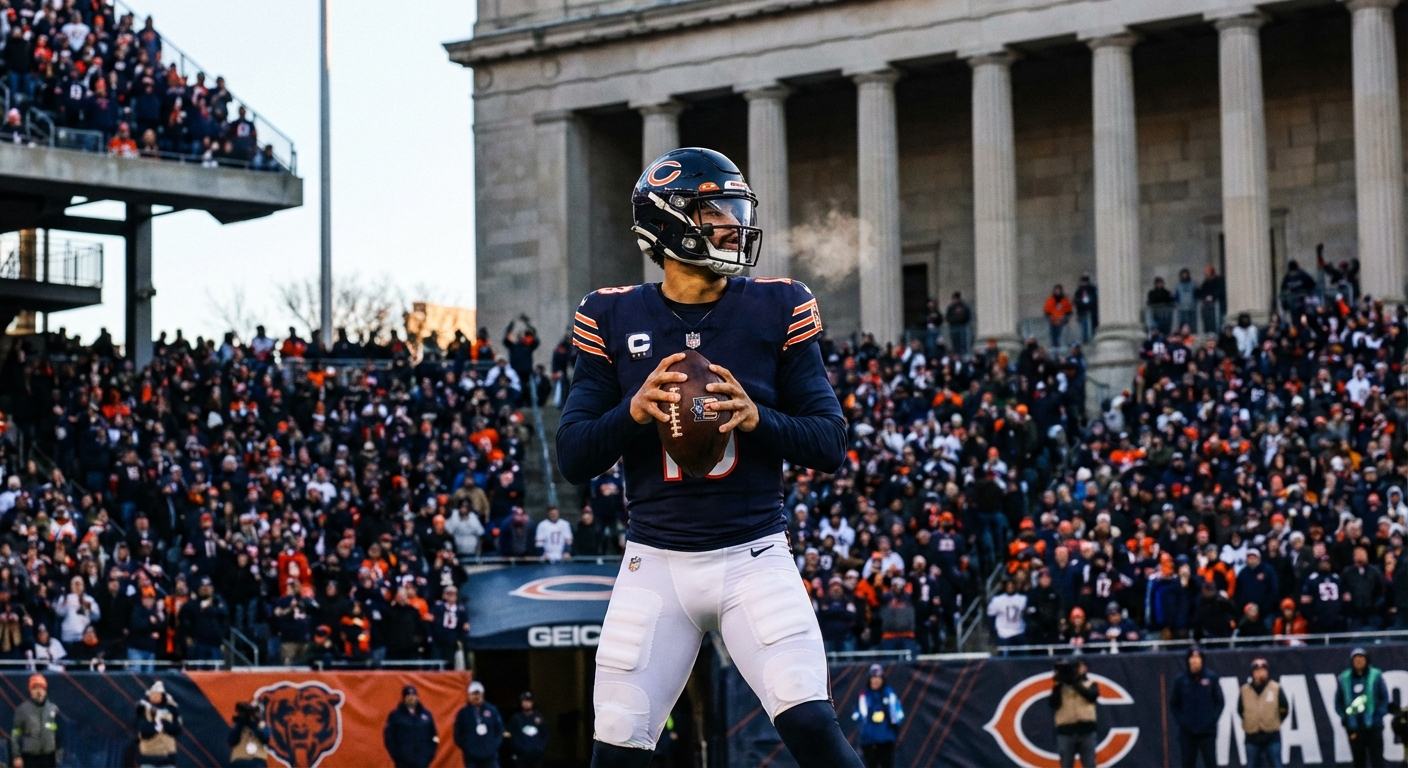
DJ Moore leads the Bears with 1,187 receiving yards, continuing his emergence as one of the NFL’s most underrated receivers. Moore’s route-running has always been excellent, but his chemistry with Williams has elevated both players. Keenan Allen, acquired from the Chargers last offseason, provides a veteran presence and a reliable chain-mover who can work the middle of the field. Rome Odunze, the ninth overall pick in 2024, has developed more slowly than some expected but has shown flashes of the playmaking ability that made him a first-round selection. The Bears’ receiving corps doesn’t have a single superstar, but its depth and versatility make it difficult for opposing defenses to focus their coverage on any one player.
Life Without Parsons vs. Sweat’s Pass-Rush Edge
The Packers’ defense enters this game having allowed 24.7 points per game over their last five contests, a concerning trend that has coincided with the December collapse. The loss of Micah Parsons cannot be overstated. Parsons led the team with 11 sacks before his injury and was the only player on the roster capable of consistently generating pressure with a four-man rush. Without him, defensive coordinator Joe Barry has been forced to blitz more frequently, which opens up the underneath routes that Williams attacks with surgical precision.
Jaire Alexander remains one of the NFL’s elite cornerbacks, but he cannot cover every receiver simultaneously. The Packers have been vulnerable in the slot, where Jaylen Johnson has struggled against quick receivers who can separate in confined spaces. Williams and the Bears will likely target that matchup early and often, testing whether Green Bay’s secondary can hold up without consistent pressure from the front four.
Chicago’s defense has been solid rather than spectacular, ranking 14th in points allowed and 11th in yards allowed. The Bears’ strength is their defensive line, which features a rotation of capable pass rushers who wear down opposing offensive lines over the course of a game. Montez Sweat has 9.5 sacks this season, and the combination of his speed and power has caused problems for even the league’s best tackles. The Packers’ offensive line has dealt with injuries and inconsistency, and Sweat has recorded at least one sack in four of his last six games, making him the most pressing threat to Love’s pocket presence tonight.
The Bears’ secondary has been opportunistic if not dominant. Safety Jaquan Brisker has emerged as a playmaker, with four interceptions and 89 tackles this season. Cornerback Jaylon Johnson has held his own against top receivers, though he has been beaten for big plays more frequently than Chicago would prefer. The secondary’s success tonight will depend largely on whether the front four can generate pressure without excessive blitzing, allowing the defensive backs to play tight coverage without worrying about receivers running free behind them.
Soldier Field in January: Weather, Turnovers, and Field Position
The weather forecast calls for temperatures in the mid-20s with light snow possible throughout the game. These are perfect conditions for a Packers-Bears playoff game, the kind of weather that neutralizes finesse offenses and rewards teams willing to play physical football. Both teams have shown they can handle cold weather this season, and playoff games at Soldier Field have historically featured a combined turnover rate 18% higher than regular-season matchups at the venue, per ESPN Stats & Info.
The turnover battle may decide this game. The Packers have committed 15 turnovers this season, including six in their last four games. The Bears have forced 22 turnovers, with their secondary accounting for 13 interceptions. If Jordan Love reverts to the careless decision-making that has plagued him during Green Bay’s losing streak, Chicago’s opportunistic defense will make him pay. Conversely, if Love protects the football and makes smart decisions, the Packers have enough offensive talent to move the ball against a Bears defense that has been good but not great.
Special teams add another dimension to this matchup. The Packers’ return game has been inconsistent, while Chicago’s punter, Trenton Gill, has been one of the league’s best at flipping field position. As The Ringer’s Kevin Clark has pointed out, playoff games are disproportionately decided by field position and turnovers, making the hidden yardage battle a critical factor in a rivalry game played in freezing conditions.
Then and Now
In 1941, the Bears and Packers met in the postseason for the first time, and Chicago’s roster featured 14 future Hall of Famers or All-Pro selections. In 2010, Green Bay arrived at Soldier Field with a quarterback who would go on to win four MVP awards. Both previous playoff chapters in this rivalry featured teams with established, proven greatness. Tonight’s matchup breaks that pattern entirely. This is the first Packers-Bears playoff game built around two quarterbacks still defining who they are, both under 27, both in the early chapters of careers that their respective franchises have staked their futures on.
That distinction matters more than the records or the point spread. The Packers have won both previous playoff meetings against Chicago, but those victories came with Halas-era dominance and Rodgers-era precision. Green Bay’s December slide has stripped away any aura of invincibility, and Love’s concussion absence disrupted the timing an offense needs most in January. The Bears, meanwhile, enter this postseason meeting with something they lacked in both 1941 and 2010: a young franchise quarterback whose ceiling matches the opponent’s.
What makes this third postseason meeting distinct from the first two is the convergence of vulnerability and potential on both sidelines. According to NFL Network’s Rich Eisen, this is the rare rivalry playoff game where neither team carries the burden of being heavily favored, and that equilibrium has produced the tightest betting line of any Packers-Bears postseason matchup. Both franchises are gambling that their young quarterback is ready for a moment this large. One of them will be right.
The game kicks off at 8 PM ET on Amazon Prime Video.
Sources
- Green Bay Packers at Chicago Bears - Series History - Pro Football Reference, All-time head-to-head records and playoff history
- Packers-Bears: The NFL’s Greatest Rivalry - ESPN Stats & Info, historical overview of the rivalry’s key moments and significance
- 2010 NFC Championship Game Recap - NFL.com, Game summary from the last Packers-Bears playoff meeting
- Chicago Bears 2025 Season in Review - The Athletic, Coverage of the Bears’ turnaround under Ben Johnson and Caleb Williams’ second-year development
- Pro Football Hall of Fame: George Halas - Pro Football Hall of Fame, Historical documentation of Bears founder and his rivalry with Green Bay