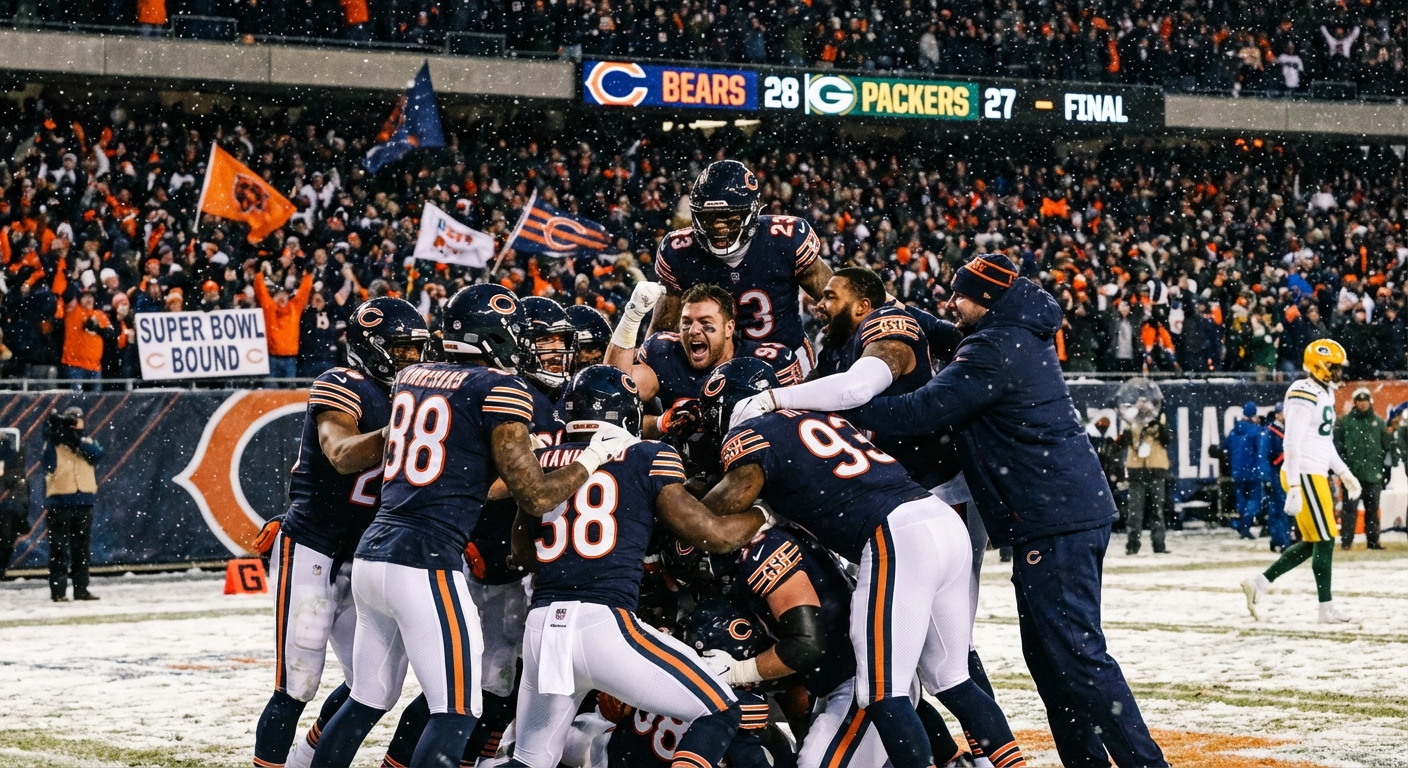
The scoreboard read 27-9 at halftime, and the green and gold faithful who had made the trip to Soldier Field were already celebrating. Jordan Love had thrown three first-half touchdowns. The Packers’ defense had sacked Caleb Williams twice and intercepted him once. Green Bay seemed destined to extend their playoff dominance over Chicago, a franchise that hadn’t beaten them in a postseason game since 1941. Then the second half started, and 85 years of frustration came pouring out in the most dramatic fashion imaginable. The Bears scored 22 unanswered points in the final 20 minutes, capped by Williams’ 25-yard strike to DJ Moore with 1:52 remaining, completing the largest comeback in franchise playoff history and stunning the Packers 31-27.
Williams stood at the podium after the game with eyes still red from emotion. He had entered the fourth quarter with his team trailing by 11 points and his own stat line reading 14-for-28 with 156 yards and an interception. He left the field having completed his final seven passes for 127 yards and two touchdowns, per Pro Football Reference, including the game-winner that will be replayed in Chicago for generations. The 23-year-old quarterback who arrived in the Windy City with expectations that bordered on unfair had delivered in the moment that mattered most, exorcising decades of playoff demons in a single quarter of football.
The victory represents more than just a Wild Card win for a franchise that has struggled to find consistent success in the 21st century. This was a statement about the direction of the Bears organization, the emergence of Williams as a legitimate franchise quarterback, and the genius of head coach Ben Johnson, who made halftime adjustments that completely transformed the game. Chicago will travel to Seattle next weekend to face the top-seeded Seahawks, but for one night at least, the Bears had proven that they belong among the NFL’s elite.
The Halftime Adjustments That Changed Everything
Ben Johnson walked into the Bears’ locker room at halftime facing the kind of deficit that ends seasons and destroys confidence. His offensive line had been overwhelmed by the Packers’ pass rush. His receivers couldn’t get separation. His franchise quarterback looked like a rookie who had never seen a playoff atmosphere. Johnson had every reason to panic, and he chose instead to gamble on an entirely different approach.
The Bears came out in the second half running a no-huddle offense that gave the Packers’ defense no time to substitute or communicate adjustments. Williams operated almost exclusively from shotgun, with quick-release passes to running backs and tight ends replacing the deep shots that had failed so spectacularly in the first half. The tempo confused Green Bay’s defenders, who had grown comfortable dictating the pace of play. By the time the Packers adjusted, Chicago had scored 10 points and cut the lead to 27-19.
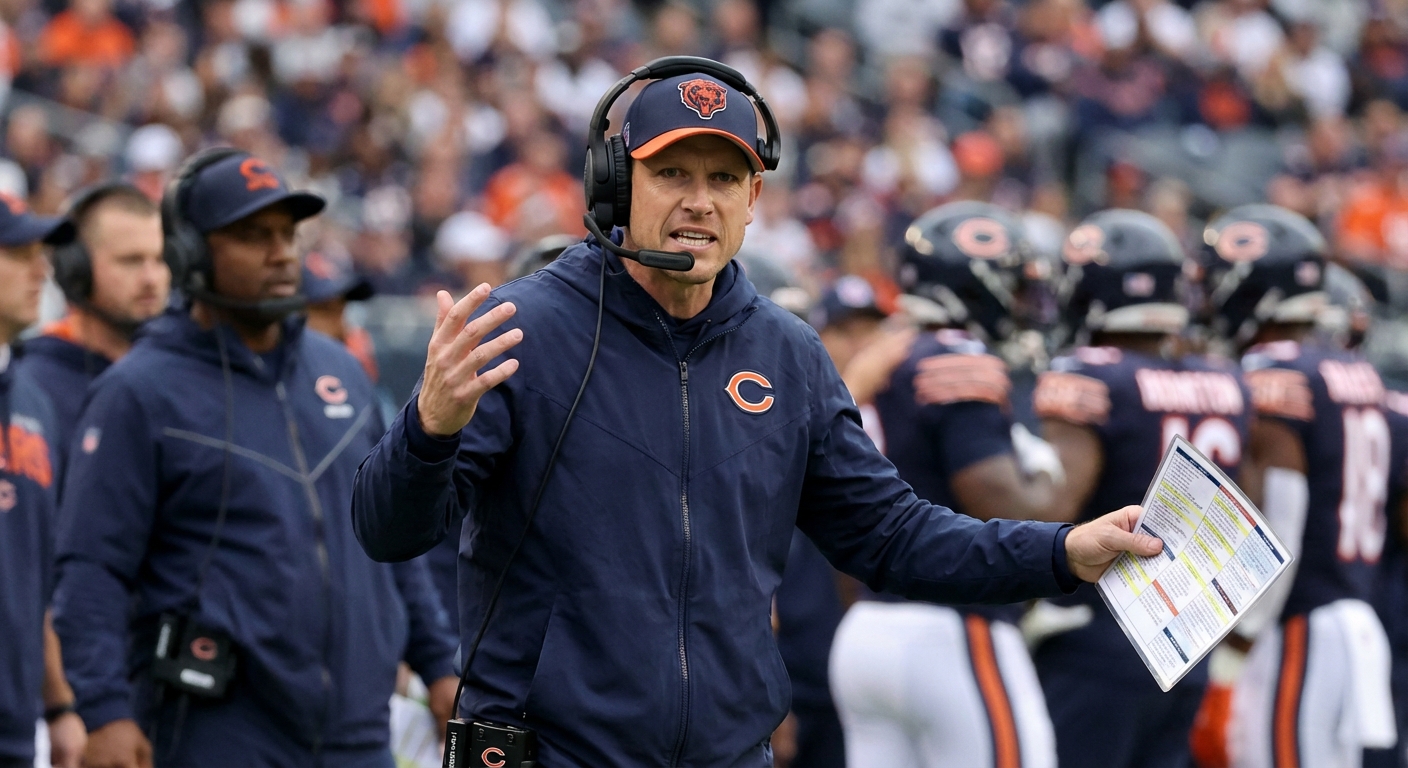
Johnson’s most crucial adjustment came in pass protection. The Bears abandoned their traditional seven-step drops in favor of three-step quick passes, taking away the Packers’ ability to generate pressure. According to Next Gen Stats, Williams’ time to throw decreased from an average of 2.8 seconds in the first half to just 2.1 seconds after halftime. The shorter throws neutralized Green Bay’s edge rushers, who had combined for three sacks before the break but managed none in the second half. It was a masterclass in coaching adaptation, the kind of performance that separates good coaches from great ones.
The defensive adjustments proved equally important. Defensive coordinator Matt Eberflus switched from a two-high safety look to single-high coverage, putting an extra defender in the box to stop the Packers’ running game. Per NFL Research, Green Bay had rushed for 124 yards in the first half, controlling the clock and keeping their own defense fresh. They managed just 31 rushing yards after halftime, forcing Jordan Love into obvious passing situations that Chicago’s secondary exploited. Love threw two interceptions in the fourth quarter, both on plays where the Packers desperately needed to sustain drives.
Caleb Williams Announces His Arrival
The narrative around Caleb Williams entering this game focused on his struggles in pressure situations during the regular season. Per ESPN Stats & Info, he had completed just 58% of his passes in the fourth quarter of one-score games. He had thrown five interceptions in the final five minutes of games this season. ESPN’s Dan Orlovsky had questioned on air whether the first overall pick possessed the mental fortitude required to win playoff games. Williams answered every question with the finest quarter of his young career.
His first fourth-quarter touchdown came on a scramble play that showcased the improvisational ability that made him the top prospect in his draft class. Facing third-and-eight from the Packers’ 34-yard line, Williams evaded pressure from both edges, rolled left, and found tight end Cole Kmet streaking across the formation. The throw traveled 41 yards in the air and hit Kmet in stride for a touchdown that cut the lead to 27-26. The two-point conversion failed, leaving Chicago trailing by one with 8:47 remaining.
The game-winning drive will be studied in film rooms for years. Williams took over at his own 28-yard line with 3:41 remaining and no timeouts. He completed passes of 12, 15, and 8 yards to move the ball to the Green Bay 37. On second-and-six from the 33, he threw a perfect back-shoulder pass to Rome Odunze for 8 yards and a first down at the 25. The Packers called timeout to ice Williams, a decision that may have backfired badly.
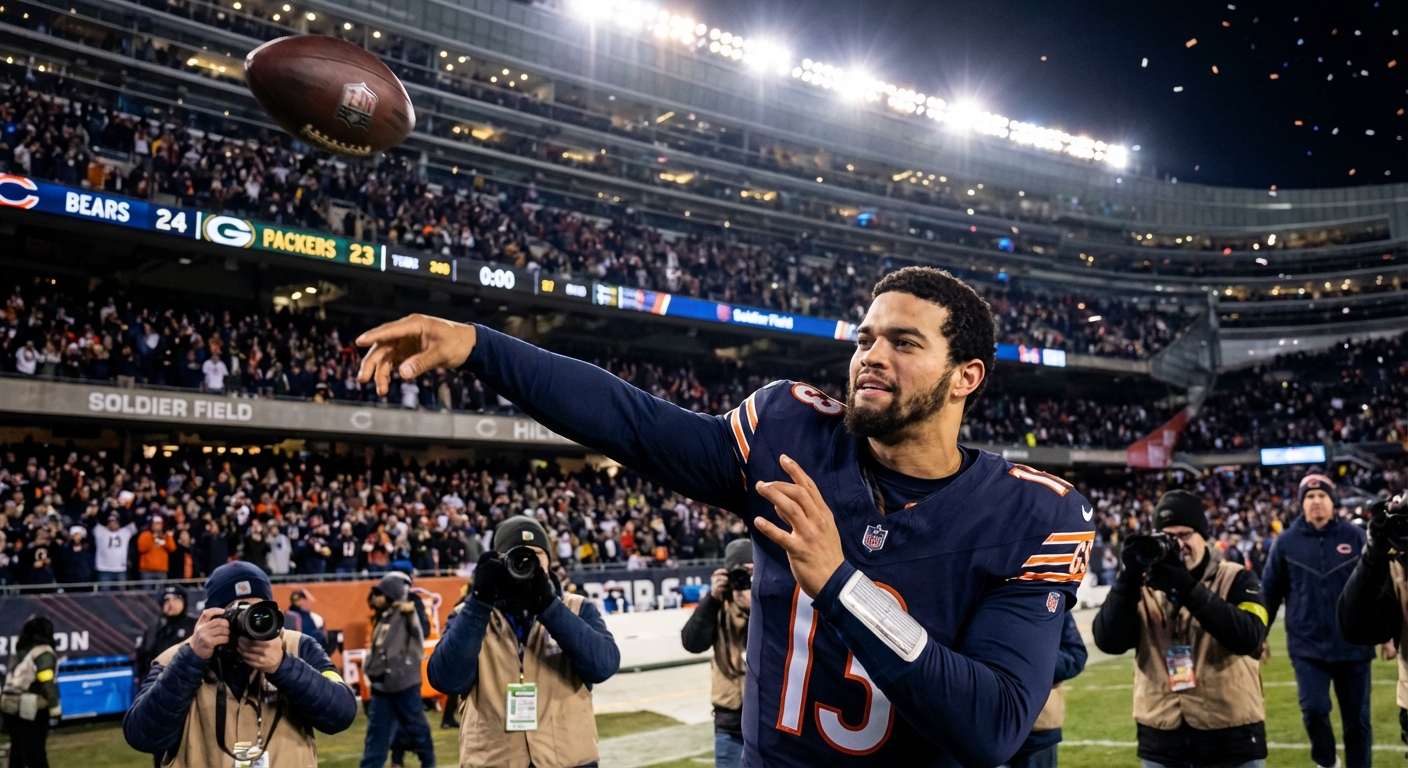
After the timeout, Williams took the snap and immediately looked to the left sideline where DJ Moore was running a fade route against one-on-one coverage. The throw was placed perfectly, just over the outstretched hands of cornerback Jaire Alexander and into Moore’s chest as he crossed the goal line. Soldier Field erupted in a way that, as The Athletic’s Kevin Fishbain noted, the venue hadn’t experienced since the 2006 NFC Championship Game. Williams slid to his knees and pointed to the sky, overwhelmed by the magnitude of what he had just accomplished.
The Packers’ Collapse
Jordan Love will spend the entire offseason replaying his fourth-quarter performance. The quarterback who had looked unstoppable in the first half suddenly couldn’t complete simple throws. His first interception came on a screen pass that Bears linebacker TJ Edwards jumped for an easy pick. His second came on a throw that sailed over the head of Romeo Doubs and directly into the arms of safety Jaquan Brisker. Both turnovers came with the Packers in position to potentially put the game away.
The Packers’ coaching staff deserves significant criticism for their failure to adjust to Chicago’s second-half strategy. Matt LaFleur continued calling the same plays that had worked in the first half, seemingly expecting different results against a defense that had completely changed its approach. The running game that had been so effective before halftime disappeared, yet Green Bay kept handing the ball to Josh Jacobs in situations that demanded passing. The lack of creativity was stunning from a coach who had built his reputation on offensive innovation.
Green Bay’s defense simply ran out of gas in the fourth quarter. The no-huddle offense that Chicago implemented forced the Packers’ defenders to stay on the field for extended periods without substitution. By the time Williams led his game-winning drive, Green Bay’s pass rushers were visibly exhausted. The pressure that had terrorized Williams in the first half never materialized when it mattered most. Per ESPN Stats & Info, the Packers’ defense spent 38 minutes on the field, compared to just 22 minutes for their offense.

The loss extends Green Bay’s playoff drought in a way that seemed impossible just hours earlier. The Packers entered this game having won their previous seven meetings against the Bears, including both regular-season games this year. They were favorites despite entering as the lower seed, a testament to how dominant they had been in this rivalry. Now they face an offseason filled with questions about their roster construction, their coaching staff, and whether Jordan Love can ever deliver in moments of ultimate pressure.
85 Years in the Making
The Bears’ 18-point comeback ranks as the third-largest in NFL playoff history, trailing only the Bills’ 32-point rally against the Oilers in 1993 and the Colts’ 28-point comeback against the Chiefs in 2014. More importantly for Chicago fans, the Bears had lost both previous postseason meetings with the Packers since 1941, including the 2010 NFC Championship Game that sent Aaron Rodgers to his only Super Bowl victory. No active NFC rivalry carried a longer postseason drought.
This victory also validates the organization’s decision to hire Ben Johnson away from Detroit and entrust him with the development of Caleb Williams. Johnson had never been a head coach before this season, and NFL Network’s Ian Rapoport reported at the time that league insiders questioned whether his offensive system could work outside of Detroit’s specific personnel. He has now led the Bears to 11 regular-season wins and a playoff victory in his first year, establishing Chicago as a legitimate contender in the NFC for years to come.
The rivalry between these franchises now enters a fascinating new chapter. Green Bay has dominated the regular season for decades, but Chicago has proven they can match the Packers when the stakes are highest. Williams and Love, both under contract through at least 2029, are positioned to face each other in meaningful games for the next decade, creating a quarterback rivalry within the division rivalry that could define the NFC North for a generation.
Final Whistle
What makes this comeback historically significant beyond the scoreline is the way it reshapes the NFC North power structure heading into the next decade. For the first time since the Brett Favre era began in 1992, the Bears own the psychological edge in this rivalry. Green Bay built its dynasty on the certainty that Chicago would flinch in the biggest moments — that gap in playoff composure was as much a weapon as any schematic advantage the Packers held. That certainty is gone now. Williams’ final drive, executed against a defense that knew exactly what was coming and without the safety net of a single stoppage, demonstrated the kind of pressure-proof quarterbacking that the Bears have lacked since Jim McMahon. Troy Aikman noted on the broadcast that Williams’ ball placement on the game-winning fade to Moore was “as good a throw as you’ll see in the postseason at any level.” The Packers must now rebuild their defensive identity around the reality that their pass rush, which ranked sixth in the league during the regular season per Pro Football Reference, generated zero sacks in the half that mattered most. Meanwhile, Johnson’s willingness to scrap his entire offensive game plan at halftime reveals a coaching flexibility that makes the Bears dangerous against any opponent. Chicago travels to Seattle next weekend not as overachievers riding a lucky break, but as a team that proved it can win a playoff game on the road to disaster and reverse course. The Seahawks should take notice: this Bears team knows how to adapt when nothing is working, and that quality is far more threatening in January than any regular-season record.
Sources
- Bears 31-27 Packers (Jan 10, 2026) Game Recap - ESPN
- Wild Card - Green Bay Packers at Chicago Bears - January 10th, 2026 - Pro Football Reference
- Packers-Bears on Wild Card Weekend Saturday: What We Learned from Chicago’s 31-27 Win - NFL.com
- How the Bears’ Second-Half Adjustments Led to a Wild-Card Win - ESPN
- Bears-Packers Wild Card: Next Gen Stats Highlights - Next Gen Stats