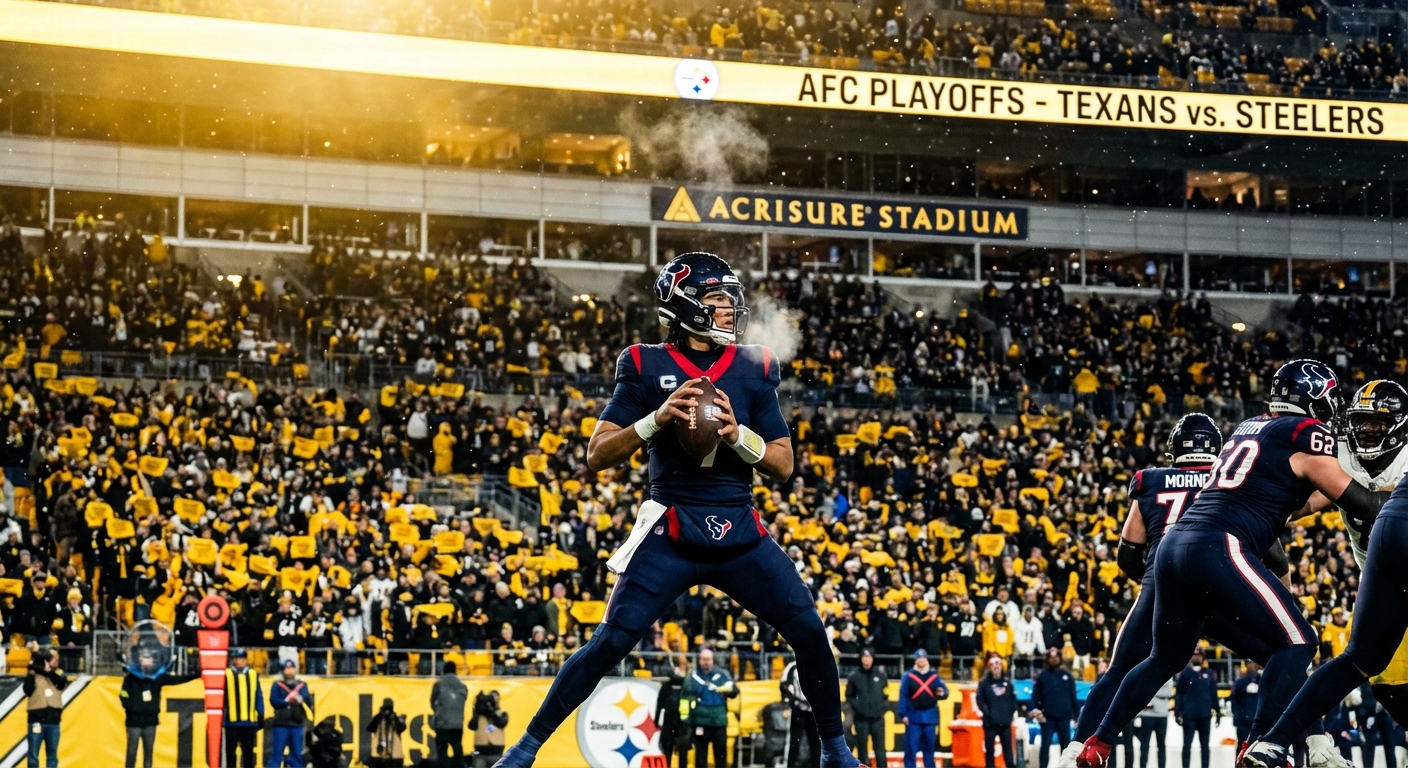
C.J. Stroud has won a playoff game in each of his first two NFL seasons. Only three quarterbacks in the Super Bowl era have accomplished that feat and extended it to three consecutive years: Russell Wilson, Joe Flacco, and Otto Graham. Tonight at Acrisure Stadium, Stroud will attempt to join that exclusive club when the Houston Texans face the Pittsburgh Steelers in the final game of Wild Card Weekend. The 23-year-old who has already rewritten the Texans’ record books now has a chance to etch his name alongside some of the greatest postseason performers in NFL history. All he has to do is beat a Steelers franchise that hasn’t won a playoff game since January 2017.
The historical stakes for Stroud are remarkable, but they exist within a broader context that makes this matchup fascinating. Houston enters as the hottest team in football, having won nine consecutive games to close the regular season and transform from a young team learning to compete into a legitimate Super Bowl contender. Their defense, orchestrated by head coach DeMeco Ryans, finished the regular season ranked first in total defense and second in scoring defense. The Texans allow just 277.2 yards and 17.4 points per game, per Pro Football Reference. Those numbers would be impressive in any era. In today’s pass-happy NFL, they border on historic.
Pittsburgh presents an intriguing challenge precisely because of its contradictions. The Steelers finished 10-7 and claimed the AFC’s fourth seed, but their path to the playoffs featured more struggles than triumphs. They lost three of their final five regular-season games before rallying to win their last two and secure the division. Their defense, which was supposed to carry the team, finished 24th in passing yards allowed. Their offense ranks 21st in points per game. Yet here they are, hosting a playoff game, protected by a home-field advantage that has historically been among the most intimidating in professional sports.
The Texans’ Defensive Machine
DeMeco Ryans built his coaching philosophy around the belief that elite defense creates elite teams. His Houston defense has validated that belief in spectacular fashion. The Texans’ front seven generates pressure at a rate that disrupts even the most accomplished quarterbacks, led by Will Anderson Jr. and Danielle Hunter, whose combined 24.5 sacks represent the most productive edge-rushing tandem in the NFL this season. Anderson, in his second year, has developed into exactly the game-wrecking presence Houston envisioned when they selected him third overall in 2023. “Anderson is the most disruptive edge rusher in football right now,” PFF’s Sam Monson wrote in his postseason rankings. “He affects the game even when he doesn’t record a sack.”
The secondary complements the pass rush with coverage that gives quarterbacks nowhere to throw. Derek Stingley Jr. has emerged as one of the league’s premier cornerbacks, allowing a passer rating of just 62.3 when targeted this season, according to PFF. The safety tandem of Jalen Pitre and Calen Bullock provides both range and physicality, turning contested catches into turnovers and limiting the explosive plays that have defined the modern passing game. Houston’s defense forced 28 turnovers during the regular season, converting opponent mistakes into short fields for their offense.
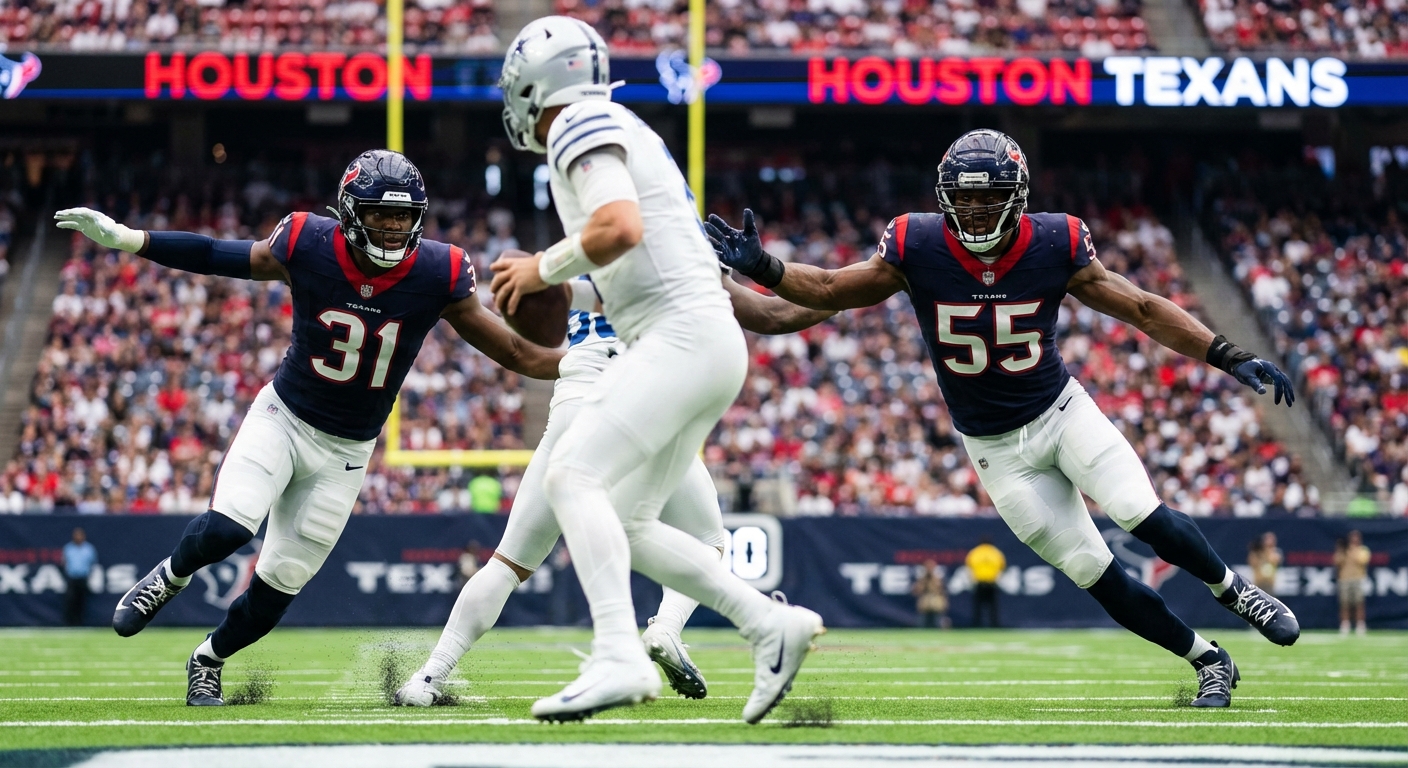
The statistical dominance extends to situational football, where Houston has been particularly suffocating. On third down, the Texans allow conversions just 32.4% of the time, the second-lowest rate in the NFL. In the red zone, opponents score touchdowns on only 44.8% of their trips inside the 20-yard line. These numbers reflect a defense that bends reluctantly and breaks rarely, the kind of unit that can carry a team deep into January regardless of what happens on the other side of the ball.
Ryans has implemented a system that maximizes his players’ strengths while disguising their responsibilities. The Texans frequently show one coverage before the snap and rotate into another after the ball is released, creating confusion for quarterbacks trying to read their progressions. This schematic complexity, combined with the individual talent across all three levels of the defense, has made Houston one of the most difficult pre-snap reads for opposing quarterbacks this season.
Stroud’s Outdoor Challenge
The concerns about C.J. Stroud entering this game center on a statistical anomaly that has defined his young career. Stroud has been demonstrably worse when playing outdoor games compared to the controlled environment of NRG Stadium’s retractable roof. His completion percentage drops from 66% indoors to 61% outdoors, per Next Gen Stats. His passer rating falls from 101.4 to 85.5. His yards per game decline from 259 to 199.6. These are significant differences that suggest environmental factors affect his performance.
The question is whether these numbers reflect a genuine limitation or simply statistical noise in a small sample size. Stroud played just six outdoor games this season, and two of those came in particularly difficult weather conditions. His worst outdoor performance, a 168-yard effort against the Jets, occurred during a driving rainstorm that affected both offenses. Removing that game from the sample makes his outdoor numbers look considerably more normal.
Tonight’s forecast calls for temperatures in the low 30s with calm winds and no precipitation. These are cold but manageable conditions, the kind of January weather that defines playoff football in the AFC North. Stroud will need to prove that he can deliver accurate passes when his fingers are numb and his breath is visible, challenges that quarterbacks like Tom Brady, Peyton Manning, and Patrick Mahomes have all faced and overcome on their paths to championship glory.
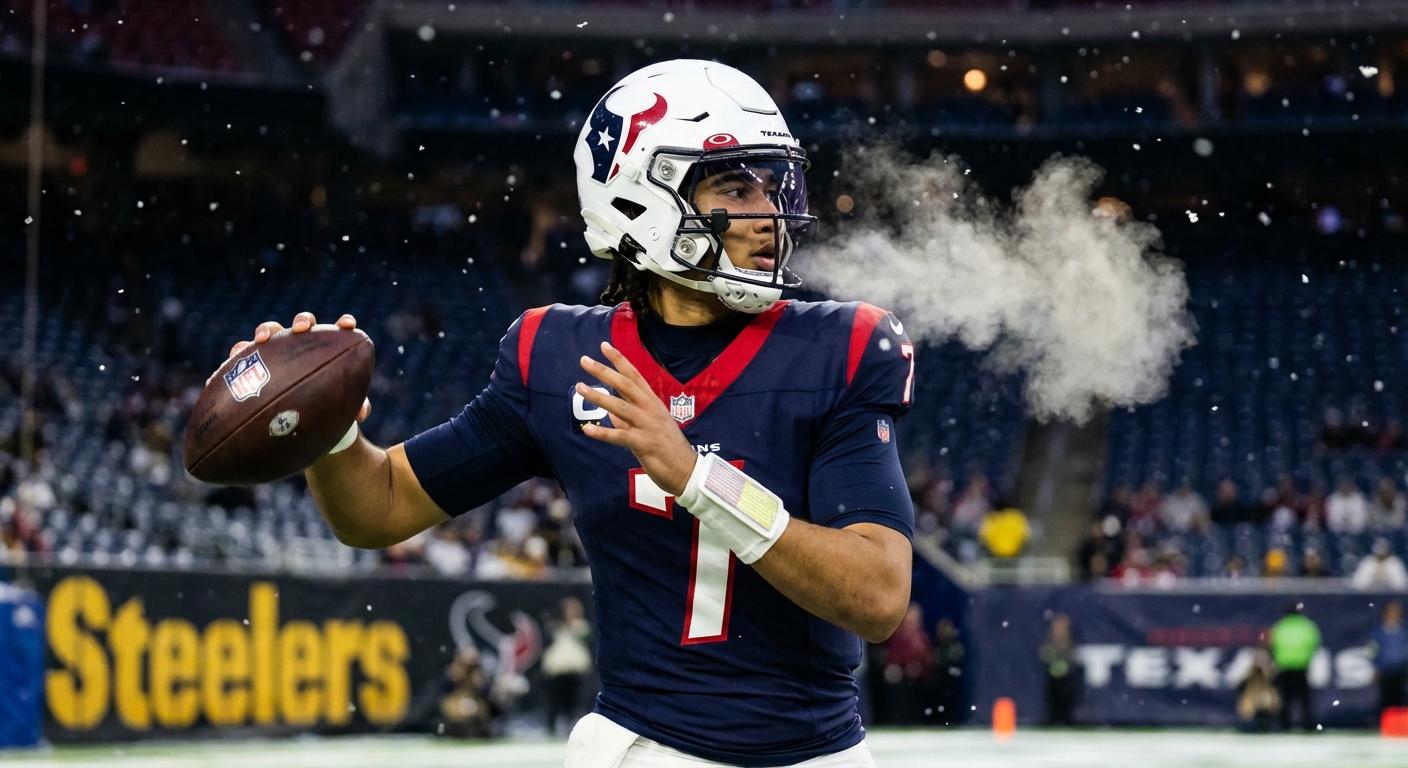
Houston’s coaching staff has spent the week preparing Stroud for the conditions he’ll face. They’ve practiced outdoors despite having access to indoor facilities. They’ve used refrigerated footballs to simulate the feel of a cold ball. They’ve studied film of Stroud’s best outdoor performances to reinforce the mechanical adjustments that work in adverse conditions. The preparation has been thorough, but preparation can only do so much. At some point, Stroud will need to step into the moment and deliver.
Pittsburgh’s Playoff Drought
The Steelers haven’t won a playoff game since January 15, 2017, when they defeated the Kansas City Chiefs 18-16 in the Divisional Round. Since then, they’ve lost five consecutive postseason games, including a particularly brutal 48-37 defeat to the Browns in 2021 and a 31-17 loss to the Bills last January. For a franchise that has won six Super Bowls and prides itself on postseason success, this drought has become an organizational embarrassment.
Russell Wilson was supposed to end the drought. The Steelers brought in the nine-time Pro Bowler specifically because of his playoff pedigree, his experience in pressure situations, and his ability to elevate his game when the stakes increase. Wilson won a Super Bowl with Seattle and nearly won another. He’s played in 18 playoff games and won 10 of them. His 33 postseason touchdown passes rank seventh in NFL history. Pittsburgh’s front office believed that experience would translate into January success.
The reality has been more complicated. Wilson turned 36 in November, and while he’s had stretches of excellent play this season, he’s also shown moments that suggest his best football is behind him. His mobility has decreased noticeably over the past two years. His deep ball accuracy, once his greatest weapon, has become inconsistent. He threw for 3,342 yards and 24 touchdowns during the regular season, respectable numbers that nonetheless represent his lowest totals since 2019.
The Steelers’ path to victory tonight depends on Wilson rediscovering the magic that defined his prime. They need the Russell Wilson who threw for 1,200 yards and 10 touchdowns during Seattle’s Super Bowl XLVIII run. They need the quarterback who orchestrated a 15-play, 80-yard drive in Super Bowl XLIX, nearly completing one of the greatest comebacks in championship game history. ESPN’s Dan Orlovsky noted on NFL Countdown that Wilson “still has the arm talent, but his internal clock has slowed down, and against a defense like Houston’s, that’s the difference between a completion and a sack.” Whether that version of Wilson still exists remains the central question of Pittsburgh’s playoff hopes.
Houston’s Pass Rush vs. Pittsburgh’s Offensive Line
The game within the game tonight pits Houston’s pass rush against Pittsburgh’s offensive line, and the advantage belongs decisively to the Texans. The Steelers allowed 45 sacks during the regular season, the seventh-highest total in the NFL per Pro Football Reference, despite Wilson’s relatively quick release. Their interior offensive line has been particularly vulnerable, with center Zach Frazier and guards Isaac Seumalo and James Daniels all struggling to handle powerful interior rushers.
Houston will exploit this weakness aggressively. Defensive coordinator Matt Burke has shown a willingness to blitz from unexpected angles, bringing safeties and linebackers on delayed rushes that create confusion for offensive lines trying to identify their assignments. The Texans recorded at least three sacks in 12 of their 17 regular-season games. They’ve held opponents below 17 points in nine of those games. When the pass rush dominates, everything else falls into place.
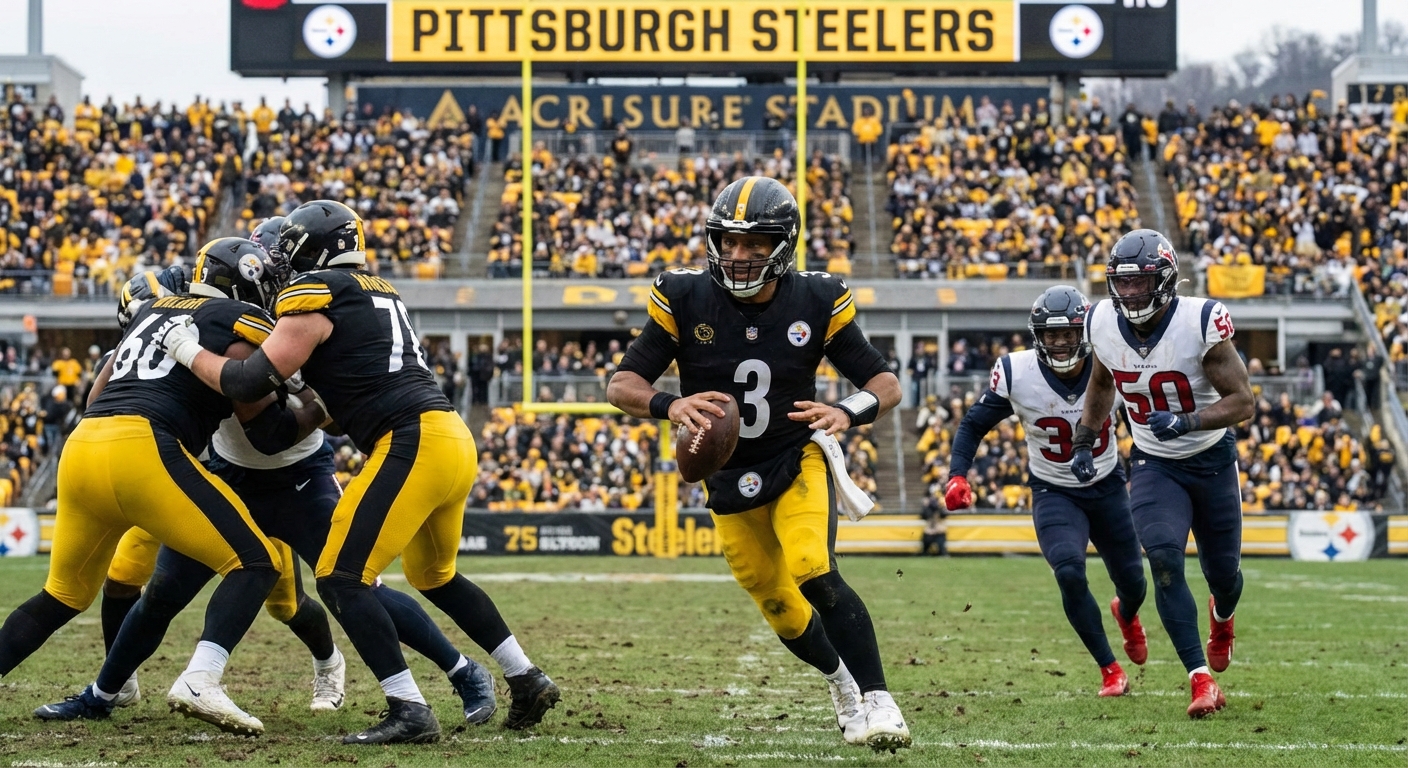
Pittsburgh’s counter-strategy involves quick passes and screens designed to neutralize Houston’s pass rush by getting the ball out before pressure can arrive. The Steelers have the receivers to make this work. George Pickens has developed into a genuine number-one target, using his 6-foot-3 frame and contested-catch ability to win on short and intermediate routes. Pat Freiermuth provides a reliable option in the middle of the field. Najee Harris can turn dump-offs into significant gains when given space to operate.
The question is whether Wilson can execute this strategy consistently against a defense that disguises its coverages as effectively as Houston’s. The Texans excel at baiting quarterbacks into throws that look open but aren’t, using late rotations to close passing windows that appeared clear before the snap. Wilson’s experience should help him recognize these disguises, but as NFL Network’s Daniel Jeremiah observed, “recognition and execution are different things when you’re 36 years old and facing the best defense you’ve seen all season.”
Stroud’s Chase for a Three-Peat Record
Beyond the immediate playoff implications, tonight’s game carries historical weight. A Texans victory would place Stroud in that exclusive club of quarterbacks who won playoff games in each of their first three seasons, a distinction only three others have achieved. These are not just good quarterbacks but franchise-defining talents who established themselves as winners from the moment they entered the league.
Stroud’s trajectory has already exceeded reasonable expectations. He was the Offensive Rookie of the Year in 2023 after throwing for 4,108 yards, at the time the fourth-most by a rookie in NFL history. He led the Texans to the playoffs in his first season and won their first postseason game in four years. He has handled pressure, scrutiny, and the weight of a franchise’s hopes with remarkable poise for someone who turned 23 in October. Adding another playoff victory would cement his status as one of the game’s emerging superstars. “Stroud has the poise of a ten-year veteran and the arm talent of a generational prospect,” The Athletic’s Aaron Reiss wrote. “Houston hasn’t had a quarterback like this in franchise history.”
For Pittsburgh, the stakes are simpler but no less significant. Another playoff loss would extend a drought that has become defining for the franchise. It would raise questions about Russell Wilson’s future, about head coach Mike Tomlin’s postseason record, about whether this organization can still compete at the highest level. The Steelers have made the playoffs in five of the last six seasons without winning a single game. At some point, participation becomes meaningless. Tonight offers a chance to prove that this year is different.
The Prediction
Houston 27, Pittsburgh 13. The Texans dominate this game more convincingly than the 3-point spread suggests, and the margin comes down to one overlooked factor: Pittsburgh’s inability to sustain drives against Houston’s third-down defense. The Steelers converted third downs at just a 37.2% clip over their final five regular-season games, per ESPN Stats & Info, and Houston’s 32.4% third-down conversion rate allowed is built to exploit exactly that weakness. Wilson will face third-and-long situations repeatedly, and Houston’s pass rush will feast in those predictable passing downs.
Stroud adds his name to that short list of early-career postseason winners, and the manner of the victory matters as much as the result. The Texans will control time of possession by running Derrick Henry’s replacement Joe Mixon effectively in the cold, keeping their defense fresh and Pittsburgh’s offense off the field. This is a team built for January football, and Pittsburgh’s late-season regression exposed a roster that reached the playoffs on reputation more than performance.
The Steelers’ drought extends to nine years, and the offseason conversation in Pittsburgh shifts from “how do we win a playoff game” to “do we need a full rebuild.” Houston advances to the Divisional Round with the kind of suffocating defensive performance that puts the rest of the AFC on notice.
Sources
- Houston Texans 2025 Season Stats - Pro Football Reference
- Pittsburgh Steelers 2025 Season Stats - Pro Football Reference
- NFL Playoffs Wild Card Keys to Win: Ranking the 49ers, Bills, Chargers, Packers, Rams, Texans - ESPN
- NFL Pass-Rusher Rankings Ahead of Week 17 - PFF
- Steelers-Texans Scouting Report and Prediction: Will Postseason Drought Finally End? - Pittsburgh Post-Gazette