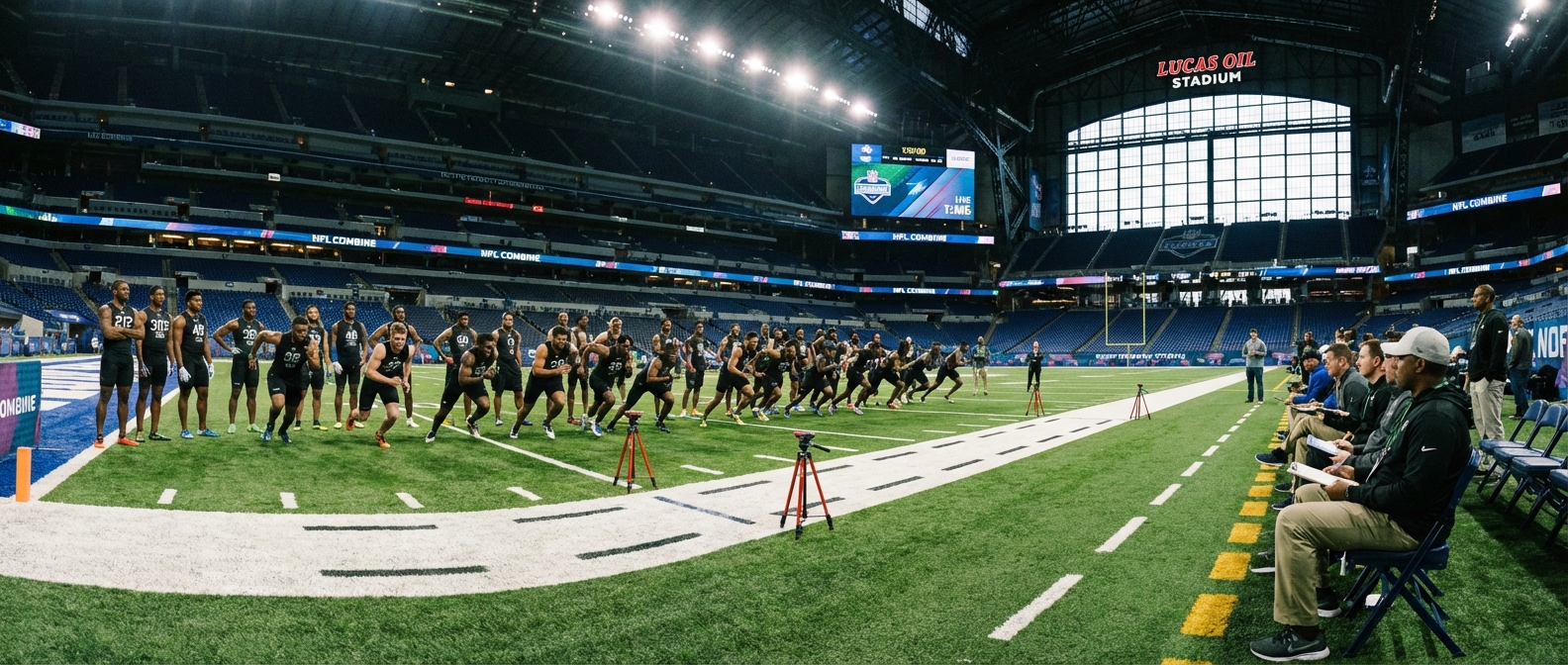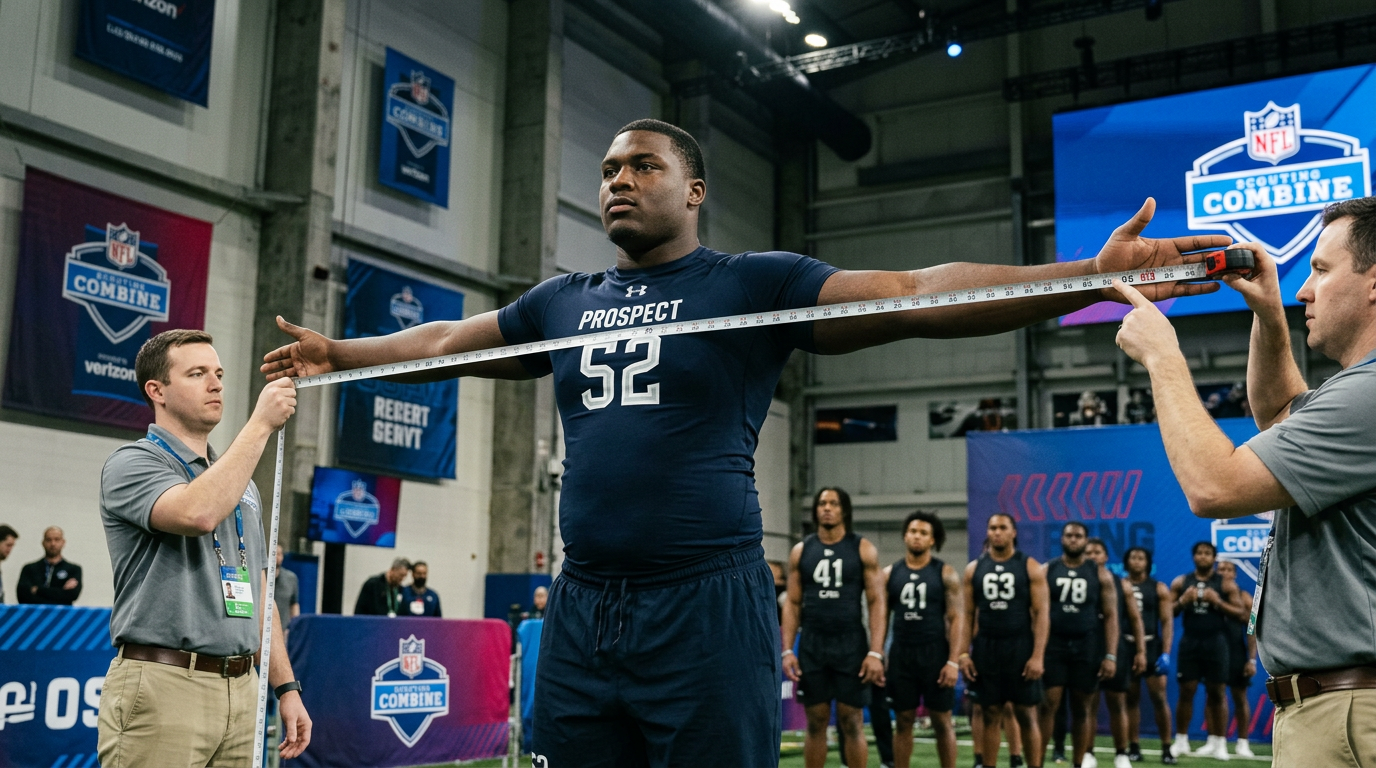
Caleb Banks walked to the measurement station at Lucas Oil Stadium, stretched his arms wide, and broke a record that had stood since the previous century. His wingspan, 85 and three-quarter inches, is the longest recorded by any defensive tackle at the NFL Scouting Combine since 1999. That translates to 7 feet, 1 and three-quarter inches from fingertip to fingertip, attached to a 6-foot-6, 327-pound frame with 35-inch arms and hands that measure 10 and seven-eighths inches. Every one of those numbers sits in the 89th percentile or higher among combine defensive linemen. Banks, the Florida defensive tackle who missed most of the 2025 season with a foot injury and entered Indianapolis as a borderline first-round projection, did not need to run a single drill to rewrite his draft stock. He just needed to stand still and let the tape measure do the talking.
The 2026 NFL Scouting Combine, running from February 23 through March 2, has already delivered the kind of measurement-day drama that separates this event from every other stop on the pre-draft circuit. With 319 prospects in attendance and on-field workouts beginning Thursday for defensive linemen and linebackers, the combine’s first few days have produced a record-setting wingspan, a consensus No. 1 pick who refuses to throw a football, and an edge rusher whose arm length has scouts arguing about whether production can override physical limitations. The biggest questions heading into Indianapolis are getting answered, and some of those answers are surprising.
The 85 and Three-Quarter-Inch Problem
Banks entered the combine as a prospect whose physical tools were understood in theory but had never been formally documented against the broader population of NFL defensive line prospects. The documentation was worth the wait. His 98th-percentile height, 89th-percentile weight, 94th-percentile arm length, 94th-percentile hand size, and 99th-percentile wingspan form a physical profile that looks like it was generated by an algorithm designed to build the ideal interior pass rusher. For context, only two players at any defensive position since 1999 have recorded longer wingspans at the combine: Pittsburgh offensive tackle Jaryd Jones-Smith in 2018 at 88.5 inches and Florida State defensive end Janarius Robinson in 2021 at 86.25 inches, per Yahoo Sports’ combine measurements tracker. Neither had a sustained NFL career, which is both a cautionary note and an illustration of why measurables alone don’t make a player.
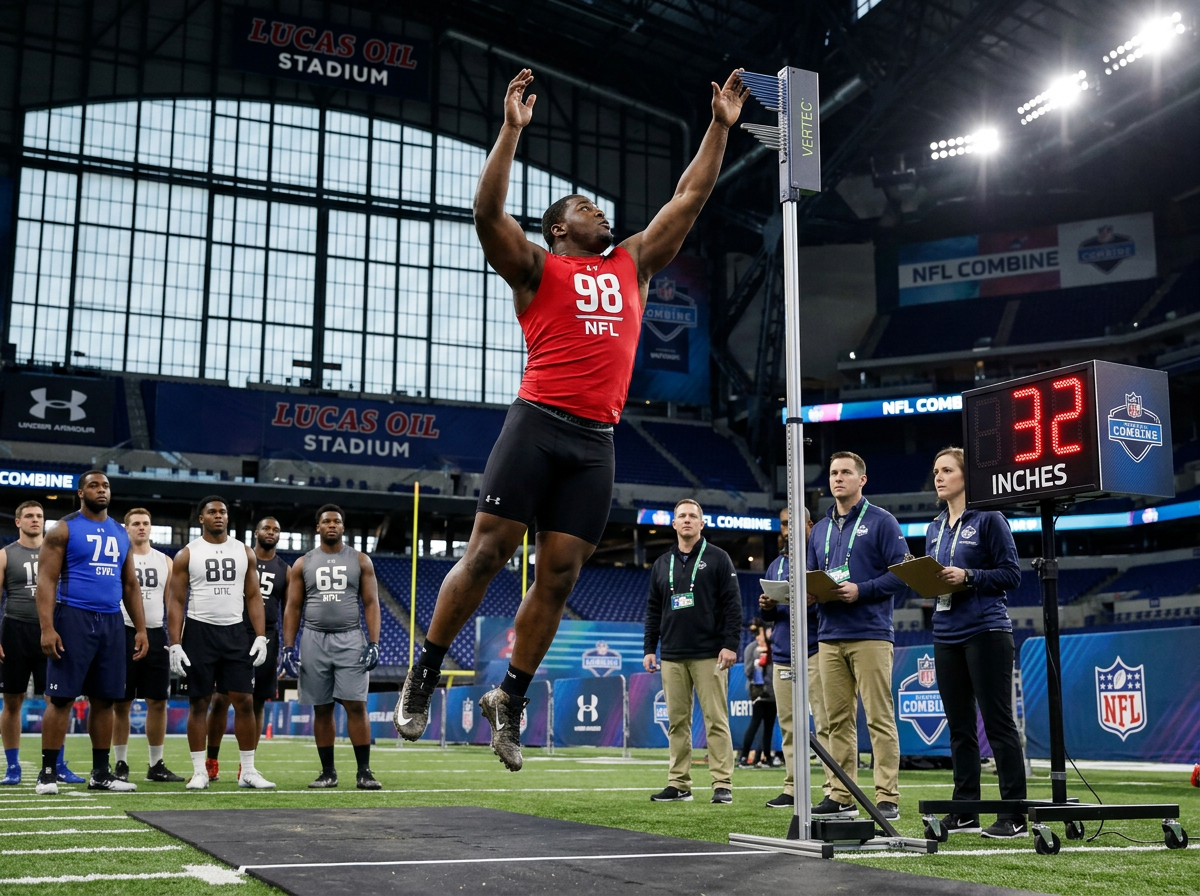
What makes Banks different from those historical comparisons is his athletic testing at that size. He ran a 5.05-second 40-yard dash and posted a 32-inch vertical jump at 327 pounds, per CBS Sports’ combine results tracker. Those are not elite numbers in isolation, but they are remarkable for a man of his dimensions. The vertical jump, in particular, suggests the kind of explosive hip power that translates to getting off the line of scrimmage against NFL guards. Banks knows what he has, and he is not shy about communicating it. When asked at his combine press conference what his main selling point to NFL teams was, Banks did not hedge. “I just put my head down and I just go run through a motherf***er’s face,” he told reporters, per SI.com.
The concern with Banks has always been consistency and health, not physical tools. He played in only three games during the 2025 season because of a foot injury, and his 2024 tape, while promising, showed a player who sometimes played too upright and disengaged poorly from blockers. ESPN’s pre-combine draft analysis maintained a first-round projection on Banks despite the limited recent tape, and the combine measurements explain why. Teams drafting interior defensive linemen are investing in physical potential as much as current production, and Banks’ physical potential is literally off the charts. His 21 tackles, seven tackles for loss, 4.5 sacks, and two forced fumbles in 2024 showed what happens when that frame is healthy and engaged.
Mendoza’s Calculated Silence
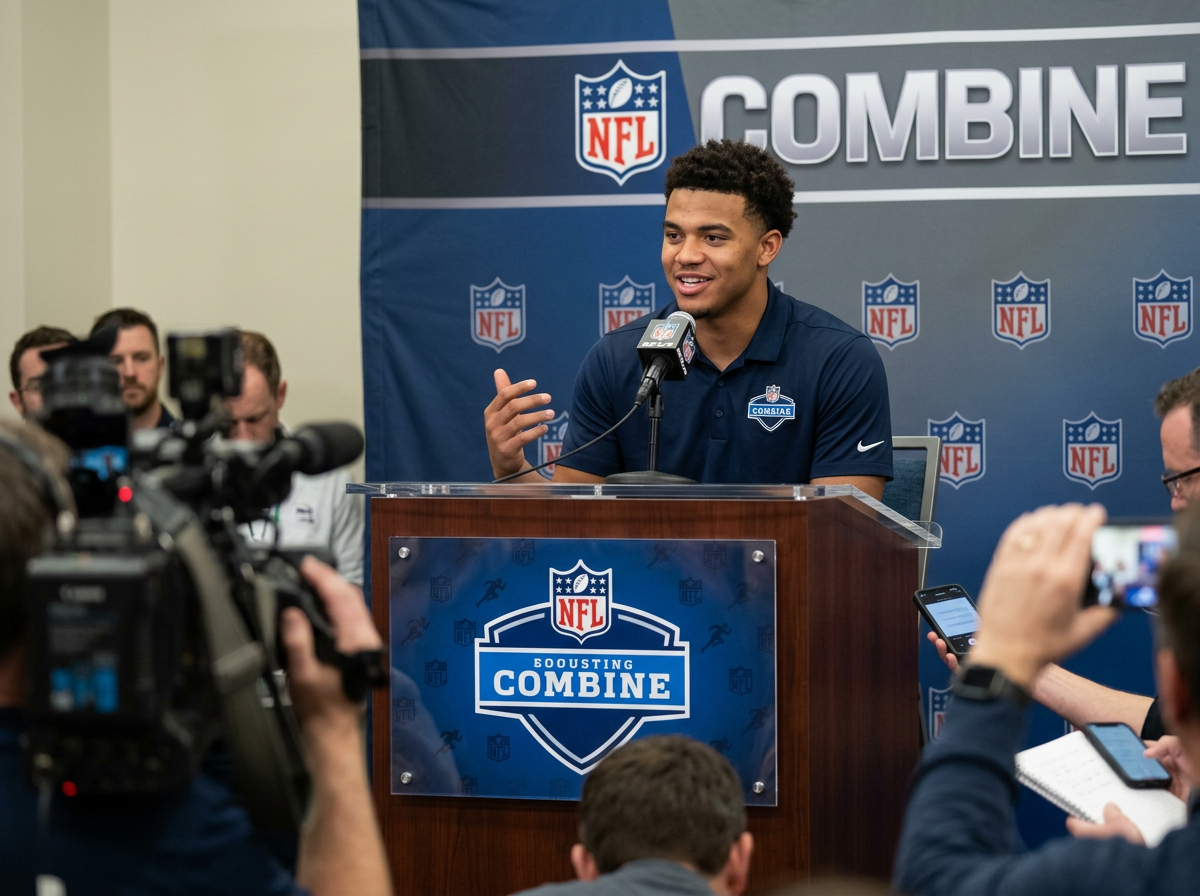
Fernando Mendoza, the Indiana quarterback and Heisman Trophy winner who is widely viewed as the most complete signal-caller to come through college football in years, confirmed what had been reported for weeks: he will not throw at the combine. He will instead wait for Indiana’s pro day on April 1, where he can work with his own receivers and his own playbook in a controlled environment. It is a decision rooted in confidence, not caution.
“At the combine, you’re throwing to different receivers, it’s a whole different thing,” Mendoza told reporters in Indianapolis, per ESPN’s Adam Schefter. “I want to throw at pro day with my guys, with my running backs and be there with the boys.” He added that the combine’s compressed schedule made throwing unnecessary for someone in his position: “I’m in a better position that I don’t gotta throw in a combine.”
The decision carries zero risk for Mendoza because his draft position is already settled. The Las Vegas Raiders, picking first overall, are expected to select him, and Raiders general manager John Spytek’s combine press conference did little to dispel that expectation. “It’s the hardest position to evaluate,” Spytek told reporters. “So much is required of those guys.” When asked what defines a franchise quarterback, Spytek described “a leader, tough as hell, somebody that loves to play football, maniacal preparer.” He did not name Mendoza, but the description reads like a scouting report on the Indiana quarterback.
NFL scouts and executives at the combine offered their own assessments of Mendoza’s game, even without seeing him throw. “He has poise in the pocket to stand and deliver, plus the mental aspect,” one NFL scout told FOX Sports. “He’s got all the NFL traits, none really that elite, but all together a very formidable package.” An NFL personnel executive was more specific, telling FOX Sports: “His best trait is his mind. He’s a pocket QB with quick eyes and a quick release. He processes coverage and pressure at a high rate. Good arm strength and excellent accuracy.” FOX Sports draft analyst Rob Rang compared Mendoza to Jared Goff, Matt Ryan, and Matt Hasselbeck, all cerebral quarterbacks who succeeded without elite arm strength or athleticism. The comparison is instructive: none of those quarterbacks needed a combine throwing session to prove what their tape already showed.
Bain’s Arms and the Measurement Debate
If Banks’ wingspan is the combine’s best measurement story, Rueben Bain Jr.’s arm length is its most concerning. The Miami edge rusher, widely considered the top pass rusher in the 2026 draft class, measured in with arms just 30 and seven-eighths inches long. That puts him in the first percentile among edge rushers since 2010, per Pro Football Network. Since 1999, only four edge rushers have measured in with shorter arms at the combine. The number matters because arm length for edge rushers correlates with the ability to keep blockers at distance, maintain leverage, and convert speed into quarterback pressure. Short arms mean offensive tackles can get into your chest more easily, neutralizing the speed and bend that make you effective on tape.
Bain also came in shorter and lighter than his Miami listed measurements, checking in at 6-foot-2 and a quarter and 263 pounds. ESPN’s Matt Miller noted the discrepancy, and the NFL world reacted with a mixture of concern and fascination. Pro Football Network described the measurement as “historical outlier territory.” But Bain, characteristically, was unbothered. “People keep bringing that up out of nowhere, but no teams brought it up to me, so I don’t bring it up either,” Bain told reporters at the combine, per NFL.com. “As long as I just talk the talk and walk the walk, play with technique, nobody actually cares about it.”
The argument for Bain despite the short arms is simple: production. His 2024 tape at Miami showed a player who consistently got inside of tackles’ bodies, used hand placement and leverage to compensate for his reach disadvantage, and generated pressure at an elite rate. He is the No. 4 player on PFN’s draft big board, behind only Caleb Downs, Arvell Reese, and Sonny Styles. The question is whether his production at the college level, where offensive tackles are less technically refined, will translate against NFL linemen who will be longer, stronger, and better coached. Bain’s arm length does not change his film. But it changes the risk calculation for a team investing a top-ten pick in him, and in a draft where the margin between the top tier and the second tier is wide, risk calculations matter enormously.
Thursday’s On-Field Fireworks
The on-field workouts for defensive linemen and linebackers began Thursday, and the early results confirmed what the measurement sessions suggested: this defensive class has legitimate depth. Penn State’s Zane Durant, a 6-foot-1, 290-pound defensive tackle, ran a 4.75-second 40-yard dash with a 1.66-second 10-yard split that led all defensive tackles, per Yahoo Sports’ live combine tracker. To put that speed in context, only three players weighing 290 pounds or more have run faster at the combine since 2005. Durant’s max speed hit 20.81 MPH, a number that is faster than Patrick Mahomes’ combine 40-yard dash (4.80 seconds) and Dak Prescott’s (4.79 seconds). A defensive tackle who can outrun NFL starting quarterbacks in a straight line is the kind of athletic profile that pushes a player up draft boards regardless of his tape.
Florida edge rusher George Gumbs Jr. added another data point to the Gators’ strong combine showing, posting a 41-inch vertical jump that leads all participants at the combine so far. That mark falls just half an inch short of tying the edge rusher combine record of 41.5 inches, set by Nolan Smith in 2023. At 6-foot-4 and 245 pounds, Gumbs is smaller than the prototypical NFL edge rusher, but explosive athleticism of that caliber forces evaluators to reconsider where a player’s ceiling actually sits. Oklahoma defensive tackle Gracen Halton posted a 36.5-inch vertical, the third-best ever recorded by a defensive tackle at the combine. Among edge rushers, UCF’s Malachi Lawrence and Wisconsin’s Mason Reiger both hit 40-inch verticals, and Penn State’s Dani Dennis-Sutton posted a 39.5-inch vertical along with a combine-leading 10-foot-11 broad jump.
What the Numbers Miss: Draft Strategy Beyond the Tape Measure
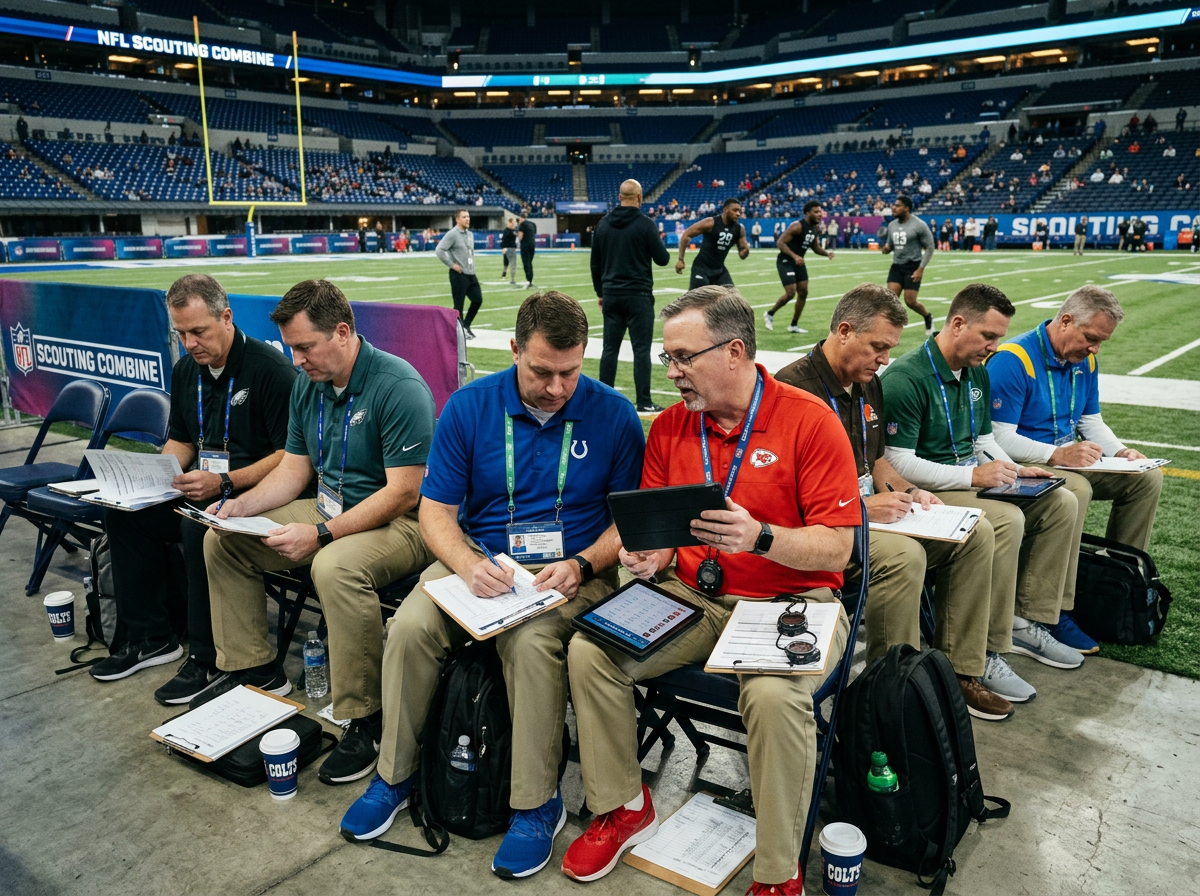
The combine’s measurement obsession, while justified by historical correlation data, can obscure the more subtle evaluation happening in the interview rooms and meeting spaces at the Indiana Convention Center. Teams conduct 15-minute formal interviews with prospects throughout the week, and those sessions often carry more weight in final draft decisions than any physical measurement. The Tennessee Titans, picking fourth overall, have been among the most active teams in formal prospect meetings, per Yahoo Sports’ meeting tracker. General manager Mike Borgonzi and head coach Robert Saleh are running a draft process focused on finding defensive playmakers to pair with a roster that needs impact talent on that side of the ball. ESPN’s Mel Kiper has the Titans selecting Ohio State linebacker Arvell Reese with that fourth pick, which would give Tennessee one of the most instinctive defensive players in the class.
The competitive advantage in the draft has shifted from simply collecting measurables to understanding which measurables matter for specific schemes. Banks’ historic wingspan is more useful in a 3-4 defense, where interior linemen are asked to occupy two gaps, than in a one-gap penetrating scheme, where quickness off the snap matters more than length. Bain’s short arms are a bigger liability in a scheme that asks edge rushers to set the edge against the run than in a scheme that uses them primarily as pass rush specialists on obvious passing downs. Teams that evaluate players against their specific schematic needs, rather than against a generic athletic ideal, consistently find more value in the draft. This is the analytical edge that combine coverage often misses: the same measurements that make one prospect a perfect fit for one team can make him a poor fit for another.
How This Plays Out
The 2026 combine’s measurement sessions have already produced more drama than most years deliver in an entire week. Banks has gone from a borderline first-round prospect with injury concerns to a physical marvel whose body dimensions sit in the 89th percentile or higher across every major measurement category. Mendoza has confirmed his status as the draft’s most self-assured prospect, a quarterback whose decision to skip throwing drills reads as strategic discipline rather than avoidance. Bain has forced the draft community to wrestle with the oldest question in scouting: when production and physical profile disagree, which one wins?
The on-field workouts will continue through Saturday, with offensive linemen, running backs, and tight ends still to come. The Super Bowl champion Seahawks don’t pick until the late first round, but they will be watching the defensive line results closely as they look to reload a championship defense. For Banks, the remaining drills are a chance to add movement data to a measurement profile that already speaks for itself. For Bain, the 40-yard dash and agility drills on Thursday afternoon offer an opportunity to demonstrate that short arms do not mean a slow first step. For Mendoza, the rest of the combine is about interviews, personality, and leadership. He does not need to throw a football to tell 32 teams what they already know. The draft is two months away. The combine is not the final evaluation. But after this week in Indianapolis, the evaluation looks meaningfully different than it did seven days ago.
Sources
- Yahoo Sports: NFL Combine measurements tracker 2026
- FOX Sports: Fernando Mendoza’s best trait, NFL scouts and execs weigh in
- SI.com: Caleb Banks quote of the combine during press interview
- NFL.com: Rueben Bain Jr. arm length measured at under 31 inches at combine
- CBS Sports: 2026 NFL combine results, measurements, 40 times