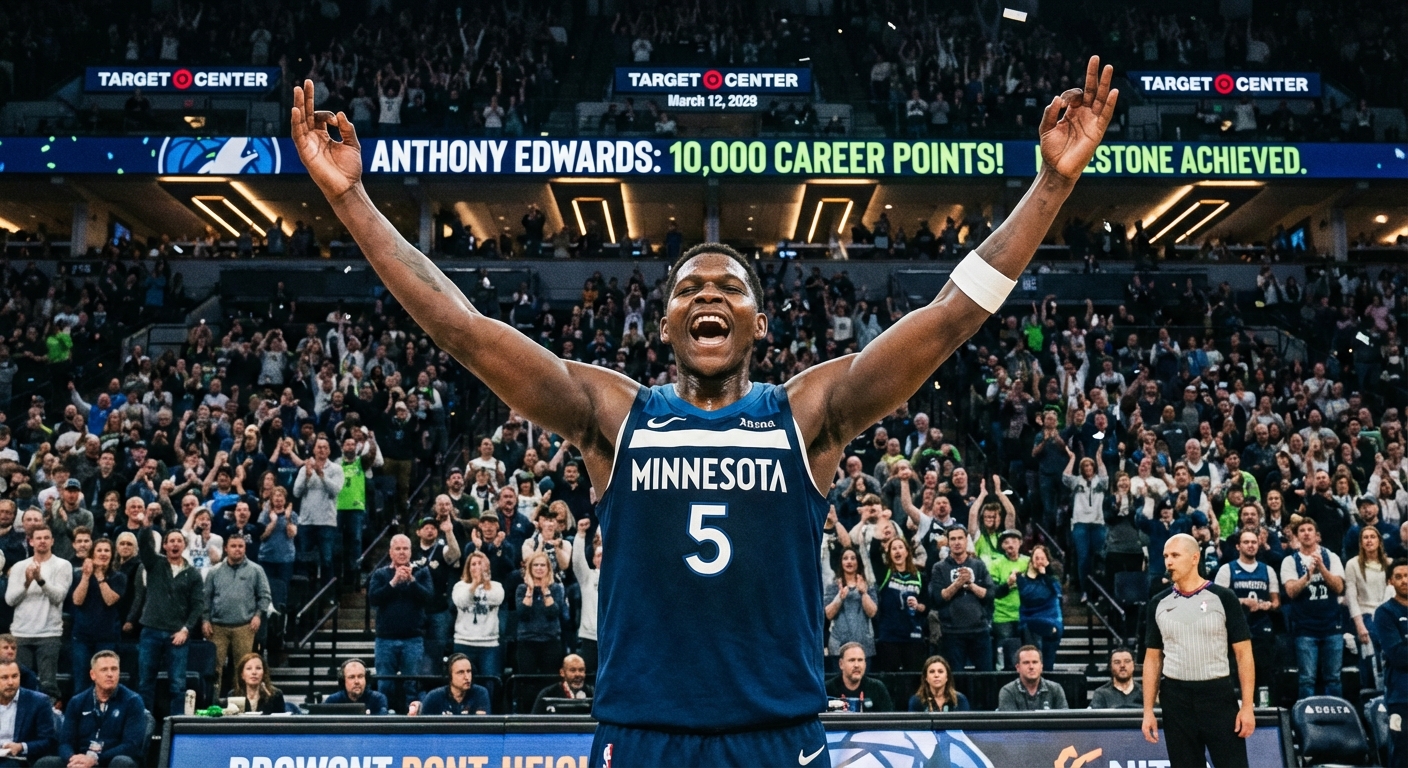
Anthony Edwards swished a 13-foot fadeaway jumper from the baseline with 6:24 remaining in the fourth quarter against Cleveland on Thursday night. The shot was unremarkable in execution, a mid-range attempt that Edwards has made thousands of times since entering the NBA in 2020. What made it significant was the number it represented: 10,000 career points, a milestone that placed the Timberwolves guard in rarefied company among the youngest players ever to achieve it. Edwards, at 24 years and 156 days old, became just the third-youngest player in NBA history to reach the mark, trailing only LeBron James and Kevin Durant on a list that includes some of the greatest scorers the game has ever produced.
His response to the accomplishment was characteristically understated. Asked about joining James and Durant in the record books, Edwards shrugged with the casual indifference that has defined his public persona since he arrived in the league. “To be honest, it’s cool, but I know I’ve got a lot more to go, so it’s really nothing, for real,” he said after Minnesota’s 131-122 victory. The dismissiveness wasn’t false modesty. It reflected a genuine understanding that 10,000 points represents a waypoint rather than a destination, a checkpoint on a journey toward the kind of career totals that define all-time greatness.
The numbers that contextualize Edwards’ achievement reveal how extraordinary his scoring pace has been. He reached 10,000 points in just 412 games, the 28th-fastest in NBA history and the seventh-fastest among active players, per Basketball Reference. Only Luka Doncic (358 games), James (368), Joel Embiid (373), Durant (381), Trae Young (390), and Donovan Mitchell (410) reached the milestone more quickly. Edwards accomplished this while playing for a franchise that has historically struggled to develop and retain superstar talent, in a market that receives a fraction of the national attention afforded to players in New York, Los Angeles, or Miami.
The Company He Keeps
The list of players who reached 10,000 points before their 25th birthday reads like a hall of fame roster. James did it at 23 years and 59 days. Durant accomplished it at 24 years and 33 days. Edwards slots in just behind them, ahead of Kobe Bryant, who had held the next spot at 24 years and 194 days until Thursday night. The others in this exclusive club include Tracy McGrady, Carmelo Anthony, and Doncic, players whose scoring ability defined their eras and whose legacies rest primarily on their capacity to put the ball through the hoop.
Edwards admitted to mixed feelings about surpassing Bryant specifically. “Yeah, I’m kind of sick that I got it from Kobe,” he said, a reference that captured both his competitive drive and his reverence for the players who came before him. Bryant remains the standard for scoring guards in Edwards’ mind, the player whose combination of skill, athleticism, and relentlessness Edwards has studied and attempted to emulate throughout his career. Passing him on any list, even one that measures accumulation rather than peak performance, carried emotional weight that the milestone itself might not have conveyed.
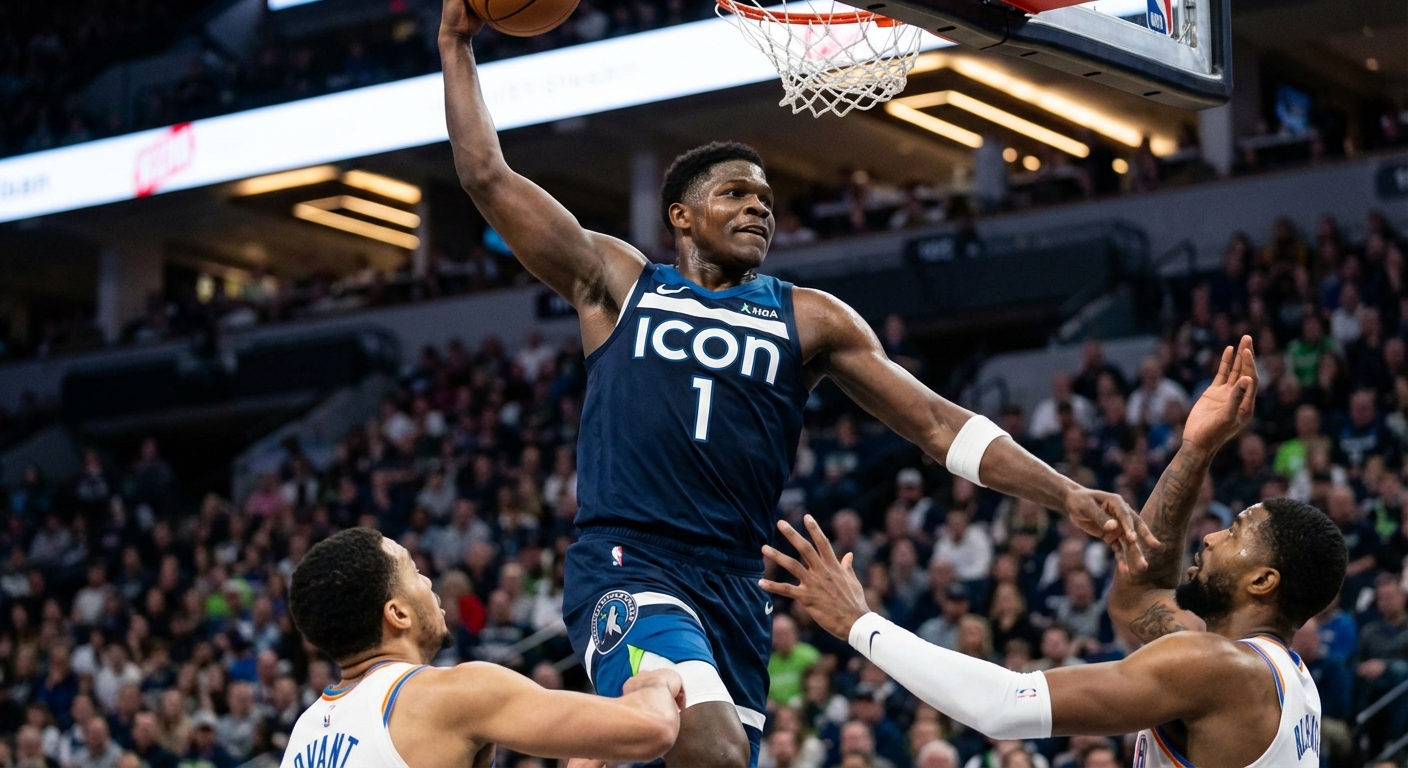
The comparison to Bryant extends beyond mere statistics. Both players entered the NBA as teenagers with outsized confidence and the skills to back it up. Both developed into elite scorers who could dominate games through sheer will and shot-making ability. Both cultivated personas that blended swagger with substance, talking trash while delivering performances that justified every word. Edwards has never hidden his admiration for Bryant, and the similarities in their games are not coincidental. He studied Bryant’s footwork, his shot selection, his ability to create separation, and his comfort in taking the biggest shots in the biggest moments.
Minnesota’s Third Franchise Scorer
Edwards became just the third player in Timberwolves history to score 10,000 points for the franchise, joining Kevin Garnett and Karl-Anthony Towns in a club that reflects Minnesota’s inconsistent ability to develop and retain star talent. Garnett, who scored 15,416 points during his original tenure with the team, remains the franchise’s all-time leader and the standard against which all subsequent Timberwolves stars are measured. Towns, who scored 11,583 points before his trade to Dallas in 2024, represented the previous hope for sustained success that never quite materialized.
Edwards now carries the burden of becoming something neither Garnett nor Towns could be: a player who leads Minnesota to a championship while remaining with the franchise long enough to cement his legacy in the city. The Timberwolves have never won an NBA title. Their only conference finals appearance came in 2004, when Garnett dragged a supporting cast that included Sam Cassell and Latrell Sprewell to within two games of the Finals before falling to the Lakers. Edwards has already matched that conference finals appearance, leading Minnesota to the Western Conference Finals last season before losing to the Thunder in six games.
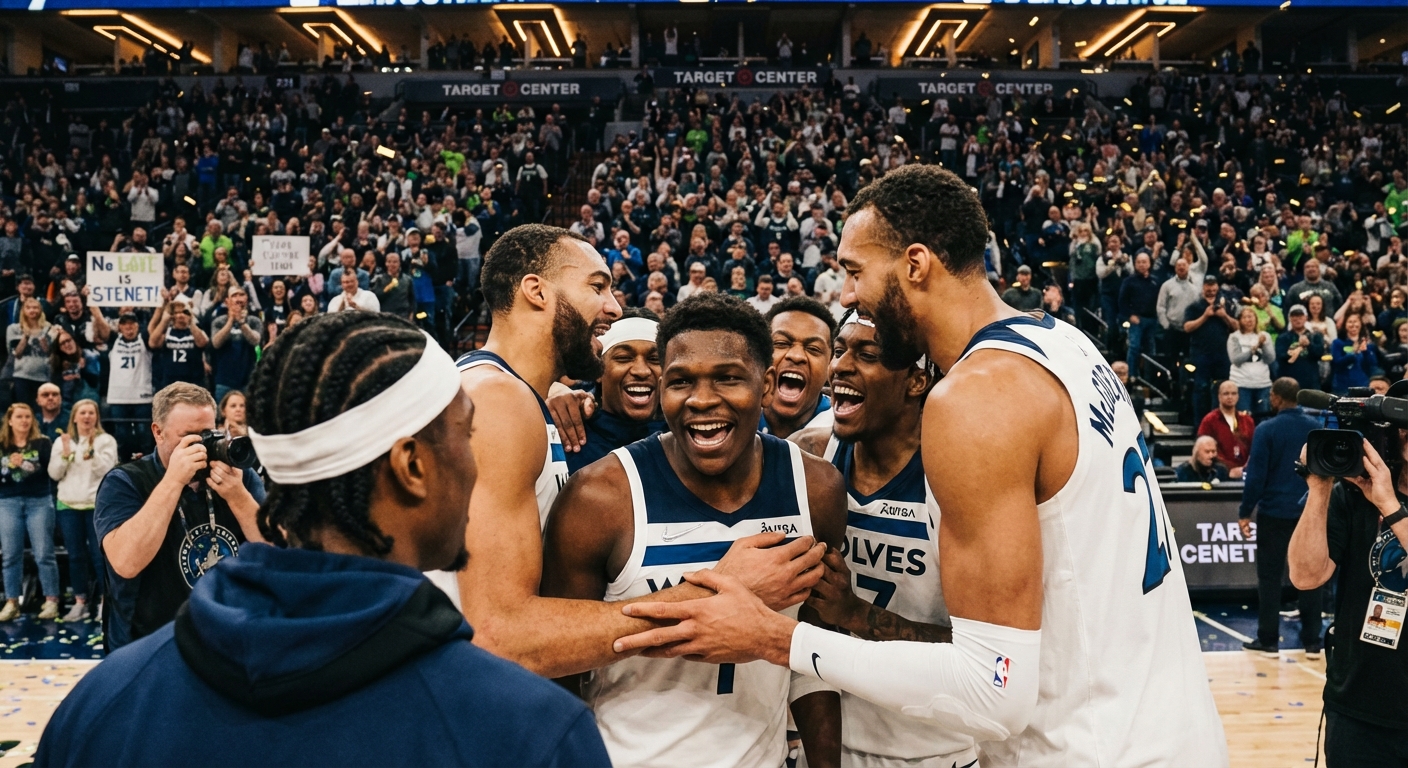
The organization’s commitment to building around Edwards has been evident in every roster decision since his emergence as a star. They traded for Rudy Gobert, sacrificing draft capital and flexibility to pair Edwards with a defensive anchor who could compensate for the team’s perimeter vulnerabilities. They developed Jaden McDaniels into a two-way wing who complements Edwards’ scoring with switchable defense and spot-up shooting. They hired Chris Finch, a coach whose offensive philosophy emphasizes creating opportunities for Edwards while maintaining the ball movement necessary to prevent defenses from collapsing on their star.
The Trajectory of Greatness
If Edwards maintains his current scoring pace, he will reach 20,000 points by age 29, according to NBA.com/stats projections. ESPN’s Tim Bontemps noted that Edwards’ career average of 24.7 points per game would rank among the highest in league history if sustained over a full career, placing him in a tier with players like Durant and Doncic who have maintained elite scoring output across multiple seasons.
The question surrounding Edwards has never been whether he can score. As The Athletic’s Jon Krawczynski observed, the question has been whether he can elevate the players around him and lead a team to championships rather than simply personal statistical accumulation. The evidence from the past two seasons suggests answers that favor Edwards’ potential. The Timberwolves have won playoff series in consecutive years for the first time in franchise history. They have established themselves as Western Conference contenders. They have done this with Edwards as their unquestioned leader, the player who takes the biggest shots and accepts accountability when they don’t go in.
His game has matured in ways that extend beyond point totals. Edwards has become a better playmaker, averaging 5.2 assists this season compared to 4.4 last year, per ESPN Stats & Info. Chris Herring of The Ringer pointed out that Edwards’ improved assist-to-turnover ratio this season reflects a player learning to read defenses rather than simply attack them. He has developed the patience necessary to operate against playoff defenses that scheme specifically to stop him. The scoring remains his primary weapon, but it now exists within a broader offensive toolkit that makes him harder to defend and more valuable to his team.
The Timberwolves’ Franchise Cornerstone
The Timberwolves currently sit second in the Western Conference, trailing only the defending champion Thunder in the standings. They have won four consecutive games entering tonight’s matchup against Utah, with Edwards averaging 27.3 points during the streak while shooting 52% from the field, per StatMuse. The team has overcome the departure of Karl-Anthony Towns more smoothly than expected, with Gobert’s defensive presence and Julius Randle’s offensive versatility filling the gaps that Towns’ trade created. Zach Lowe of ESPN noted that Minnesota’s net rating with Edwards on the floor ranks among the top five in the league this season, a sign that his scoring translates directly into team-level dominance.
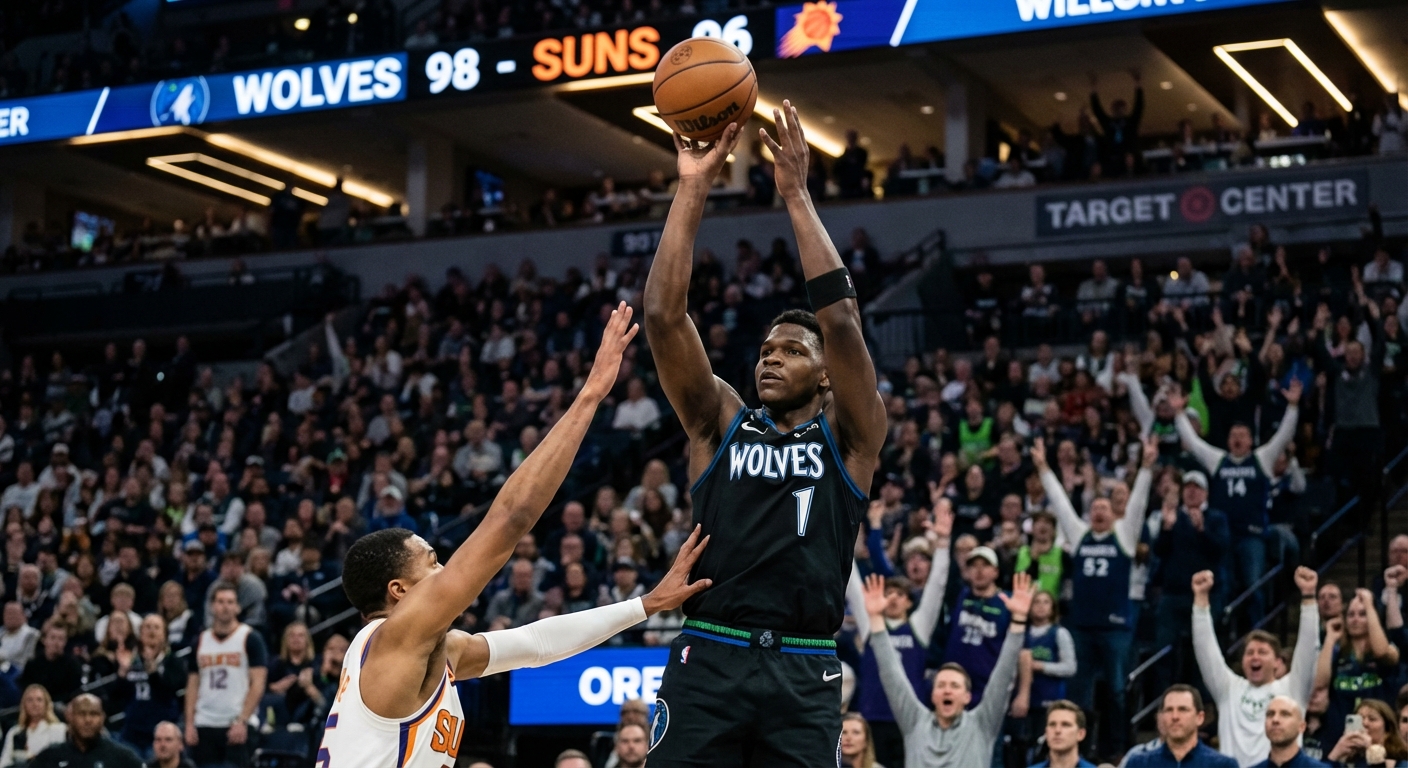
Edwards’ 10,000-point milestone arrives at a moment when the league’s hierarchy is shifting. LeBron James, who attended Sunday’s showdown between the Lakers and Bucks, is 41 years old and playing limited minutes. Stephen Curry is 37 and managing his workload carefully. Kevin Durant is 36 and has dealt with injury concerns throughout the season. The generation that dominated the NBA for the past decade is giving way to new stars, and Edwards has positioned himself at the front of that transition.
The question is no longer whether Edwards belongs among the game’s elite scorers. It is how high he can climb on the lists that measure sustained excellence over careers rather than single seasons. His pace through 412 games already places him ahead of where Bryant, McGrady, and Anthony were at the same point in their careers, per Basketball Reference. “I know I’ve got a lot more to go,” he said Thursday night. For a player who just turned 24, that’s exactly the right perspective.
What It Means
Ten thousand points is a counting stat, and counting stats can flatten the distinction between volume scorers and transformative ones. What separates Edwards from the mere accumulators on the 10,000-point list is the context in which he has scored. He has done it in a small market with limited free-agent appeal, on a franchise that went 16 consecutive seasons without a playoff series win before his arrival. Garnett scored more points in a Timberwolves uniform, but he did so largely in losing seasons, reaching the conference finals just once before demanding a trade. Edwards has already matched that conference finals appearance in fewer seasons and with a roster built to sustain contention rather than collapse under the weight of one player’s brilliance.
The milestone also reveals something about the shifting economics of NBA stardom. Edwards signed his maximum rookie extension without the leverage games and trade demands that have become common among young stars unhappy with their franchise’s direction. His willingness to build in Minnesota rather than angle for a move to a larger market has given the Timberwolves organizational stability they have never previously enjoyed. That stability, as much as Edwards’ scoring, is what makes this 10,000-point milestone meaningful. It signals that Minnesota may finally have a franchise player who stays long enough to see the project through.
At 24, Edwards has scored 10,000 points, led a team to the conference finals, and established himself as one of the five best players in the Western Conference. His place among the game’s best is settled. What remains unanswered is whether Minneapolis, a city that has watched stars leave for decades, finally has someone who will make his entire legacy there. If so, 10,000 is not just a milestone. It is the foundation of something the franchise has never had: sustained greatness.
Sources
- Anthony Edwards Career Stats and Game Log - Basketball Reference
- Youngest Players to 10,000 Career Points - NBA.com/stats
- Wolves’ Anthony Edwards Becomes 3rd Youngest to 10,000 Points - ESPN NBA
- Anthony Edwards the 3rd-Youngest Player in NBA History to Reach 10,000 Career Points - NBA.com
- The Steps Anthony Edwards Took to Get Here - The Ringer