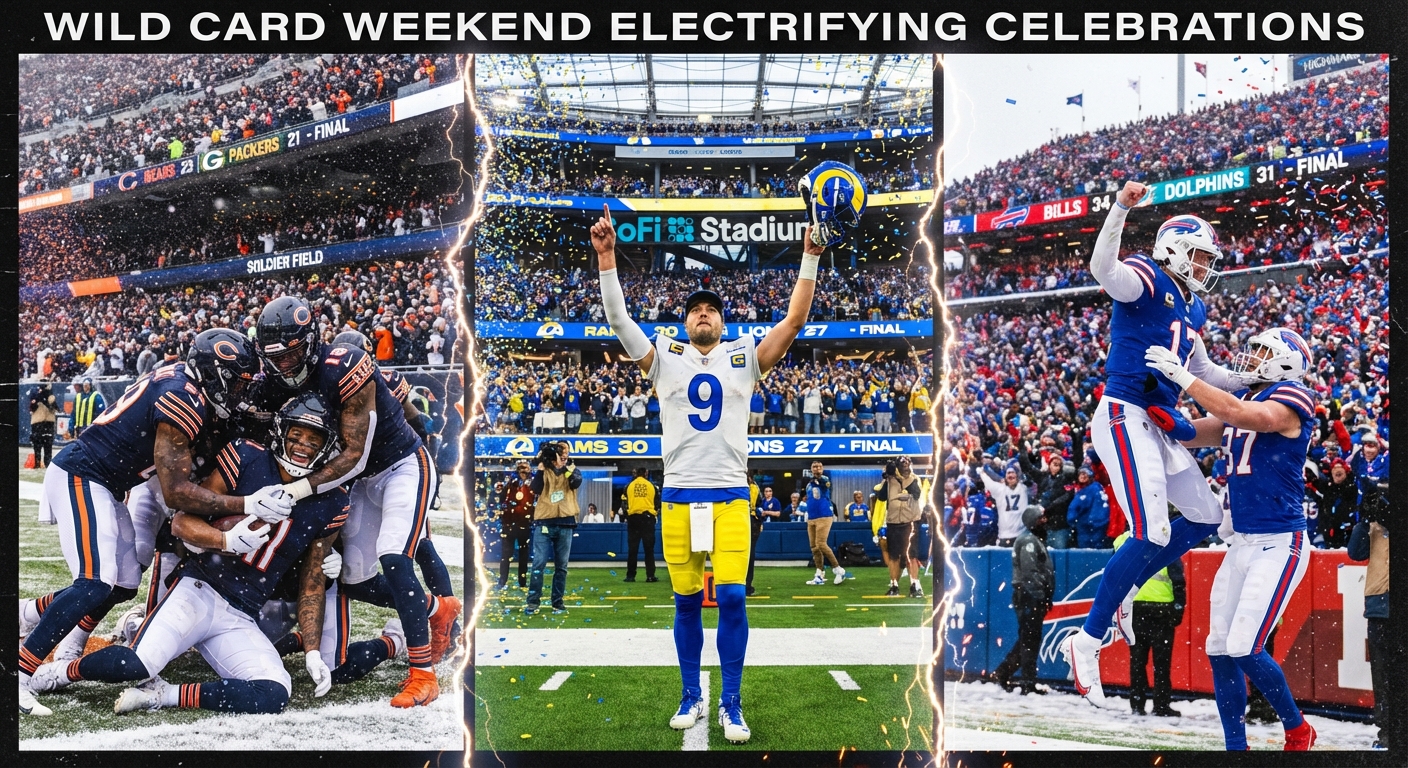
Wild Card Weekend 2026 will be remembered as the moment playoff football became something closer to scripted drama than athletic competition. Through the first four games of the postseason, not a single contest was decided by more than four points. The Bears erased an 18-point deficit. The Rams scored with 38 seconds remaining. The Bills won on Josh Allen’s first-ever fourth-quarter playoff comeback. The 49ers knocked out the defending Super Bowl champions in a game that featured four lead changes in the final quarter alone. By Sunday night, the NFL had set records that may never be broken, turning a weekend that typically features blowouts and upsets into the most compelling showcase of competitive football anyone has ever witnessed.
The numbers tell a story that defies probability. Twelve fourth-quarter lead changes across four games set a new record for any postseason in NFL history, per Pro Football Reference. That’s not just a Wild Card record or a weekend record. That’s more fourth-quarter lead changes than any previous complete playoff bracket has produced. Three of the four games ended with game-winning touchdowns scored inside the final two minutes, the first time that has ever happened in a single round of playoff competition, according to NFL Research. The combined margin of victory across all four games was 13 points. The average margin was 3.25 points, per ESPN Stats & Info. Every game came down to the final possession, and in most cases, the final play.
What made this weekend remarkable wasn’t just the volume of drama but its distribution. As NFL Network’s Rich Eisen put it, “There was no letdown game sandwiched between classics. Every single matchup delivered at the highest level.” Fans who worried they might burn out from tension after the first upset found that each subsequent game raised the stakes higher. The Rams-Panthers game, which kicked off Saturday afternoon and seemed destined to be the weekend’s appetizer, ended up setting the tone with a finish that had viewers screaming at their televisions. By the time Sunday night arrived, the NFL had achieved something unprecedented: a playoff round where every single game was an instant classic.
The Bears Rewrite Their History
Chicago’s 18-point comeback against Green Bay ranks as the third-largest fourth-quarter rally in NFL playoff history, per Pro Football Reference, trailing only the Bills’ legendary 32-point comeback against the Oilers in 1993 and the Colts’ 28-point surge past the Chiefs in 2014. But for Bears fans, the historical context that matters most has nothing to do with generic NFL records. This was the franchise’s first playoff victory over Green Bay in 85 years. The last time the Bears beat the Packers in a postseason game, Franklin Roosevelt was president, World War II hadn’t started, and most of the players on the field were born before television existed.
Caleb Williams threw for more yards in the fourth quarter (184) than he did in the first three quarters combined (177), according to NFL Research. His transformation from overwhelmed rookie to clutch performer happened in real time, with the nation watching. The game-winning touchdown, a 25-yard strike to DJ Moore with 1:43 remaining, was executed with the precision of a quarterback who had been in that situation hundreds of times, not one who had never before led a fourth-quarter comeback in a playoff game. Williams found Moore in single coverage against Jaire Alexander, one of the league’s best cornerbacks, and delivered a pass that only his receiver could catch.
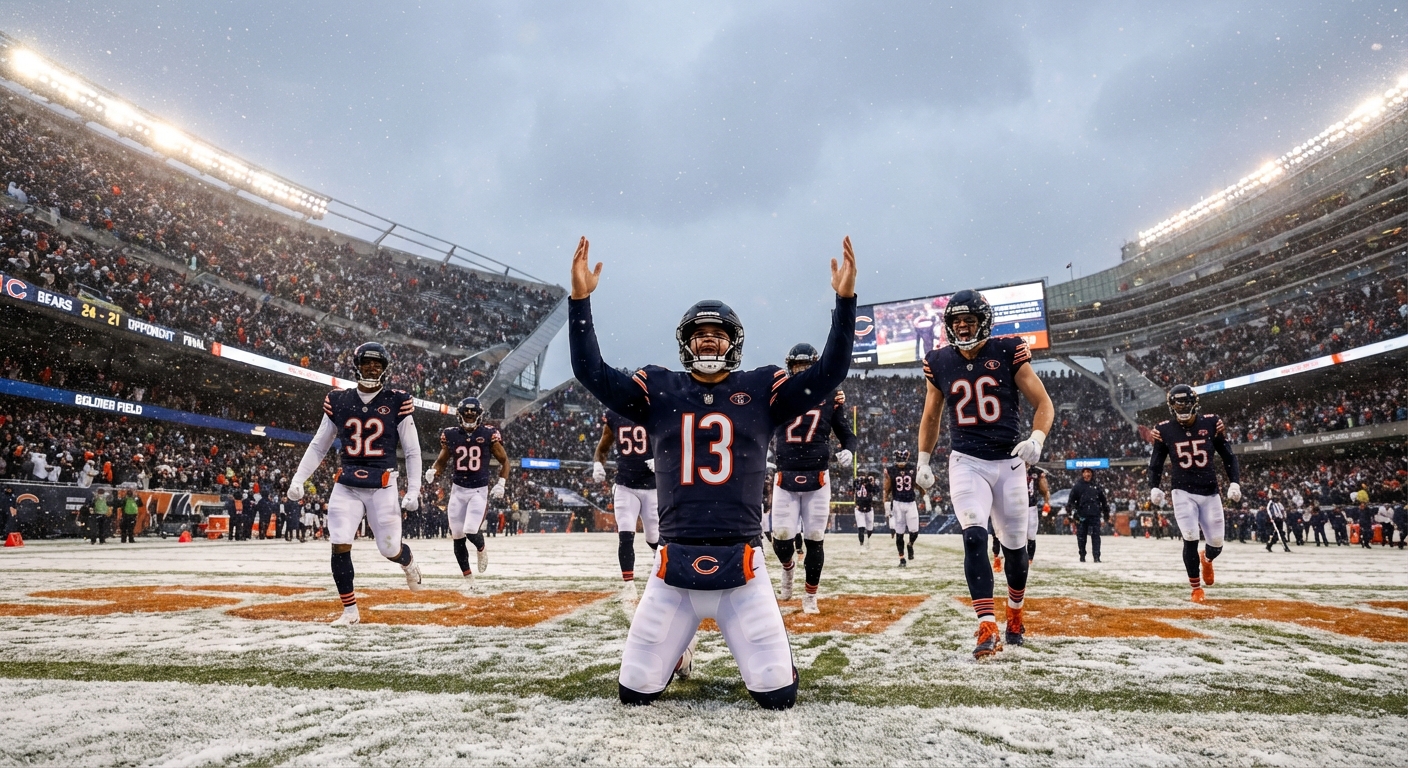
The comeback validated everything the Bears have built over the past two seasons. Head coach Ben Johnson’s halftime adjustments transformed a team that looked outclassed into one that looked unstoppable. His decision to implement a no-huddle offense exhausted Green Bay’s defense and prevented them from substituting. His switch to quick-release passing neutralized the Packers’ pass rush, which had terrorized Williams in the first half but failed to record a single sack after halftime. The Bears will face the Rams next weekend in a matchup that seemed unthinkable when Chicago trailed 27-9 at halftime.
Stafford Proves He’s Not Done
The Rams’ 34-31 victory over the Panthers didn’t generate the same historical narratives as Chicago’s comeback, but it featured a finish every bit as dramatic. Matthew Stafford, playing in his 14th NFL season and facing questions about whether his best football was behind him, led a 75-yard drive in the final minutes that culminated in a 19-yard touchdown pass to Puka Nacua with 38 seconds remaining. The throw was vintage Stafford: a frozen rope into tight coverage that arrived before the defender could react, delivered with the game on the line by a quarterback who has always performed his best when the pressure is highest.
Carolina had taken a 31-27 lead with 2:14 remaining on a Bryce Young touchdown run, seemingly completing their own improbable victory. The Panthers had entered the playoffs as the NFC’s fourth seed, a position that surprised most observers who had expected their young quarterback to need another year of development. Young had been brilliant throughout the game, throwing for 311 yards and three touchdowns while making the Rams’ defense look pedestrian. His scrambling touchdown to take the lead appeared to be the signature moment of his young career.
Stafford needed just 1:36 to erase it. He completed passes of 23, 17, and 16 yards to move the ball into Carolina territory, then found Nacua breaking free on a post route against single coverage. The 38-second margin was tight enough that Carolina had time for a final desperation drive, but Young’s pass into double coverage on the game’s final play was intercepted at the Rams’ 35-yard line. Los Angeles had survived a game they trailed for 31 minutes, earning a trip to Chicago that few predicted when the bracket was released.
Allen Finally Gets His Moment
Josh Allen entered Wild Card Weekend having never led a fourth-quarter comeback in a playoff game. He had lost heartbreakers to the Chiefs, including the infamous 13-seconds game in 2022 where Kansas City drove 44 yards in the final moments to force overtime. He had watched Patrick Mahomes and other elite quarterbacks build reputations as clutch performers while his own postseason legacy remained complicated by close losses. On Sunday against Jacksonville, Allen finally got the ending he had been chasing.
The Bills trailed 24-20 with 2:47 remaining when Allen took over at his own 25-yard line. What followed was the drive that will define this chapter of his career. He completed five consecutive passes, including a 28-yard strike to Keon Coleman on third-and-eight that moved the ball to Jacksonville’s 34-yard line. He scrambled for 11 yards on a designed quarterback draw that the Jaguars failed to diagnose. He converted a fourth-and-two with a dart to Dalton Kincaid over the middle that showed no fear and total confidence in his ability to make tight-window throws.
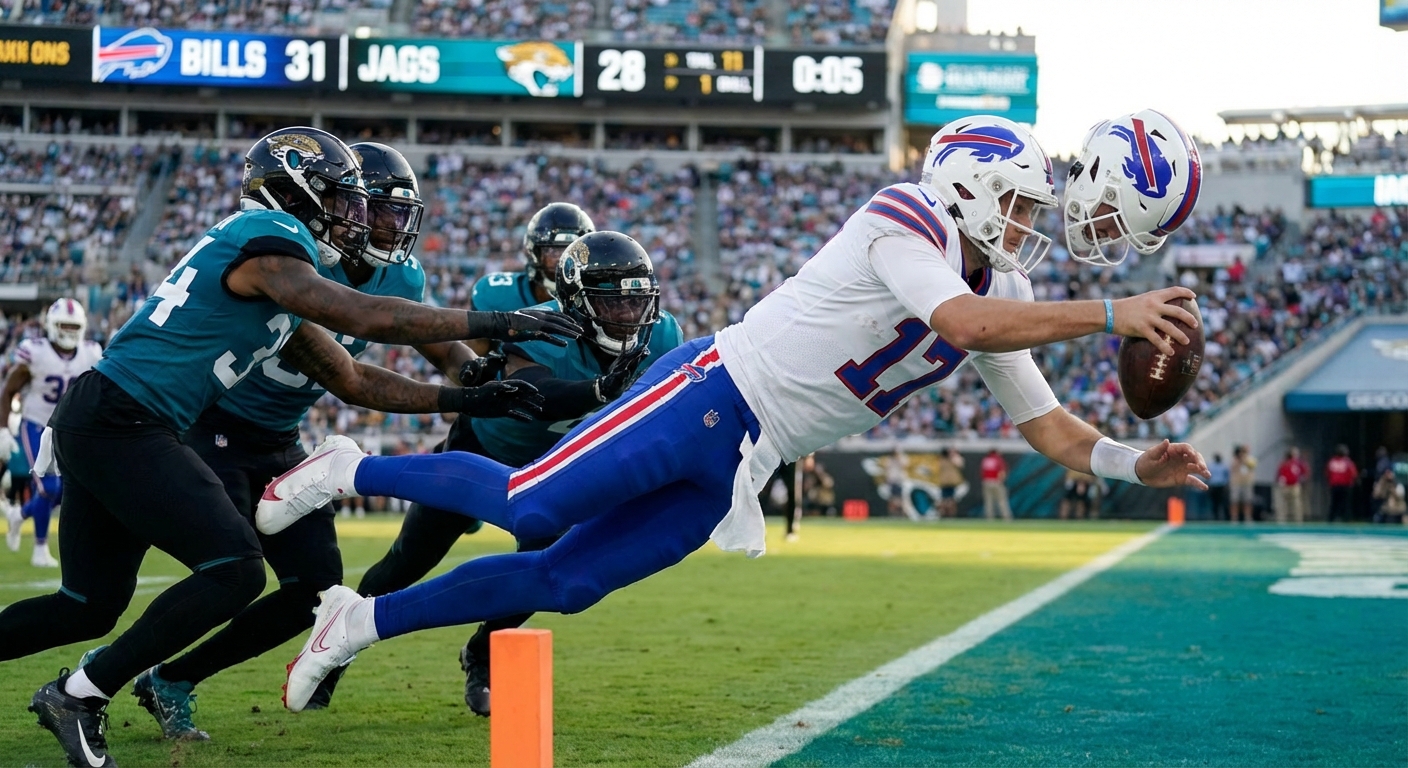
The touchdown came on a 1-yard quarterback sneak with 58 seconds remaining. Allen took the snap, lowered his shoulder, and pushed his way into the end zone through a pile of bodies that seemed determined to deny him. He emerged from the scrum with the ball raised above his head and a look of pure relief on his face. The Bills had won 27-24, and Allen had finally authored the kind of finish that had eluded him throughout his postseason career. “That drive will change how people talk about Josh Allen forever,” The Ringer’s Kevin Clark wrote. “He was the last elite quarterback without a signature playoff comeback. Now he has one.” Buffalo will travel to Denver next weekend, carrying momentum from a victory that exorcised demons accumulated over years of close calls.
The 49ers End Philadelphia’s Dynasty Dreams
The Eagles entered Wild Card Weekend as the NFC’s third seed and the defending Super Bowl champions, seeking to become the first NFC team to win back-to-back titles since the Patriots accomplished the feat in 2003-04. They left as one-and-done participants, eliminated 23-19 by a San Francisco team that had appeared vulnerable throughout the regular season but somehow found its playoff form when it mattered most. The 49ers’ victory was the weekend’s biggest upset, ending Philadelphia’s championship reign and validating the belief that Kyle Shanahan’s team remains dangerous regardless of their seeding.
Brock Purdy threw the game-winning touchdown pass to Christian McCaffrey with 2:54 remaining, a 4-yard connection that capped an 87-yard drive and silenced a Lincoln Financial Field crowd that had been raucous throughout the afternoon. The throw required Purdy to read a defensive rotation and adjust his target mid-drop, the kind of mental processing that separates competent quarterbacks from excellent ones. McCaffrey did the rest, slipping past a linebacker and diving into the end zone before safety Reed Blankenship could close the distance.
Philadelphia’s final drive featured one of the weekend’s most controversial moments. Trailing by four with 1:47 remaining, Jalen Hurts threw what appeared to be a touchdown pass to A.J. Brown, only for the officials to rule that Brown had stepped out of bounds before making the catch. The replay was inconclusive, but the call stood, and the Eagles were forced to settle for a field goal that cut the lead to one point with 41 seconds remaining. San Francisco recovered the onside kick and knelt out the clock, ending Philadelphia’s season and their hopes of becoming just the tenth franchise in NFL history to win consecutive Super Bowls.
Divisional Round Collision Courses
The chaos of Wild Card Weekend has produced a Divisional Round bracket loaded with compelling matchups. In the NFC, the top-seeded Seahawks will host the 49ers in a rematch of their Week 18 showdown that decided the division title. The Bears will host the Rams, with Chicago’s confidence soaring after their historic comeback and Los Angeles riding the adrenaline of Stafford’s late-game heroics. Both games feature teams that demonstrated an ability to win close contests throughout Wild Card Weekend.
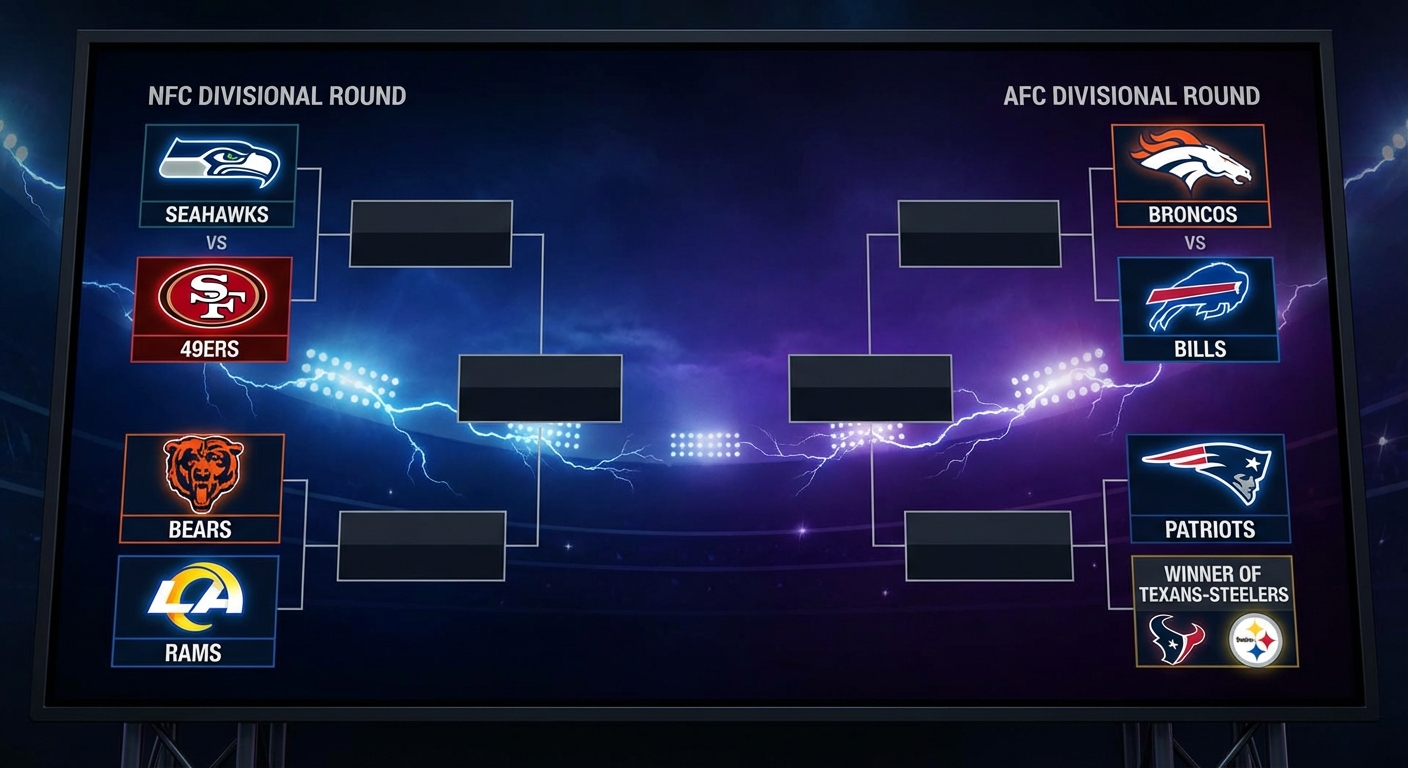
The AFC picture will clarify after tonight’s Texans-Steelers game, but two matchups are already set. The Bills will face the Broncos in Denver, a game that pits Allen’s newfound clutch credentials against Bo Nix’s first playoff experience. The Patriots will host the winner of Monday night’s game, with Drake Maye having already proven himself capable of winning in the postseason with New England’s 16-3 victory over the Chargers.
The question now is whether the Divisional Round can match the drama that Wild Card Weekend delivered. Four games, a record number of late lead swings, three game-winning touchdowns in the final two minutes, and not a single comfortable victory. As ESPN’s Bill Barnwell noted, “This wasn’t just the best Wild Card Weekend ever. It was arguably the best single weekend of football the NFL has ever produced, and the Divisional Round matchups it created are loaded.”
Final Whistle
What separates Wild Card Weekend 2026 from every other opening round in NFL history is not just the record-setting drama but the generational significance of the quarterbacks who delivered it. This was the weekend where the NFL’s generational transition announced itself on the postseason stage. Caleb Williams, in his first playoff game, engineered the kind of comeback that defined the careers of Joe Montana and John Elway. Josh Allen shed the narrative that had followed him for four postseasons. Bryce Young proved he belongs in the conversation even in defeat. Brock Purdy continued to defy every expectation placed on a 262nd overall pick. The only veteran who matched them, Matthew Stafford, did so by channeling the same reckless confidence that defines his younger counterparts.
That record-setting total of fourth-quarter lead changes, per Pro Football Reference, surpassed the previous mark of eight set across the entire 2018 postseason. The combined 13-point margin across four games made this the tightest Wild Card Weekend since the current playoff format was established in 1990, according to NFL Research. The Athletic’s Mike Sando called it “the weekend that proved parity isn’t just a talking point anymore; it’s the defining characteristic of the modern NFL.”
The Divisional Round begins Saturday carrying the weight of these results. But the lasting impact of this weekend extends beyond the bracket. Wild Card Weekend 2026 demonstrated that the NFL’s next generation of quarterbacks can deliver under the highest pressure the sport offers, and that the league’s competitive balance has reached a point where any team still playing in January can beat any other. That combination of emerging talent and structural parity is what makes this postseason feel different from anything that came before it.
Sources
- NFL Wild Card Weekend Scores and Highlights - ESPN
- 2025 NFL Playoff Standings and Results - Pro Football Reference
- 2025-26 NFL Playoffs Bracket - NFL.com
- Wild Card Weekend Delivers Historic Late-Game Drama - CBS Sports
- NFL Scores and Recaps for Every Wild Card Game - PFF