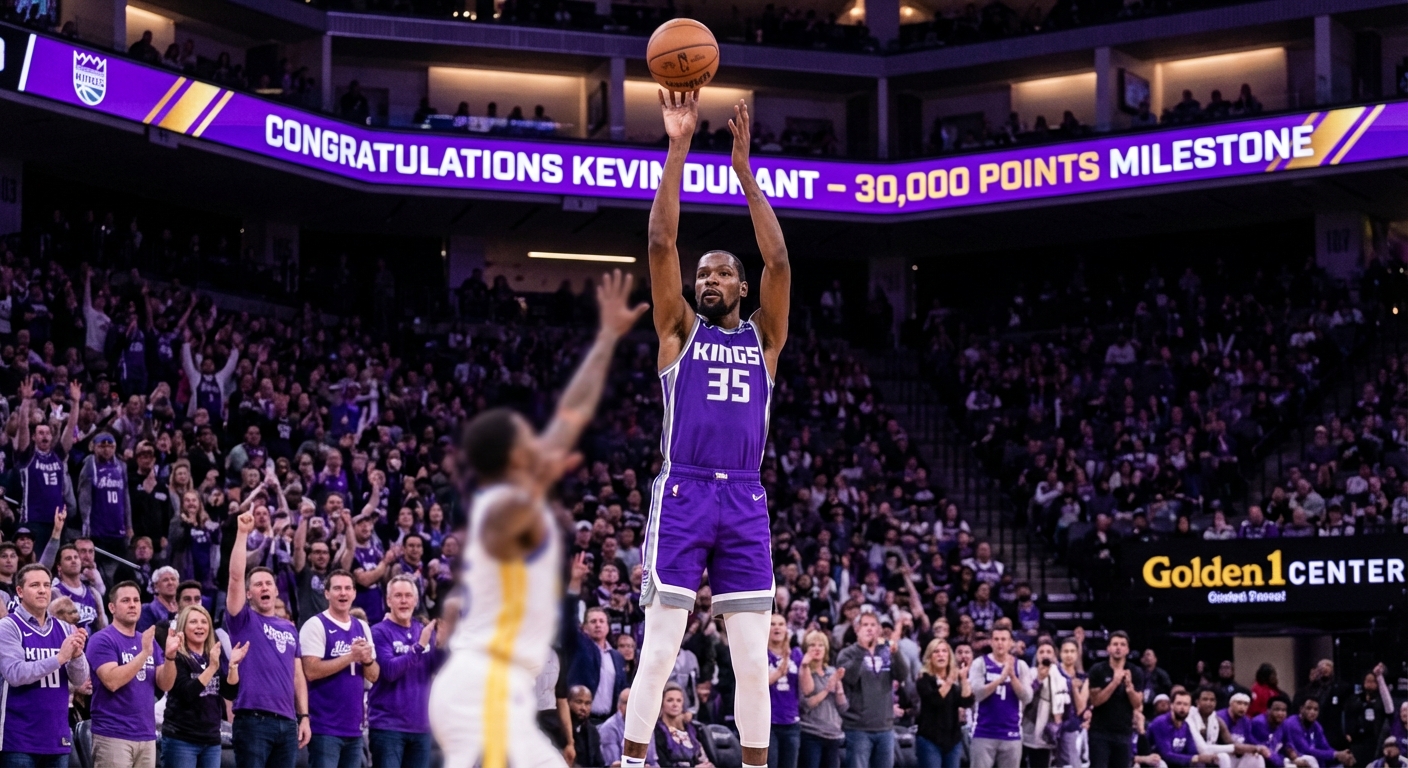
The shot that moved Kevin Durant past Wilt Chamberlain on the NBA’s all-time scoring list was, appropriately, the most Kevin Durant shot imaginable. A third-quarter pull-up jumper from seventeen feet, released from a point approximately nine feet off the ground, falling through the net with the softest of touches. No celebration followed. No timeout was called. Durant simply jogged back on defense as if he had just hit any other basket in any other game, letting the moment pass with the same understated efficiency that has defined his 18-year career. When the announcement came during the next stoppage, Durant acknowledged the crowd briefly before turning his attention back to the game. He finished with 23 points in Sacramento’s 111-98 victory over Houston, passing Chamberlain’s 31,419 career points with a lifetime total that now sits at 31,422.
The contrast between Durant’s milestone and the legend he surpassed could not be more striking. Chamberlain scored 100 points in a single game, averaged 50 points per game for an entire season, and dominated the sport with a physical presence that seemed borrowed from mythology. Durant has never scored 60 points in a game. He has never averaged 35 points per game for a full season. He has achieved his place in history through relentless consistency rather than singular dominance, accumulating points the way compound interest accumulates wealth. His genius lies not in the spectacular but in the sustainable, not in peaks that touch the sky but in a plateau so high that most players can only dream of reaching it.
The Architecture of a Scoring Machine
Durant’s path to seventh on the all-time list began with physical gifts that border on the unfair. At seven feet tall with a wingspan that stretches past seven and a half feet, he possesses the measurements of a traditional center but moves like a guard. His release point, estimated by biomechanics experts to average approximately 10.2 feet above the ground, makes his shot essentially unblockable when his form is correct. In 18 seasons, opponents have blocked Durant’s jump shot fewer than 50 times total. That number becomes almost comical when you consider he has attempted over 20,000 field goals in his career.
But physical gifts alone don’t explain Durant’s scoring. The league is full of tall players who can’t shoot and athletic marvels who can’t score consistently. What separates Durant is the refinement of his game, the way he has systematically eliminated weaknesses and added counters until his offensive repertoire became essentially complete. Early in his career, critics questioned his ability to score in the post. He added a deadly fadeaway. They questioned his three-point shooting. He became one of the most efficient high-volume three-point shooters in league history. They questioned his ability to create for himself off the dribble. He developed a crossover and hesitation move that creates separation against any defender.
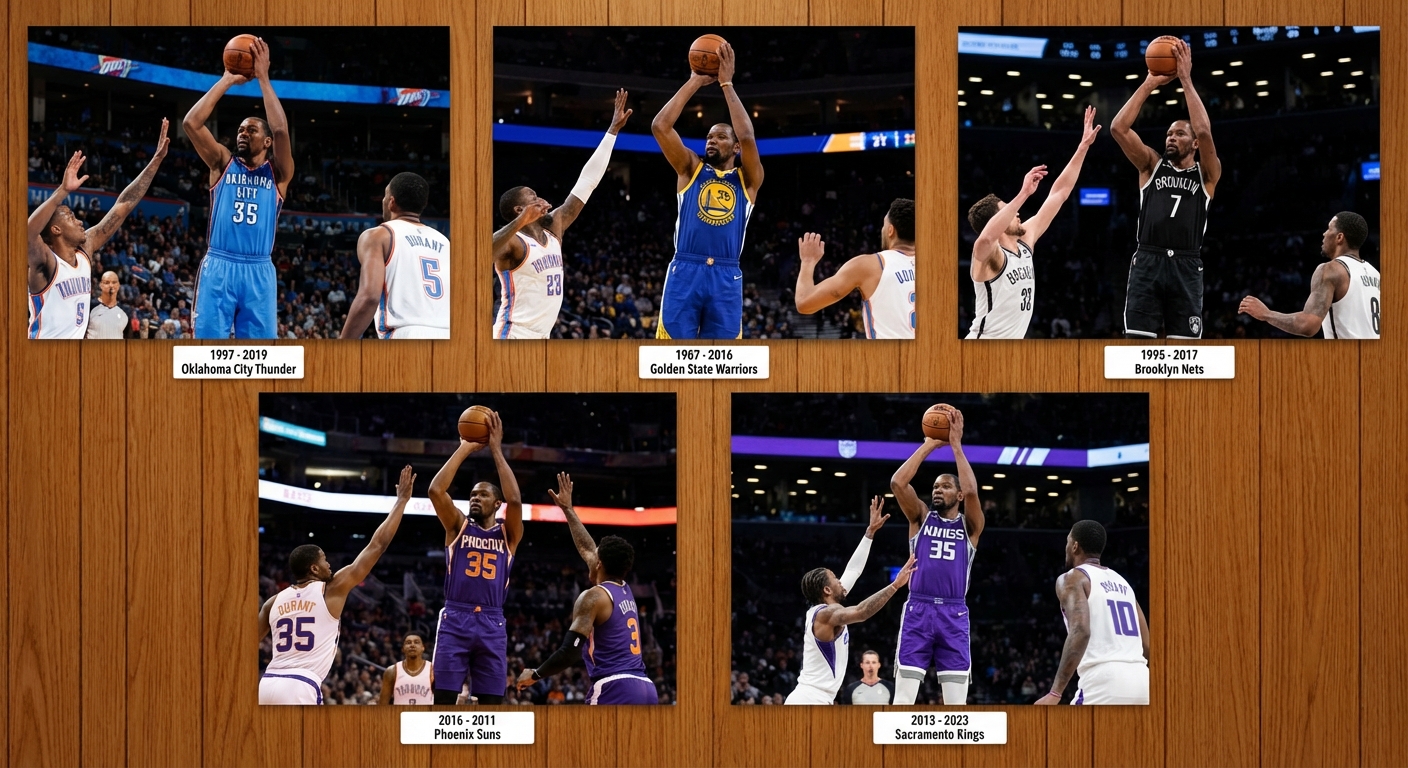
The efficiency numbers tell the story most clearly. Durant has averaged 27.3 points per game for his career while maintaining a true shooting percentage above 61%, per Basketball Reference. For context, only one other player in NBA history has averaged at least 27 points per game with a true shooting percentage above 60% for their career: Stephen Curry. Durant has done this while taking significantly more mid-range jumpers than Curry, a shot selection that analytics experts have spent the last decade trying to eliminate from the game. According to NBA.com/stats, Durant has attempted more than 6,800 career mid-range field goals, converting at a rate above 48%. He shoots the “bad” shots and makes them at rates that would be elite even for layups and three-pointers.
Where Durant Stands Among the Greats
The all-time scoring list reads like a mythology of basketball greatness. Kareem Abdul-Jabbar sits at the top with 38,387 points, a record that seemed untouchable until LeBron James began his assault on it. James currently stands second with 40,489 points and counting, having passed Kareem two seasons ago. Karl Malone (36,928), Kobe Bryant (33,643), Michael Jordan (32,292), and now Durant (31,422) round out the top seven. Each name represents a different era of basketball excellence, a different approach to the art of scoring.
Durant’s placement among these legends gains additional context when you consider the circumstances of his career. He missed essentially all of the 2019-20 season recovering from an Achilles tendon rupture, an injury that has ended many careers and diminished many others. He missed significant time in other seasons due to various injuries, including the foot problems that plagued his final years in Oklahoma City. Per StatMuse, Durant has missed 228 regular-season games across his career due to injury, yet has still climbed to seventh on the all-time list. Despite these setbacks, he has continued to score at elite rates into his late 30s, posting 25.9 points per game this season on a Sacramento team that has restored his joy in playing basketball.
The Achilles injury deserves particular attention because of what it revealed about Durant’s game. Many feared that an injury so devastating to explosiveness would rob him of his scoring ability. Instead, Durant returned with his shot as pure as ever, his footwork as precise as before, and his basketball IQ elevated by necessity. He could no longer blow by defenders with the same ease, so he developed even more counters, more ways to create separation without relying on raw athleticism. The injury that should have ended his run at the all-time list instead demonstrated why he belongs there in the first place.
The Chamberlain Comparison
Wilt Chamberlain averaged 30.1 points per game for his career, the highest scoring average in NBA history. He scored 50 or more points 118 times, including 45 games of 50-plus in a single season. His 100-point game against the New York Knicks in 1962 remains the most legendary statistical achievement in the sport’s history. By any measure of pure dominance, Chamberlain stands alone atop the mountain of basketball scoring excellence.
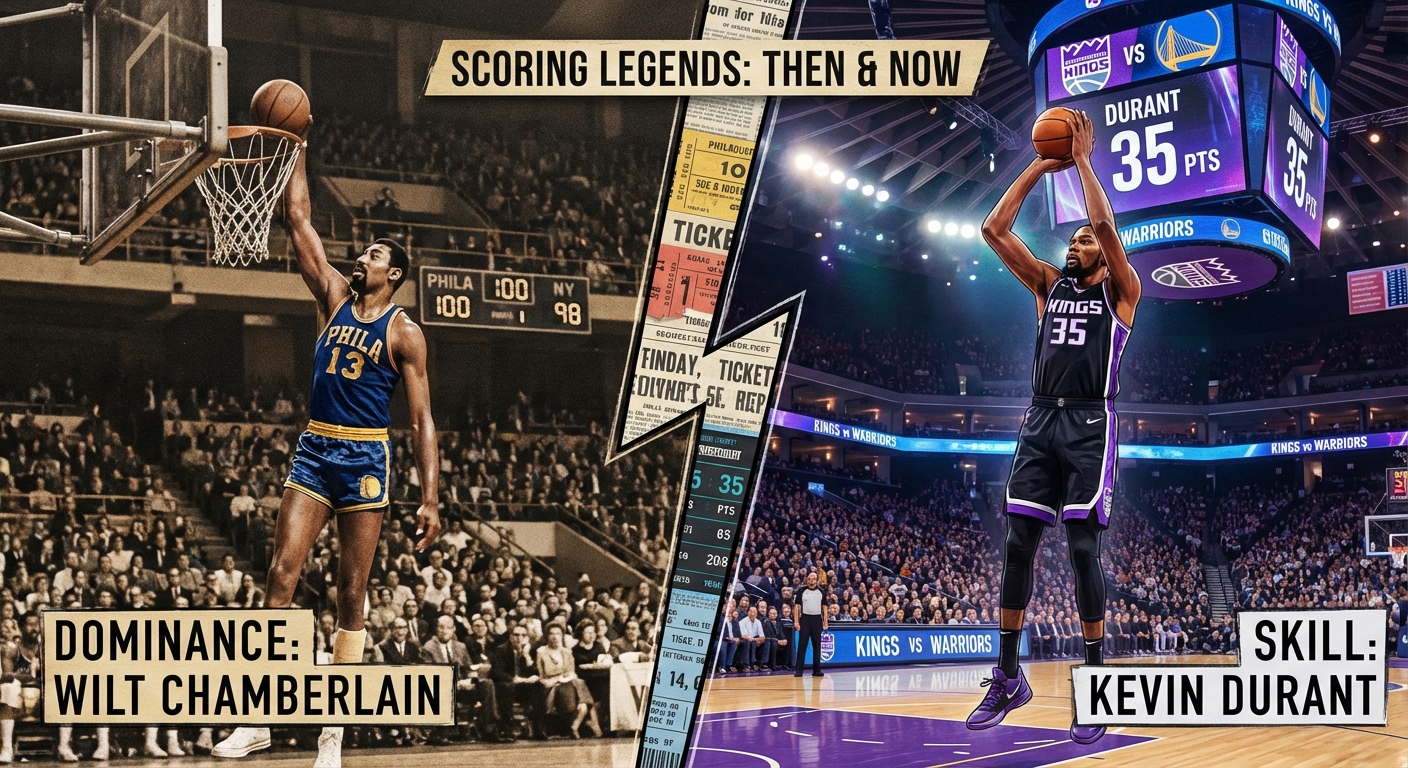
Yet Durant surpassing Chamberlain on the career list tells us something important about how basketball has evolved. Chamberlain played only 14 seasons, retiring at 36 after growing bored with a league that couldn’t challenge him. Durant, now 37, continues to play because modern sports medicine, nutrition, and training methods have extended careers far beyond what previous generations experienced. The same factors that have allowed LeBron to chase Kareem have enabled Durant to reach heights that seemed impossible given his injury history.
The style comparison reveals even more. Chamberlain scored through overwhelming physical dominance, often recording his points on dunks, putbacks, and close-range shots that no one could contest. Durant scores through skill and craft, pulling up for jumpers over defenders who know exactly what’s coming but can’t stop it anyway. Chamberlain made the game look easy because he was so much bigger and stronger than everyone else. Durant makes the game look easy because his technique is so refined that physical disadvantages become irrelevant.
The Sacramento Renaissance
Durant’s arrival in Sacramento via trade from Phoenix last season raised eyebrows across the league. Why would a player of his caliber want to finish his career in one of the NBA’s smallest markets? “Kevin wanted a place where basketball came first,” ESPN’s Tim Bontemps noted at the time of the trade. “Sacramento gave him that, and you can see it in how he plays now: loose, confident, unburdened.” Durant wanted to play in an environment where winning mattered more than drama, where he could mentor young players without the pressure of championship expectations overshadowing every game. The Kings offered that environment, and Durant has thrived in it.
His partnership with De’Aaron Fox has produced the most efficient offense of Durant’s career. Fox’s speed creates driving lanes and kickout opportunities that Durant exploits with devastating efficiency, per Basketball Reference, which shows Sacramento’s Durant-Fox pick-and-roll producing 1.14 points per possession this season. The two have developed a two-man game that opposing defenses struggle to contain, with Fox’s penetration forcing help defenders to leave Durant open for his pull-up jumpers. Sacramento’s offense ranks fourth in the league this season, according to NBA.com/stats, a remarkable turnaround for a franchise that struggled to field competitive teams for nearly two decades before Durant’s arrival.
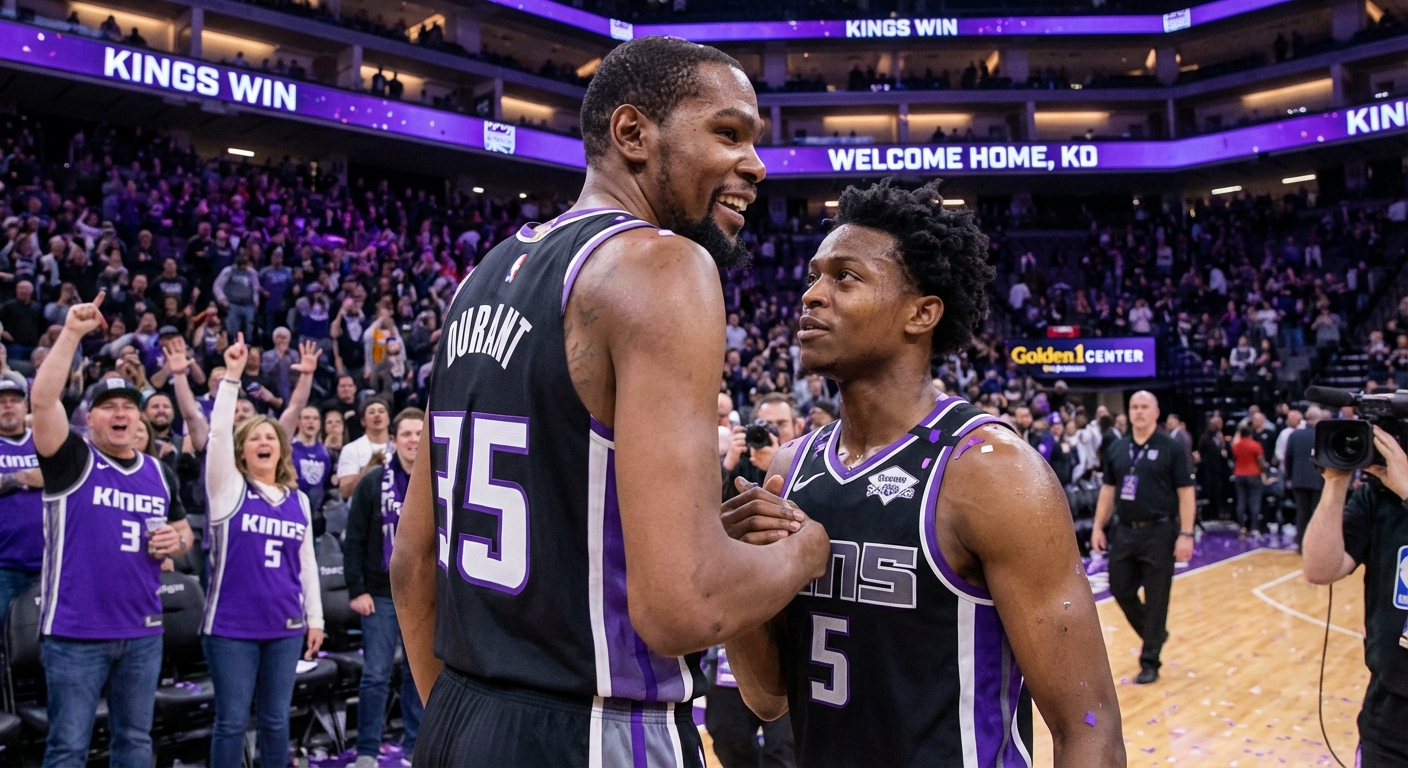
The milestone against Houston came during Sacramento’s push for playoff positioning in a crowded Western Conference. The Kings entered Monday’s games fifth in the West, within striking distance of home-court advantage in the first round. Durant has made clear that he came to Sacramento to win, and the team’s competitive standing validates that decision. “He changes the calculus for every defense in the league,” The Athletic’s Sam Amick wrote in his season assessment of the Kings. “Sacramento’s ceiling is directly tied to how long Durant can keep performing at this level.” Durant’s presence has elevated everyone around him, from Fox to Domantas Sabonis to the young players coming off the bench.
The All-Time Scoring Ladder
Durant needs 2,221 points to pass Kobe Bryant for sixth place and 4,870 to pass Michael Jordan for fifth on the all-time list, per Basketball Reference. At his current pace of approximately 26 points per game, passing Bryant could happen late this season or early next, while catching Jordan would require Durant to play into his 39th year. Given his statements about wanting to continue as long as his body allows, both milestones appear within reach.
The larger question is how Durant’s legacy will be remembered relative to the names he’s passing. As ESPN’s Zach Lowe has argued, the all-time scoring list rewards longevity as much as dominance, which is why Jordan, widely regarded as the greatest player ever, sits sixth rather than first. Bryant won five championships while Durant has won two. Malone never won a title while Durant won both of his as the second-best player on historically great Golden State teams. These comparisons are instructive but incomplete, because each player existed in their own context, facing their own challenges and achieving their own versions of greatness.
The Legacy Question
Passing Chamberlain forces a reconsideration of where Durant belongs in the broader hierarchy of NBA greatness, not just among scorers but among all players. The all-time scoring list has always served as a proxy for sustained excellence, yet Durant’s case exposes its limitations as a ranking tool. Chamberlain’s shorter career, already discussed above, explains the raw total, but the deeper point is structural: the all-time list penalizes players who dominated so thoroughly that they lost motivation. Durant, playing through a torn Achilles and multiple franchise upheavals, has lasted 18 seasons precisely because he has never dominated so completely that the game grew stale. Longevity and durability are themselves forms of greatness, ones the game has historically undervalued.
What makes Durant’s position at seventh genuinely remarkable is that he has reached it while playing a style of basketball that the sport’s analytical revolution has spent a decade trying to make extinct. The mid-range pull-up jumper, his signature weapon, grades out as one of the least efficient shots in basketball when taken by an average player. Durant is not an average player. His ability to generate elite efficiency from theoretically suboptimal shot selection represents a kind of scoring intelligence that transcends era, distinct from both Chamberlain’s physical dominance and Curry’s three-point revolution. As The Athletic’s Marcus Thompson observed, “Durant doesn’t bend his game to fit the era. He just keeps proving that his game works in any era.”
The seventh spot on the all-time list is a waystation, not a destination. If Durant plays two more seasons at something close to his current production, he will pass both Bryant and Jordan, landing among the top four scorers in the 78-year history of the NBA. That final ranking would place him in a tier of cumulative scoring achievement that only LeBron James, Kareem Abdul-Jabbar, and Karl Malone have reached, company that demands a serious reassessment of a career that has too often been defined by the teams Durant chose rather than the basketball he played.
Sources
- Kevin Durant Career Stats and History - Basketball Reference
- NBA All-Time Scoring Leaders - NBA.com/Stats
- Kevin Durant Passes Wilt Chamberlain for 7th on NBA Career Scoring List - ESPN
- Kevin Durant Passes Wilt Chamberlain for 7th on the NBA’s Career Scoring List - NBA.com